Reported by:

Cherry Meigh Timbol
News Content Editor
Published November 25, 2026
A sensational claim that President Donald Trump could use a $150 trillion national resource reserve as an economic weapon against China has drawn attention online. However, the figure is not an officially announced U.S. government fund or military program. It originates from an investment-marketing campaign promoting the potential value of mineral resources on federally owned lands.
The campaign, titled The American Birthright, is associated with financial commentator Jim Rickards and published by Paradigm Press. It presents America’s natural resources as a largely untapped national asset that could potentially strengthen the country’s economic position and reduce its dependence on foreign suppliers, particularly China.
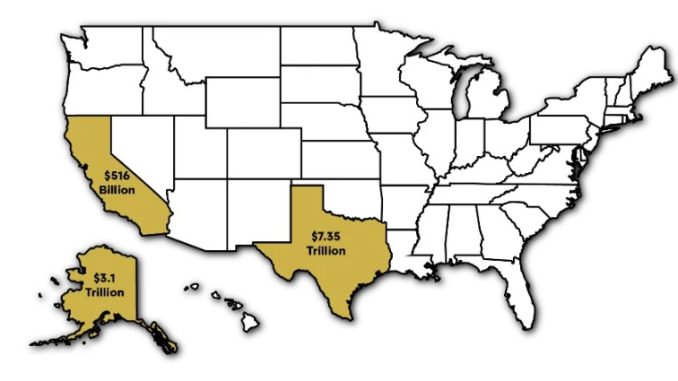
According to the promotional material, the United States possesses an estimated $150 trillion in resource wealth, which could be unlocked through changes in how the federal government manages and develops public lands. The campaign describes this potential wealth as a national inheritance and suggests that the Trump administration could use it to reshape the country’s economic future.
However, the $150 trillion figure should be treated as a promotional estimate rather than an independently established valuation of recoverable resources. The existence of valuable minerals on federal lands does not mean that the government has access to an equivalent amount of immediately available money.
The 1862 Law Behind the Claim
The campaign points to legislation dating back to the 19th century, arguing that federal land and mineral rights provide the legal foundation for unlocking America’s resource wealth.
It specifically invokes the General Mining Law framework and Title 30 of the U.S. Code, which governs mineral resources on public lands.
However, the idea that the legislation established a secret $150 trillion trust for Americans has been challenged in a legal complaint filed by the Mayor and City Council of Baltimore in June 2026.
The complaint alleges that the promotional campaign falsely represents the existence of a secret government trust and misleads consumers into believing that purchasing an investment newsletter would provide special access to opportunities created by government policy.
According to the filing, the product actually offers investment recommendations involving mineral companies. These allegations are part of a civil lawsuit and should not be confused with a final court ruling.
Why Mineral Resources Matter in the U.S.-China Competition
Despite the disputed financial claims, the underlying issue reflects a genuine strategic concern for Washington: China’s influence over global critical mineral supply chains.
China has established a dominant position in the processing and refining of several minerals essential to modern manufacturing, including materials used in electric vehicle batteries, electronics, renewable energy technologies and defense systems.
Reducing dependence on Chinese supply chains has therefore become an important objective of U.S. economic and national security policy.
Expanding domestic mining, improving mineral processing capabilities and developing alternative international supply partnerships could help Washington reduce vulnerabilities in strategically important industries.
However, building these industries requires substantial investment, environmental approvals, infrastructure development and years of production planning. Mineral deposits cannot automatically be converted into commercially viable supplies.
Trump’s Economic Strategy Toward China
The Trump administration has continued to use tariffs and trade restrictions as instruments of economic pressure against Beijing.
On November 26, 2026, Reuters reported that Washington’s latest tariff approach sought to reduce China’s influence over global trade by increasing tariffs on Chinese goods while encouraging trading partners, including the European Union, Japan and Vietnam, to limit certain economic ties with China.
The measures come amid continuing negotiations between the two economic powers and preparations for a planned meeting between Trump and Chinese President Xi Jinping.
Access to critical minerals and the ability to manufacture essential technologies domestically could complement these trade policies. Nevertheless, economic competition with China involves much more than mineral ownership. It also depends on manufacturing capacity, technological innovation, investment and access to international markets.
Separating the $150 Trillion Claim From Government Policy
The distinction between America’s actual mineral resources and the promotional campaign surrounding them is important.
The Baltimore lawsuit specifically challenges the claim that Trump is preparing to unlock a secret $150 trillion government trust. It also alleges that the advertising uses the promise of extraordinary investment opportunities to encourage consumers to purchase financial newsletters.
There is currently no verified basis for describing the supposed $150 trillion reserve as an established government financial asset or an officially designated economic weapon against China.
The broader proposal of developing America’s domestic mineral resources, however, remains a legitimate subject of economic and national security debate.
A Potential Strategic Advantage, Not a Confirmed Superweapon
America’s natural resources could provide an important advantage in its long-term competition with China, particularly if Washington succeeds in expanding domestic extraction and processing capabilities.
But the idea that a $150 trillion reserve could single-handedly change the balance of economic power between the two countries remains unproven.
For now, the so-called superweapon is better understood as a dramatic description of America’s potential mineral wealth, promoted through an investment-marketing campaign rather than an announced U.S. government strategy.
The real test will be whether the United States can turn its natural resources into a reliable industrial supply chain capable of competing with China’s established position in the global minerals market.