
A reported expansion at a North Korean nuclear facility could increase the country’s capacity to produce weapons-grade uranium, raising concerns over its nuclear weapons program and regional security.
Reported by:

Cherry Meigh Timbol
News Content Editor
Published November 27, 2026
North Korea may be expanding its capacity to produce weapons-grade uranium following reported construction and development activities at a nuclear facility, according to an assessment cited in recent reporting. The potential expansion has renewed attention on the country’s nuclear weapons program and its ability to increase production of material used in nuclear warheads.
Weapons-grade uranium is a highly enriched form of uranium that can be used in nuclear weapons. Its production requires specialized facilities, including uranium enrichment plants equipped with centrifuges that separate uranium isotopes to increase the concentration of uranium-235.
Satellite Imagery Raises Questions About the Facility’s Purpose
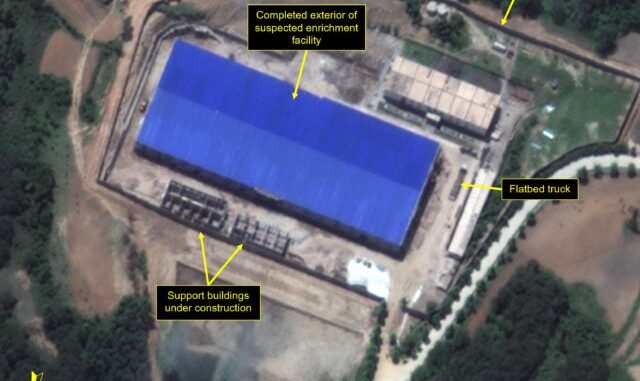
The latest assessment was published on November 24, 2026, by the Washington-based Institute for Science and International Security (ISIS). Researchers examined satellite images of construction at Yongbyon, located approximately 100 kilometers north of Pyongyang.
According to the institute, construction of an extension to the original uranium enrichment facility began in September and progressed rapidly. Satellite imagery showed that the new structure primarily consists of a large hall without internal dividing walls.
Researchers said the design could accommodate additional uranium enrichment equipment, potentially increasing North Korea’s ability to produce highly enriched uranium.
However, the institute identified several possible explanations for the construction. The extension could support increased production of low-enriched uranium, provide additional operational space for existing enrichment activities, accommodate research and development, or be used to produce weapons-grade uranium.
The institute said the possibility of additional weapons-grade uranium production warranted attention, although satellite imagery alone could not establish the facility’s precise purpose.
IAEA Confirms Further Expansion at Yongbyon
The assessment follows a November 18 statement by International Atomic Energy Agency (IAEA) Director General Rafael Grossi, who confirmed that North Korea had constructed another extension to its original uranium enrichment facility at Yongbyon.
Grossi said construction began in mid-September 2026, with the exterior of the new extension completed by late October.
The IAEA has also observed continuing enrichment operations at Yongbyon and Kangson, another suspected nuclear enrichment site near Pyongyang.
North Korea expelled IAEA inspectors in 2009, preventing the agency from conducting direct inspections of its nuclear facilities. Since then, the organization has relied primarily on satellite imagery and other publicly available information to monitor developments.
Grossi described the continued expansion of North Korea’s uranium enrichment program as a serious concern.
Nuclear Material Production and Regional Security
North Korea’s nuclear program involves the production of two principal materials used in nuclear weapons: highly enriched uranium and plutonium.
Uranium enrichment increases the concentration of uranium-235, an isotope that can sustain a nuclear chain reaction. Plutonium, meanwhile, can be obtained through the operation of certain nuclear reactors and subsequent reprocessing of spent nuclear fuel.
The IAEA has separately reported indications that Yongby’son’s five-megawatt reactor continues to operate and may be undergoing its seventh irradiation cycle. The agency has also observed activity at the site’s light-water reactor.
These developments suggest that North Korea continues to maintain and expand several parts of its nuclear infrastructure, although the precise quantities of weapons-grade material being produced remain difficult to independently verify.
North Korean leader Kim Jong Un has repeatedly called for expanding the country’s nuclear arsenal. In June 2026, state media reported that he had instructed officials to further increase the production of weapons-grade nuclear material, describing the expansion as necessary to strengthen the country’s nuclear deterrent.
The developments have implications for security across Northeast Asia, particularly for South Korea, Japan and the United States, which have expressed concern over North Korea’s advancing nuclear and missile capabilities.
International Monitoring Remains Limited
International efforts to monitor North Korea’s nuclear activities remain challenging because the country does not permit international nuclear inspectors to access its facilities.
Although satellite imagery can reveal construction, changes in infrastructure and signs of activity, it cannot independently confirm the exact function of every building or determine how much weapons-grade uranium is being produced.
The latest assessment by the Institute for Science and International Security therefore represents an evaluation of possible uses for the newly constructed extension rather than confirmation that it is already producing weapons-grade uranium.
The IAEA continues to monitor developments and has repeatedly raised concerns about the expansion of North Korea’s nuclear capabilities.




