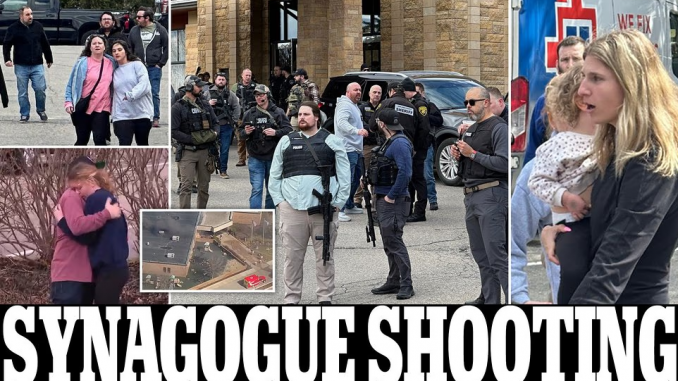
The gunman opened fire at Temple Israel in West Bloomfield Township, Michigan at about 12.30pm. The synagogue is a reform Jewish place of worship that has a preschool attached to it. It has one of the largest congregations in the country and was open at the time. The Jewish Federation of Detroit said: ‘We are aware of an active security incident at Temple Israel. Law enforcement are responding.
Published March 13, 2025
Suspect Dead; No Congregants Injured, Authorities Say
An active shooter and vehicle‑ramming attack occurred Thursday afternoon at Temple Israel, a large Reform Jewish synagogue in West Bloomfield Township, Michigan — part of the Detroit metropolitan area. Law enforcement responded to reports of shots fired and an intentional crash into the building around 12:30 p.m. EDT.
Officials say the suspect drove a vehicle through the synagogue’s front entrance, crashing into the interior and subsequently opening fire. Security personnel on site engaged the attacker, and the suspect was fatally shot during the exchange. Authorities later confirmed the suspect is dead.
A fire ignited by the crash caused smoke and visible damage to part of the building, prompting a large response by fire crews and law enforcement.

Officers responded to the synagogue, seen here, on Thursday with smoke seen coming out of the roof and a side door

An apparently frightened woman gathers children from Temple Israel synagogue, which has an early childhood center, in West Bloomfield Township after a gunmen opened fire
No Other Casualties Reported
Despite the dramatic scene, local officials reported that no children, staff members, or worshippers were killed or seriously injured in the attack. A lead security team member was struck by the suspect’s vehicle and taken to a hospital with non‑life‑threatening injuries.
Temple Israel houses not only worship spaces but also an early childhood learning center. At the time of the incident, the school was not in full session, and students and congregants were safely evacuated. Parents were directed to pick up children from a nearby Jewish Community Center.
Mayor and law enforcement officials urged people to avoid the area and shelter in place during the police response, and nearby schools were placed on lockdown as a precaution.
Law Enforcement and Federal Involvement
The FBI, Michigan State Police, Oakland County Sheriff’s Office, and local police worked together at the scene. According to federal sources, agents were actively investigating both the crash and shooting, as well as the suspect’s possible motives and background.
Eyewitnesses and live video showed a heavy police presence, including SWAT units and emergency vehicles, surrounding the temple and securing the location while evacuations continued.

Law enforcement respond to the active shooter situation at Temple Israel synagogue

An armed officer responds to the active shooter incident at Temple Israel synagogue in West Bloomfield, Michigan

Scores of police vehicles from neighboring departments, a SWAT team, bomb technicians and bomb-sniffing dogs have responded to the scene

Dozens of police cars are seen here on the scene

The FBI and hundreds of law enforcement officers raced to Temple Israel in West Bloomfield as smoke billowed from the building
Community Response and Security Alerts
The Jewish Federation of Detroit issued a statement confirming the “security incident” at Temple Israel and advised all Jewish organizations in the area to enter lockdown protocols, keeping doors secured and halting normal activities until further notice.
Authorities also increased patrols around other places of worship in the region.
Officials have not publicly identified a motive, and investigations are ongoing. Governor Gretchen Whitmer and community leaders released statements condemning violence and reaffirming support for the safety and well‑being of faith communities in Michigan.

People gather near Temple Israel synagogue in West Bloomfield Township, Michigan

Families embrace outside of a Michigan synagogue after an assailant drove truck into the building on Thursday afternoon
Temple Israel: A Major Community Institution
Temple Israel is one of the largest Reform Jewish congregations in the United States, with an active membership and a range of educational and community programs. Incidents of targeted violence against houses of worship have heightened concerns about hate‑crime threats across religious communities in recent years.

Emergency personnel respond to a reported shooting incident at Temple Israel synagogue in West Bloomfield, Michigan
 Implications of the Michigan Synagogue Attack: A Security and Societal Perspective
The attack at Temple Israel in West Bloomfield, Michigan is more than an isolated act of violence—it is a stark warning about vulnerabilities in American society, institutional preparedness, and community resilience. Examining the event through a lens of pragmatic safety and cultural awareness offers several key takeaways.
1. Vulnerabilities in Faith-Based Institutions
Religious institutions have long been seen as sanctuaries—spaces where people are free from the dangers of the outside world. This incident exposes the fallacy of that assumption. Despite having basic security protocols, the attacker was able to drive into the building and initiate an armed assault.
-
Security gaps are real: Even with metal detectors, controlled entrances, and staff training, a single determined assailant can overwhelm a system if there is no layered, robust defense strategy.
-
Infrastructure matters: Physical barriers such as reinforced entrances, bollards, and controlled access points are critical deterrents. Investing in security infrastructure is no longer optional; it is a necessity.
The lesson is clear: spiritual or cultural mission alone cannot substitute for practical, tangible protections. Institutions must treat security as a core operational function, not a secondary concern.
2. The Importance of Armed Response and Trained Personnel
The swift neutralization of the attacker underscores the value of preparedness. Law enforcement and on-site security teams were able to prevent a much larger tragedy.
-
Armed deterrence works: When trained personnel are present and ready to respond, even determined attackers are less likely to achieve their objectives.
-
Training is critical: Security protocols must include regular drills, situational awareness training, and coordination with local police to ensure rapid and decisive responses.
This event provides a real-world case study: effective defense depends on preparation, readiness, and the ability to act decisively under pressure.
3. Societal and Policy Implications
Acts of violence targeting communal spaces bring broader policy questions into focus. While debates often center on criminal justice or gun legislation, this attack highlights a more fundamental issue: responsibility at the community and institutional level.
-
Balancing freedoms and safety: Communities must weigh the need for open, welcoming spaces against the requirement for security. Policies that restrict defensive measures, even in faith-based institutions, can leave communities exposed.
-
Encouraging proactive measures: Incentives for private security, grants for emergency infrastructure, and clear guidance from local authorities can empower institutions to protect themselves effectively.
4. Cultural and Psychological Impact
Beyond physical harm, attacks like this sow fear and tension within communities. Congregants may feel their homes of worship are no longer safe, creating long-term psychological and social consequences.
-
Reaffirming communal vigilance: Faith communities should be encouraged to take active roles in protecting their members, fostering a culture of preparedness rather than helplessness.
-
Strengthening local ties: Collaboration between congregations, neighborhood organizations, and law enforcement strengthens resilience and deters potential attackers.
The underlying message is that security and cultural vitality are not mutually exclusive; a community can remain welcoming while also being protected.
5. Lessons for the Broader Public
The Temple Israel incident should serve as a cautionary tale nationwide:
-
Prioritize preparedness: Emergency response plans, training, and infrastructure are vital.
-
Invest in deterrence: Security is not just a cost—it is an investment in safety, continuity, and peace of mind.
-
Cultivate vigilance: Awareness of threats and proactive measures can prevent tragedies before they occur.
-
Empower local enforcement: National laws and guidelines are insufficient if local communities cannot act decisively to defend themselves.
Ultimately, the attack reinforces the principle that freedom and safety require responsibility, readiness, and action at the community level. Waiting for outside authorities or hoping for an incident to “never happen” is a dangerous mindset; history shows that tragedies strike when preparation is absent.
 Overall Takeaway: Vigilance, Responsibility, and Preparedness Are Non-Negotiable
The attack at Temple Israel is a stark reminder that the safety of our communities cannot be taken for granted. Houses of worship, schools, and cultural institutions are meant to be sanctuaries, but in an era of unpredictable threats, they can no longer rely solely on good intentions. Protection requires vigilance, preparation, and the willingness to act decisively.
Communities that prioritize security, train their members, and invest in effective deterrents demonstrate resilience in the face of violence. Law enforcement can respond, but the first line of defense often lies within the community itself.
The broader lesson is clear: freedom, faith, and community life are precious, but they must be safeguarded through responsibility, foresight, and practical action. Waiting for tragedy to strike before acting is a costly mistake; proactive measures ensure that congregations, families, and cultural institutions can thrive safely for generations to come.
SOURCES: DAILYMAIL ONLINE – Shooter killed after driving car into Detroit synagogue with preschool and opening fire, as cops say all children and staff survived the attack
REUTERS – Suspect dead in Detroit-area synagogue shooting, no other casualties reported
PEOPLE – Shooter Reported at Mich. Synagogue as Vehicle Rams Into Building, Suspect Reportedly Dead
AP NEWS – Armed man rammed vehicle into Michigan synagogue and was fatally shot by security, AP source says