by Diana Zapata • News Writer /Editorial Specialist
Published October 23, 2026
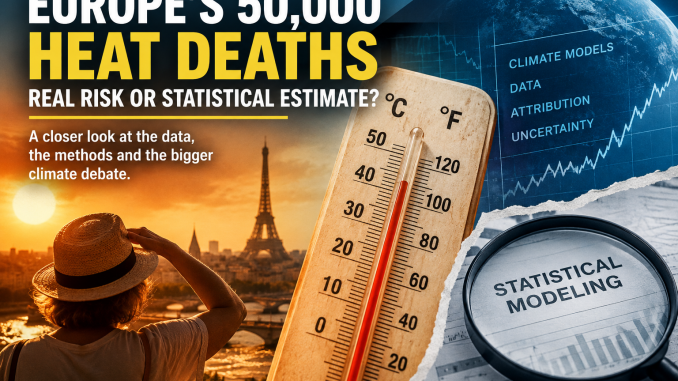
The headline is alarming: more than 50,000 people reportedly died from heat across European cities during the summer of 2026, with researchers attributing approximately two-thirds of those deaths to human-caused climate change. But before accepting the headline as conclusive evidence of a climate emergency, readers should examine how the figures were produced, what the study actually measured and where scientific uncertainty remains.
The issue is not whether extreme heat can kill. It can. The more important question is whether the reported figures justify the certainty with which climate change is presented as the principal explanation.
A death toll derived from statistical modeling
The research, conducted by scientists associated with Imperial College London and the London School of Hygiene and Tropical Medicine, estimated 50,391 heat-related deaths in 854 European urban areas. Of those, 32,619 were attributed to human-caused climate change.
These figures deserve attention, but their statistical origins also deserve scrutiny.
The researchers did not simply count 50,391 death certificates explicitly identifying heat as the cause of death. Instead, they combined temperature records with established statistical relationships between temperature and mortality, then compared the estimated outcomes with a simulated climate without human-caused warming.
This distinction matters. A modeled estimate can provide valuable information about a public health risk, but it is not identical to a directly observed death count.
The question for readers is straightforward: How sensitive are the results to the assumptions used in the model, the historical baseline selected and the hypothetical climate against which the researchers compared actual conditions?
Those are legitimate questions for any scientific study, particularly one generating headlines involving tens of thousands of deaths.
Christy discusses satellite temperature measurements, climate data and the limitations of climate models. This is a useful skeptical perspective on how climate evidence is interpreted.
What does “attributed to climate change” actually mean?
The figure of 32,619 deaths may sound precise, but it represents a statistical estimate of the difference between two modeled scenarios—not a list of individuals whose deaths can be definitively assigned to climate change.
Researchers estimate how mortality might have differed under cooler conditions without human-caused warming. The difference between the modeled outcomes is then attributed to that warming.
This is a recognized scientific method, commonly called climate attribution. However, the result depends on the quality of the underlying data and the assumptions used to construct the comparison.
A skeptical editorial should therefore ask whether the headline communicates the uncertainty behind that calculation clearly enough.
It should also distinguish between three claims: heat contributed to mortality, human-caused warming increased heat exposure, and a specific number of deaths can be attributed to that additional warming. Each claim requires its own supporting evidence.
The limits of the study deserve equal attention
The study examined 854 urban areas, representing roughly 40% of the population across the countries included in the analysis. Its findings are important, but the geographic coverage should not be confused with a complete, directly observed census of every heat-related death throughout Europe.
The researchers’ longer-term analysis also notes that modeled estimates can differ from official mortality statistics because the methods use different populations, geographic boundaries, reference periods and definitions of heat-related mortality. The researchers further acknowledge that their approach does not account for population adaptation to heat.
These limitations do not invalidate the findings. They do, however, provide reasons to demand transparency about the model’s assumptions, uncertainty ranges and sensitivity to alternative methods.
A responsible news report should explain these qualifications alongside its headline rather than leaving readers with the impression that every figure represents an independently verified individual death.
Could adaptation and public health measures reduce the toll?
Another question deserves attention: how much of the estimated mortality burden could be prevented through practical measures?
Heat-related risks vary with age, underlying health, housing conditions, access to cooling, public health services and local infrastructure. Older adults are particularly vulnerable.
That suggests governments have several immediate options, including better heat warnings, accessible cooling facilities, improved building design, shaded public spaces and targeted assistance for vulnerable residents.
A climate skeptic can reasonably argue that governments should evaluate these measures on their demonstrated public health benefits rather than treating emissions reductions as the only meaningful response.
However, adaptation and emissions reduction are not mutually exclusive. The evidence that public health measures can save lives does not establish that limiting additional warming is unnecessary.
Should a single summer determine climate policy?
One summer, however severe, cannot by itself settle every question about long-term climate trends, future mortality or the costs and benefits of climate policies.
Those questions require evidence collected over longer periods, comparisons across regions and careful evaluation of competing explanations.
For skeptics, the central concern should be whether public officials and news organizations communicate the distinction between observed conditions, modeled estimates and projections of future harm.
For climate researchers, the challenge is to make their methods and uncertainties understandable to the public.
For policymakers, the responsibility is to assess both the benefits and costs of proposed interventions, including their effects on energy affordability, economic resilience and public health.
The public should not be asked to choose between unquestioning acceptance and outright rejection of scientific research. Scrutiny is appropriate, but it must apply to the evidence on both sides.
This interview presents a direct skeptical argument about climate risks, temperature trends and model projections. It is an opinionated perspective, so readers should evaluate its claims against the underlying data.
💬 Overall Takeaway:
The estimate of more than 50,000 heat-related deaths across European urban areas is a serious public health finding, but it should be understood in the context of how researchers calculated it.
The strongest skeptical argument is not that heat deaths are imaginary or that climate change has been disproved. It is that a model-based estimate should be reported with its assumptions, uncertainties and limitations clearly explained—and should not be treated as proof of every broader claim made in its name.
Readers deserve to know what was measured, what was estimated, what remains uncertain and which policies are most effective at protecting lives.
Scientific credibility depends not only on producing alarming numbers, but also on explaining precisely what those numbers can and cannot establish.
SOURCES: Original research:
Peer-reviewed research on heat mortality
Carbon Brief explainer on estimating heat-related deaths
Roy Spencer’s climate commentary