
Published January 24, 2025
Extreme Heat? Or Overhyped Alarmism?
Australia has experienced another hot season, with heatwaves and bushfire warnings dominating the headlines. Mainstream scientists and media outlets claim that these events are proof of human-caused climate change. But the evidence tells a different story.
Extreme weather has always occurred in Australia. Droughts, record temperatures, and fires long predate industrial emissions. Assigning these events to CO₂ alone is not only scientifically dubious — it’s politically convenient.
Models vs Reality
The World Weather Attribution (WWA) study suggested that human emissions made the recent heatwave “1.6 °C hotter” and “five times more likely.” Sounds alarming — but it’s worth remembering that these conclusions come from computer models, not reality.
Models rely on assumptions, adjusted datasets, and statistical tricks to produce the results media reports as facts. Small changes in parameters can dramatically alter the “human contribution” — showing just how fragile these claims really are.
Natural Cycles: The Real Drivers
Historical records and paleoclimate data show that Australia has always had hot summers, prolonged droughts, and intense bushfires. Ocean cycles like ENSO (El Niño/La Niña) and the Pacific Decadal Oscillation, along with solar variability, explain much of the recent extremes — long before modern CO₂ emissions became significant.
This perspective is highlighted in “The Great Global Warming Swindle” (https://youtu.be/oYhCQv5tNsQ), which demonstrates how temperature trends and extreme events can be explained by natural variability and historical cycles — not humans.
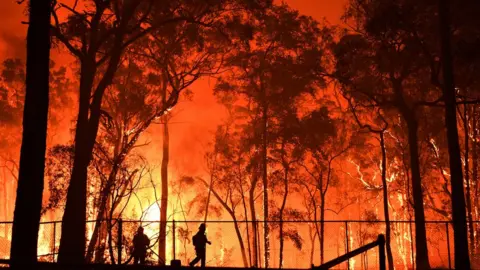
EPA Fires continue to burn across New South Wales and Queensland
Media, Politics, and Panic
Every extreme event today is framed as a “climate crisis.” Heatwaves, fires, and floods are packaged as evidence that industrial society is destroying the planet. Yet the models behind these headlines are uncertain, and adjustments to raw temperature data often exaggerate warming trends.
This isn’t science communicating uncertainty — it’s science being politicized. Alarmist messaging stokes fear while downplaying natural causes, making the public believe that humans are solely responsible for every disaster.
Alternative Explanation
A simple, evidence-based view of the current heatwave shows multiple drivers:
-
Natural climate variability — decades of historical temperature swings.
-
Ocean cycles and solar influence — long-term natural patterns.
-
Urban heat islands — cities trap heat, skewing perception.
-
Land and vegetation factors — bushfire risk is shaped by previous rainfall and fuel buildup.
These factors alone can explain a large portion of the extreme conditions without invoking human-caused climate change.
 Video Overview: Climate Hustle
Climate Hustle is a documentary produced by Marc Morano and released in 2016/2017. It presents a contrarian view of climate science, challenging the mainstream consensus that human activities are the dominant cause of global warming and related extreme weather. The video combines interviews, graphics, and global examples to argue that climate science is overstated, uncertain, and politically influenced.
Main Claims of the Video
1. Climate Models Are Unreliable
-
The documentary repeatedly criticizes climate models, claiming that predictions of warming, extreme weather, and disaster risk are often overestimated.
-
It suggests that models are sensitive to assumptions and adjustments, meaning that small changes in input data can produce drastically different outcomes.
-
This aligns with the skeptic perspective: models cannot provide absolute certainty, especially for individual events like Australia’s 2025–26 heatwave.
2. Extreme Weather Happens Naturally
-
The film emphasizes that heatwaves, droughts, and storms occur naturally and have happened throughout history.
-
Examples include past temperature records and pre-industrial disasters, demonstrating that extreme events are not proof of human-caused climate change.
-
This directly connects to your article’s argument that attributing a single heatwave or bushfire season to emissions is oversimplified.
3. Historical Temperature Fluctuations Are Ignored
-
The documentary highlights periods of warming and cooling over centuries (e.g., Medieval Warm Period, Little Ice Age), arguing that long-term natural variability is often downplayed in modern climate discussions.
-
Claim: Modern heatwaves may partly be part of these natural cycles, not solely anthropogenic trends.
-
Skeptical framing: Statistical attribution studies may exaggerate human influence because they don’t fully account for historical variability.
4. Political and Economic Agendas Drive the Climate Narrative
-
Climate Hustle argues that governments, media, and NGOs promote climate alarmism for political, financial, and ideological reasons.
-
Claim: Policy responses like carbon taxes, emission regulations, or renewable energy subsidies are framed as necessary due to human-caused climate catastrophes — regardless of scientific certainty.
-
This supports your article’s section on “Media, Politics, and Panic,” showing why some attribution claims are amplified beyond what evidence justifies.
5. CO₂ Is Overemphasized
-
The video challenges the idea that carbon dioxide is the dominant driver of warming, suggesting that natural factors like solar activity, ocean cycles, and feedback loops play a major role.
-
Skeptical takeaway: Attributing a single extreme event to CO₂ emissions is scientifically tenuous, which is exactly the argument your article makes about Australia’s heatwave.
6. Questionable Data and Adjustments
-
Climate Hustle points out cases where temperature datasets have been adjusted or “corrected”, arguing that such manipulations can exaggerate warming trends.
-
For skeptics, this raises doubts about the reliability of the data used in studies like World Weather Attribution.
Overall Takeaway: Rethinking Heatwaves, Fire Risk, and Alarmist Narratives
Australia’s recent heatwave and heightened fire risk are real, but the mainstream narrative that human-caused climate change is solely responsible deserves closer scrutiny. While organizations like World Weather Attribution use models to quantify human influence, these models are not infallible — they rely on assumptions, statistical adjustments, and simplifications of a highly complex climate system. Assigning a single extreme event to CO₂ emissions with high confidence overstates certainty and ignores the natural variability that has shaped Australia’s climate for centuries.
Historical records show that severe heatwaves, droughts, and fires occurred long before industrial emissions became significant. Ocean cycles, solar variability, land management practices, and urban heat effects all play a role — factors that are often underrepresented in alarmist reporting.
The documentary Climate Hustle (https://youtu.be/ZBGCjqUdQJQ) reinforces this perspective. It highlights the limitations of climate models, emphasizes natural climate cycles, and critiques how media and political agendas amplify human-attribution narratives. While controversial, the film serves as a visual example of the broader skepticism regarding extreme weather attribution.
In short, the climate system is multi-factorial, dynamic, and only partially understood. Extreme events should not automatically be framed as evidence of human-caused climate catastrophe. By acknowledging historical context, natural variability, and uncertainties in modeling, we can approach Australia’s heatwaves and fire risk with reasoned analysis instead of panic, focusing on practical adaptation and preparedness rather than alarmist storytelling.
Transparency, context, and critical thinking are essential. The science is complex — and humans, while influential, are not the only actors shaping the weather we experience.
SOURCES: WORLD WEATHER ATTRIBUTION – Climate change eclipses La Niña cooling in Australia to drive extreme heatwave and heightened fire risk
ARXIV – Quantifying the effect of interannual ocean variability on the attribution of extreme climate events to human influence
WATTSUPWITHTHAT – When the Narrative Dies: Climate.gov and the Quiet Collapse of Climate Alarmism
CLIMATE HUSTLE (Documentary)
THE GREAT GLOBAL WARMING SWINDLE (Documentary)