
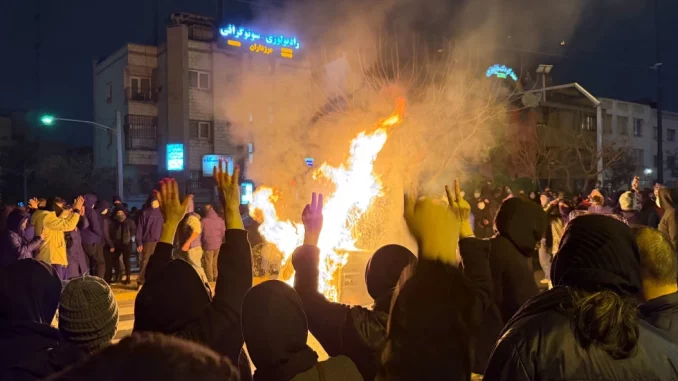
Iranians attend an anti-government protest in Tehran, Iran Jan. 9,2026
Published January 24, 2025
Iran’s government has issued a stark warning to the United States — declaring that any military attack, no matter how limited, would be treated as an “all‑out war” — as tensions escalate sharply in the Middle East and a severe internal crisis grips the Islamic Republic.
A senior Iranian official, speaking anonymously, said Tehran views the arrival of a U.S. aircraft carrier strike group and other military assets in the region as a serious development, and that any perceived violation of Iranian sovereignty “will be met in the hardest way possible.” The official stressed that Iran’s armed forces are on high alert and preparing for the worst‑case scenario amid what Tehran calls an ongoing threat from Washington.
U.S. President Donald Trump repeated that an “armada” of U.S. naval forces is heading to the region, emphasizing that he hopes military action will be unnecessary but reiterating warnings to Tehran against violence — especially against civilians. Trump has also criticized Iran over its crackdown on domestic protests and its nuclear activities.
Nationwide Protests and a Bloody Crackdown
Iran’s political crisis stems from widespread protests that began in late December 2025, initially sparked by economic hardship following a sharp collapse of the Iranian rial and rising living costs. As discontent spread, demonstrations rapidly expanded across the country, becoming some of the largest anti‑government protests since the 1979 Islamic Revolution.
Authorities responded with one of the most violent crackdowns in decades, deploying security forces — including the paramilitary Basij — against demonstrators. Despite the government’s attempts to shut down the internet and curb information flow, reports have emerged of intense violence, mass arrests, and heavy casualties.
According to AP’s reporting and estimates from rights groups:
-
The crackdown has become the bloodiest since the Iranian Revolution, with authorities using live ammunition and heavy force against largely peaceful crowds.
-
Protesters have mobilized in cities nationwide, often overcoming near‑total internet blackouts imposed by the government to limit international visibility.
-
Multiple sources indicate thousands of deaths, though exact figures vary widely due to communication restrictions.
State media and official government counts have acknowledged several thousand deaths, while activist and independent human‑rights groups report that the true toll could be significantly higher. The Human Rights Activists News Agency and others have cited figures in the thousands, including civilians and security personnel, while noting that casualties continue to mount.
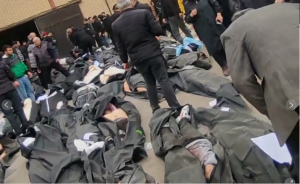
This frame grab from videos taken fron Jan. 9-11,2026 and circulating on social media purportedly shows images from a morgue with dozens of bodies and mourners after crackdown on the outskirts of Iran’s capital in Kahrizak, Tehran Province
Broader International and Regional Impact
The combined pressures of domestic unrest and external confrontation have placed Iran at the center of heightened geopolitical tensions:
-
U.S.–Iran military tensions have increased as Trump’s administration continues to deploy forces to the region, citing both the internal crackdown and concerns about Iran’s nuclear program.
-
European airlines and international carriers have rerouted or canceled flights over the Middle East amid safety concerns linked to the crisis.
-
The United Nations and human‑rights organizations have expressed alarm over the scope of violence during the protests, while global governments watch the situation closely.
Iran’s leadership has accused foreign governments of fomenting unrest and interfering in its internal affairs, a characterization that further complicates diplomatic avenues. Tehran insists its actions are lawful and necessary to preserve national stability.
 Implications
of Iran’s Threats and Nationwide Protests
1. Heightened Risk of U.S.–Iran Military Conflict
-
Iran’s declaration that any attack will be treated as an “all-out war” significantly raises the stakes for the U.S. and its allies in the Middle East.
-
Even a limited military action or accidental incident could escalate quickly into a broader regional conflict.
-
U.S. naval deployments signal that Washington is taking the threat seriously, which could trigger a dangerous cycle of military posturing.
2. Domestic Instability and Government Legitimacy Crisis
-
The nationwide protests, combined with violent crackdowns, indicate that Iran’s government is facing serious domestic legitimacy challenges.
-
The brutality of the response may suppress protests temporarily but could fuel further dissent and long-term instability.
-
Prolonged unrest could lead to economic paralysis, internal factional disputes, or even regime change pressures.
3. Humanitarian Consequences
-
Reports of thousands of deaths, mass arrests, and communication blackouts highlight a growing humanitarian crisis.
-
International human-rights organizations may push for sanctions or intervention, which could widen Iran’s isolation.
-
Civilians are at severe risk, and the country may face a refugee crisis if protests intensify or repression worsens.
4. Regional and Global Economic Impact
-
Iran is a major oil exporter; instability could affect global oil prices, disrupt shipping routes in the Persian Gulf, and influence markets.
-
Airlines have already rerouted flights over the region, which may increase travel costs and disrupt global trade.
-
Regional powers may take sides, potentially destabilizing neighboring countries like Iraq, Syria, or the Gulf states.
5. Diplomatic and Strategic Ramifications
-
Iran’s stance complicates diplomatic negotiations, particularly over nuclear programs and sanctions relief.
-
Other countries may feel compelled to reinforce alliances or prepare contingency plans.
-
The combination of internal unrest and external threats could make Iran more unpredictable on the international stage, increasing the risk of miscalculations.
6. Potential Long-Term Outcomes
-
Escalation: A military confrontation could spark a broader regional war.
-
Suppression: The government may consolidate power through brutal crackdowns, but at the cost of international condemnation.
-
Negotiation: Internal unrest and international pressure might push Iran toward limited concessions or dialogue to reduce tensions.
 Overall Takeaway:
Iran now faces an unprecedented crossroads, caught between widespread internal unrest and growing tensions with the United States. The government’s warning that any U.S. military action will be treated as an “all-out war” underscores the serious risk of escalation, signaling that even limited conflict could spiral into a larger regional confrontation.
At home, the nationwide protests — some of the largest since the 1979 Islamic Revolution — highlight a deep legitimacy crisis. The government’s heavy-handed response, including internet blackouts, mass arrests, and reports of thousands of deaths, may temporarily suppress dissent but risks fueling further anger and long-term instability. These events underscore the fragility of Iran’s domestic political order and its vulnerability to both internal and external pressures.
The situation also carries significant regional and global implications. Instability in Iran could disrupt energy markets, affect international shipping routes in the Persian Gulf, and spark security concerns across the Middle East. Neighboring countries and global powers are likely to adjust military and diplomatic strategies in response to the rising tension. Meanwhile, international human-rights organizations are calling attention to the humanitarian toll of the crackdown, which may increase Iran’s political and economic isolation.
In essence, Iran’s twin crises — domestic unrest and confrontational foreign policy — pose a multifaceted challenge. The coming weeks will be critical in determining whether the country moves toward negotiation, further repression, or a dangerous escalation. For the international community, vigilance, careful diplomacy, and humanitarian attention will be essential to prevent a situation that could have far-reaching consequences for the region and beyond.
SOURCES: AP NEWS – Scale of Iran’s nationwide protests and bloody crackdown come into focus even as internet is out
REUTERS – Iran will treat any attack as ‘all-out war against us,’ says senior Iran official




