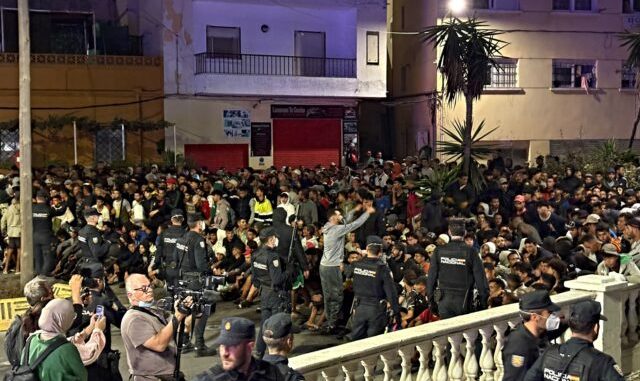
The Spanish North African exclave of Ceuta endured another chaotic night into early morning after an avalanche of invading migrants still in the city rushed a new “temporary” seaside shelter.
Reported by:

Cherry Meigh Timbol
News Content Editor
Published September 18, 2026
CEUTA, Spain — Tensions erupted in Spain’s North African enclave of Ceuta on Friday as authorities began moving thousands of migrants who had been living on beaches and public areas to a newly established temporary accommodation site at the port.
The operation, which began early Friday morning, quickly became disorderly as large crowds gathered in an effort to secure places at the new facility. Spanish police fired warning shots into the air as officers struggled to control the crowd.
According to Spain’s state news agency EFE, more than 3,000 migrants staying on Ceuta’s Benítez and Trampolín beaches were moved during the operation. About 170 National Police officers, including riot-control units, as well as additional security personnel, participated in the transfer.
The new temporary facility at the port has capacity for approximately 1,700 adult men, meaning it cannot accommodate everyone who remains without permanent shelter. Reuters reported that Spanish authorities estimate around 10,000 migrants remain in Ceuta, following the unprecedented influx from Morocco in late July.
Crowds Surge During Transfer
The operation was intended to clear migrants from beaches where many had been sleeping for weeks. Migrants were escorted along a route of roughly one kilometer toward the port facility.
However, tensions increased when large numbers of people attempted to enter the new accommodation area. Reuters reported that police used batons and fired rubber bullets into the air as clashes and jostling broke out.
Spanish media also reported injuries during the initial rush. El País described an initial stampede and said warning shots were fired as officers attempted to regain control of the situation.
Breitbart reported the scenes as another episode in the continuing crisis that has placed considerable pressure on Ceuta’s limited housing and reception infrastructure.
Crisis Stems From July Border Surge
The immediate crisis follows the extraordinary movement of migrants from Morocco into Ceuta in late July.
Reuters reported that more than 72,000 people crossed into the enclave during the mass border rush, although the majority subsequently left or returned to Morocco. Spanish authorities have continued to deal with those who remained in the territory.
The scale of the influx overwhelmed existing reception facilities. Migrants have been sleeping on beaches, streets and makeshift camps while authorities prepared additional temporary accommodation.
The situation has also generated political and diplomatic tensions over Spain’s management of the border and the European Union’s migration policies.
Shelter Capacity Remains a Major Challenge
Humanitarian organizations have criticized the Spanish response, arguing that authorities were too slow to provide adequate accommodation for people remaining outdoors.
Reuters reported that one NGO estimated approximately 4,000 migrants were still sleeping outdoors on beaches and pavements, although estimates vary. The newly constructed port facility is therefore insufficient to house everyone currently without shelter.
The facility is designed specifically for adult men. Children and unaccompanied minors are being handled separately under Spain’s protection system. Earlier reporting indicated that thousands of unaccompanied minors were identified following the July arrivals.
The continuing shortage of accommodation illustrates the difficulty facing Ceuta after the unprecedented border surge. Authorities must simultaneously manage public order, humanitarian needs and the security of Spain’s external border.
A Continuing European Migration Challenge
Friday’s events highlight the broader challenges confronting Europe as governments attempt to manage irregular migration while providing shelter and legal protections to people who have already entered their territories.
EU Migration Commissioner Magnus Brunner said Friday that images of the Ceuta crossings had contributed to political pressure surrounding migration policy, even as irregular arrivals elsewhere in Europe have declined following tighter migration measures.
For Ceuta, however, the immediate challenge remains on the ground: thousands of people still require accommodation while authorities attempt to restore order and clear public spaces that have become makeshift camps.
The latest confrontation underscores how quickly a humanitarian accommodation effort can become a public-order challenge when available capacity falls far short of demand.
🧩 Bottom Line:
The turmoil in Ceuta shows how quickly a large migration influx can place pressure on limited housing, public services, and law-enforcement resources. As Spanish authorities move migrants into temporary accommodation, the challenge remains balancing humanitarian responsibilities with maintaining public order and effective border management.
SOURCES: BREITBART NEWS – Watch: Ceuta Chaos as Invading Migrants Rush to Claim New ‘Temporary’ Shelter
REUTERS – Spanish police launch operation to clear Ceuta migrants off beach