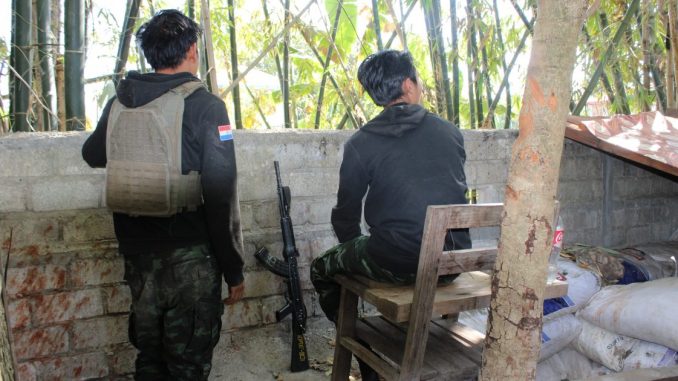
While China supplies the Burma junta with modern weapons, the resistance scrambles to fight with whatever equipment they can find or make. Photo by Antonio Graceffo.
Published March 27, 2026
China’s involvement in the ongoing conflict in Myanmar (also known as Burma) is drawing increasing attention, as reports suggest Beijing is playing a deeper role behind the scenes.
Recent developments indicate that China has been providing support to Myanmar’s military government, including financial aid and weapons. Analysts say this support has helped the military regain control in some areas after facing strong resistance from armed groups.
Observers believe China’s actions are not just about helping an ally, but also about protecting its own interests in the region. Myanmar is strategically important because it gives China access to natural resources, trade routes, and infrastructure projects, including pipelines and ports connected to its Belt and Road Initiative.
China has also been using its economic influence to pressure different groups inside Myanmar. In some cases, it has cut off supplies like electricity, fuel, and internet access to force cooperation from armed factions.
At the same time, China has been accused of playing both sides—supporting the government while also maintaining influence over certain ethnic armed groups near its border. This strategy allows Beijing to keep leverage over the situation and maintain stability where it matters most to its interests.
Experts say China’s long-term goal may be to keep Myanmar stable enough to protect its investments, but not necessarily fully peaceful. A weaker, dependent Myanmar could give China stronger control over key economic and strategic areas in Southeast Asia.
This growing involvement has raised concerns among other countries, especially in the West, who worry that China is expanding its influence in the region through indirect control rather than open conflict.
As the situation continues, many are watching closely to see how far China will go—and what it could mean for the balance of power in Asia.
🔍 Analyst Insight: CHINA’S STRATEGIC PLAY IN MYANMAR
A Long-Term Strategy, Not a Short-Term Move
China’s involvement should be viewed as part of a long-term plan rather than a reaction to current events. Myanmar sits in a critical position—providing China access to the Indian Ocean and reducing reliance on contested sea routes. This makes influence over Myanmar not just beneficial, but strategically important for decades to come.
Influence Through Dependence, Not Occupation
Rather than sending troops, China builds influence by making itself necessary. Through funding, infrastructure projects, and political backing, it creates conditions where Myanmar’s leadership may rely on Beijing for survival. This kind of dependence can be more powerful than physical control because it shapes decisions from within.
Control Without Visibility
One of the most notable aspects of this strategy is how subtle it is. There are no large-scale public interventions, yet influence continues to grow. This allows China to avoid global backlash while steadily increasing its role behind the scenes.
Strategic Flexibility by Backing Multiple Sides
Maintaining relationships with different factions provides leverage. If power shifts, China is not left starting over—it already has ties in place. This reduces risk and ensures continued influence regardless of political outcomes.
Economic Pressure as a Tool of Power
Control over trade routes, energy supplies, and investments gives China the ability to apply pressure when needed. Even small disruptions—such as limiting fuel or electricity—can push local actors to cooperate without a single shot being fired.
A Model That Could Be Repeated
What is happening in Myanmar may not be an isolated case. This method of gaining influence—quiet, steady, and rooted in dependence—could be applied in other regions. That possibility raises concerns about how global power dynamics may evolve in the future.
👥 Human Element: THE COST BEYOND POLITICS
Families Living in Constant Uncertainty
For civilians, daily life has become unpredictable. Parents worry about safety, children grow up surrounded by instability, and entire communities live with the constant possibility of displacement. The emotional toll is as heavy as the physical dangers.
Displacement and Loss of Livelihood
Many people have been forced to leave their homes, farms, and businesses behind. This not only creates immediate hardship but also removes long-term opportunities for stability and growth. Rebuilding becomes harder the longer the conflict continues.
Limited Access to Basic Needs
Access to food, clean water, healthcare, and electricity is no longer guaranteed in many areas. Interruptions caused by conflict or external pressure can quickly turn everyday life into a struggle for survival.
Voices That Go Unheard
As larger powers and armed groups shape the direction of the country, ordinary citizens often have little say in decisions. This creates frustration and a sense of being left out of their own future.
Cultural and Community Strain
Conflict doesn’t just damage infrastructure—it affects relationships and trust within communities. Long-standing social ties can weaken as people are divided by politics, survival needs, or forced migration.
Strength and Self-Reliance at the Local Level
Despite these hardships, many communities continue to rely on each other. Informal support systems—neighbors helping neighbors—have become essential. This resilience highlights the strength of local communities even when formal systems fall short.
A Future Shaped by Today’s Struggles
The longer the conflict and outside influence continue, the more lasting the impact will be. Children growing up in this environment may face limited opportunities, shaping the country’s future for years to come.
🎯 Conclusion: A QUIET SHIFT IN POWER
The situation in Myanmar reflects more than just an internal conflict—it highlights how global influence can be expanded without direct confrontation. China’s growing role shows a calculated approach built on leverage, dependence, and long-term positioning rather than open force.
For many observers, the concern is not only about what is happening now, but what it could lead to in the future. When a nation becomes reliant on outside support for security and economic survival, its ability to act independently can slowly diminish.
At the same time, the ongoing instability continues to take a toll on ordinary people, raising questions about whether foreign involvement is truly helping bring lasting peace—or simply reshaping control.
In the bigger picture, Myanmar may be a preview of a broader strategy—one where influence is gained step by step, and where power is exercised quietly but effectively.
SOURCES: THE GATEWAY PUNDIT – China’s War in Burma: Funding, Weapons, and Strategic Control
THE IRRAWADDY – China Steps Into Great-Power Trap With Myanmar Intervention