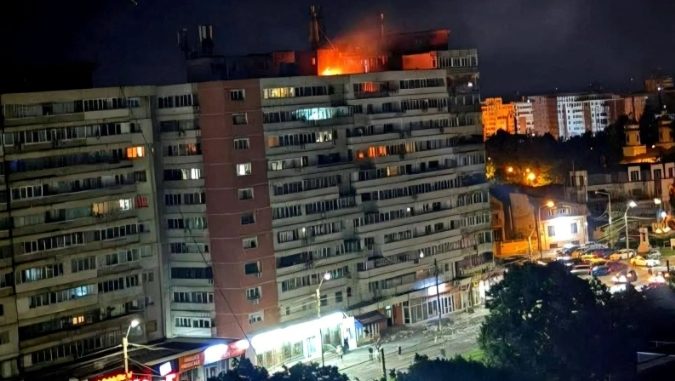
A fire erupted from the 10-storey block after the hitCredit: Reuters
Published May 29, 2026
🧭 Headline Brief
A Russian-made explosive drone crossed into Romanian airspace during overnight attacks on Ukraine and struck a residential apartment building in Galați, injuring civilians and triggering a fire — marking a rare and alarming spillover of the war into NATO territory, according to defense officials and early reports.

A fire burns on the roof of a block of flats after a drone crashed into the building, causing an explosion and injuring two people, near the border with Ukraine, in Galati, Romania, May 29, 2026.via REUTERS

Forensic investigators examine the impact after a Russian drone struck an apartment building in Galati, May 29, 2026.AFP via Getty Images
🧩 Context Signal

A man walks at the site of an explosion following a drone attack in Galati, Romania, May 29, 2026.via REUTERS

Firefighters work at a block of flats after a drone hit close to the border with Ukraine, in Galati, Romania, May 29, 2026.via REUTERS

Romanian law enforcement officers work on the site of the explosion in Galati, May 29, 2026
🌍 Field Reality
On the ground in Galați, residents described a sudden explosion followed by fire erupting from the upper floors of the apartment complex. Emergency crews worked through the night to extinguish the blaze and secure the structure, which sustained visible damage to its roof and stairwell areas.
Authorities confirmed that:
- The drone entered Romanian airspace during a Russian strike on Ukrainian infrastructure
- It traveled deep enough into the country to reach a populated civilian zone
- Romanian F-16 jets were deployed but could not prevent impact
- Around 70 residents were evacuated from the building
- At least two civilians sustained injuries and were treated at the scene
Officials emphasized that this marks one of the most serious cross-border incidents involving civilian infrastructure inside NATO territory since the war began.
Residents have since been relocated while structural engineers assess whether the building remains safe for occupancy.
🔍 Global Lens
The incident has intensified concerns across Europe that Russia’s war in Ukraine is increasingly producing spillover effects beyond its borders.
NATO officials and European leaders reacted sharply, with warnings that repeated airspace violations could force a reassessment of defensive posture along the alliance’s eastern flank.
Key geopolitical implications include:
- Renewed pressure on NATO to expand anti-drone and air defense coverage along Romania’s border
- Heightened scrutiny of Russia’s use of long-range drones in densely populated corridors
- Concerns that similar incidents could occur in neighboring NATO states such as Poland and the Baltic region
- Calls for faster deployment of interception systems and integrated air monitoring
European officials described the strike as part of a broader pattern of escalating aerial warfare that is increasingly difficult to contain within Ukraine’s borders.
While Moscow has not issued a detailed response, the incident is expected to further strain already deteriorating diplomatic relations between Russia and NATO member states.
📌 Closing Signal
The strike on the apartment building in Galați is now being treated in Romania as more than an isolated wartime anomaly—it is being assessed as a warning sign about how far modern drone warfare can spill beyond its intended battlefield.
Even as initial reports suggest the drone was likely part of a wider wave of attacks on Ukrainian infrastructure near the border region, the fact that it crossed into NATO airspace and struck a civilian residence has shifted the conversation in Bucharest and across allied capitals. What was once largely treated as a border-adjacent risk is increasingly being viewed as a direct test of airspace integrity in a densely populated European region.
Romanian authorities have moved quickly to reassure the public while simultaneously acknowledging the seriousness of the breach. Emergency inspections continue at the damaged apartment block, with engineers assessing whether parts of the structure remain stable after fire damage and impact shockwaves. Residents displaced by the blast remain under temporary accommodation arrangements as investigators reconstruct the drone’s final flight path.
At the diplomatic level, the incident has added new pressure to already strained security discussions within NATO. Officials are now weighing whether existing air defense coverage along the eastern flank is sufficient to intercept fast-moving, low-altitude drones before they reach populated areas. The episode has also intensified calls for expanded early-warning integration between Ukraine’s battlefield tracking systems and NATO surveillance networks.
While no broader military escalation has been announced in direct response, the political tone has clearly hardened. European defense planners are now openly discussing the increasing likelihood that similar incidents could occur again, particularly in border regions where Russian strike patterns are dense and unpredictable.
For residents in Galați, however, the geopolitical implications are secondary to the immediate reality: a civilian apartment block was breached by a weapon of war, in a place where many believed the front line had not yet arrived. The damage to the building is still being measured, but the psychological impact—on both Romania’s border communities and NATO’s eastern security posture—may prove far more difficult to repair.
As investigations continue, the incident is expected to remain a focal point in ongoing debates over escalation control, air defense readiness, and the increasingly blurred boundaries of modern conflict.