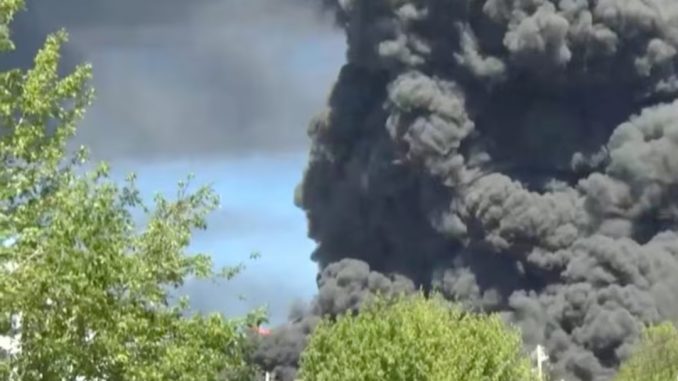
Heavy smoke rises above the area during a visit by Krasnodar region’s Governor Veniamin Kondratyev, who inspects emergency services following a Ukrainian drone attack that caused a fire at an oil refinery, amid the Russia-Ukraine conflict, in Tuapse, Russia, April 28, 2026, in this still image taken from video.
Published May 5, 2026
The war between Russia and Ukraine is entering another volatile phase as both sides escalate drone and missile strikes while simultaneously floating competing ceasefire proposals that have done little to slow the fighting on the ground.
Ukrainian forces have sharply increased long-range drone operations targeting Russian military infrastructure, logistics hubs, and energy facilities deep inside Russian-controlled territory. Recent reports show Ukraine conducting more than 160 precision strikes in a single month, hitting command posts, ammunition depots, and supply routes far from the front lines.
At the same time, Russia has continued heavy missile and drone attacks on Ukrainian cities and energy infrastructure, including strikes that killed civilians and damaged critical gas production facilities, further straining Ukraine’s already fragile energy grid.
Competing Ceasefires, No Real Pause in Fighting
Both Moscow and Kyiv have recently announced separate ceasefire proposals tied to symbolic dates, including Russia’s Victory Day commemorations. However, neither side appears fully committed to a sustained pause, with each accusing the other of preparing continued strikes.
Ukrainian President Volodymyr Zelensky has pushed for a longer, more stable ceasefire, while Russia has proposed shorter, time-limited truces centered around national events.
Despite these announcements, fighting has continued across multiple fronts, with drone warfare and artillery exchanges remaining constant.
Drone Warfare Becomes the Defining Battlefield
One of the biggest shifts in the conflict is the growing reliance on drones and long-range strikes. Ukraine has expanded its domestic drone production and is increasingly using unmanned systems to strike targets hundreds of kilometers inside Russian territory.
Russia, meanwhile, continues large-scale drone and missile barrages aimed at weakening Ukraine’s energy and military infrastructure, often targeting cities and industrial sites.
Military analysts say the war is increasingly defined by “strike and counter-strike” operations rather than traditional front-line advances.
Front Lines Still Moving, But Slowly
On the ground, Russian forces continue making incremental advances in eastern Ukraine, capturing small settlements in ongoing offensive operations. However, gains remain slow and costly, with both sides suffering heavy attrition.
Russia Matters
Ukraine, meanwhile, is focusing on disrupting Russian supply chains and weakening rear-area logistics rather than large territorial gains.
🔍 Critical View: What This War Is Really Showing
The Russia-Ukraine war is no longer just about front-line battles—it has turned into a long, grinding conflict where drones, missiles, and economic pressure matter as much as territory. Critics say this shift exposes deeper problems in how the war is being managed and where it is heading.
No clear end strategy
One major concern is that neither side appears to have a realistic path to ending the war quickly. Instead, the conflict has settled into a pattern of constant strikes and counterstrikes, with no clear agreement on what “victory” or a final settlement would actually look like.
War by drones changes everything
The heavy use of drones and long-range attacks has made the war more unpredictable. Critics argue this type of warfare makes it easier to strike deep behind enemy lines, but harder to achieve real, lasting military gains that change the overall situation.
Civilian and infrastructure damage keeps rising
As strikes continue, critical infrastructure like power plants, fuel supplies, and transport networks are repeatedly targeted. Critics say this shifts the war beyond the battlefield and puts more pressure on ordinary civilians, especially during harsh weather and energy shortages.
Endless aid raises questions
Western support has played a major role in keeping Ukraine in the fight. But critics argue that long-term funding and weapons shipments without a clear exit plan risk turning the conflict into a prolonged drain on resources with no defined endpoint.
Ceasefires that don’t hold
Short-term ceasefire proposals keep appearing, but none have led to a lasting pause in fighting. Critics say this pattern shows a deeper lack of trust and raises doubts about whether temporary truces are meaningful or just symbolic.
👥 On the Ground: Life Inside a Grinding War
On the ground in Ukraine and along the front lines, the war has settled into a harsh routine of constant alerts, intermittent strikes, and life shaped around survival rather than normalcy. Soldiers and civilians alike are dealing with a conflict that has become less about big movements and more about daily pressure from drones, artillery, and air raids.
Constant drone activity overhead
One of the most noticeable changes is the nonstop presence of drones. They are used for surveillance and attacks on both sides, meaning troops and civilians often hear or see them long before anything happens. This has turned everyday movement into something cautious and calculated.
Front lines barely moving, but always active
In many areas, the front lines have shifted very little, but fighting continues almost every day. Small advances or withdrawals happen, but there are no major breakthroughs—just steady, grinding exchanges of fire.
Cities under repeated stress
In towns and cities away from the front, life continues, but under pressure. Power outages, air raid sirens, and infrastructure damage are part of daily reality in some regions, especially after strikes targeting energy systems and transport hubs.
Soldiers focused on endurance, not quick victory
Troops on the ground describe the conflict less as fast-moving warfare and more as endurance. Holding positions, surviving artillery fire, and adapting to drone surveillance have become central to daily operations.
Civilians adapting to uncertainty
For ordinary people, routines are constantly adjusted. Schools, businesses, and transport systems operate when possible, but plans often change quickly due to alerts or damage from nearby strikes.
🎯 The Final Word:
The Russia-Ukraine war has clearly moved into a long, drawn-out phase where constant drone strikes, artillery fire, and limited territorial changes define the reality on the ground. Despite repeated talk of ceasefires and negotiations, the fighting continues with no clear end in sight, and each side appears focused more on wearing the other down than reaching a settlement. Critics argue that this ongoing cycle shows the lack of a realistic, enforceable peace plan, turning what was expected to be a shorter conflict into a prolonged struggle with growing costs. In simple terms, the war is no longer about quick breakthroughs—it has become a sustained test of resources, endurance, and political will, with ordinary people and global economies continuing to feel the impact.