
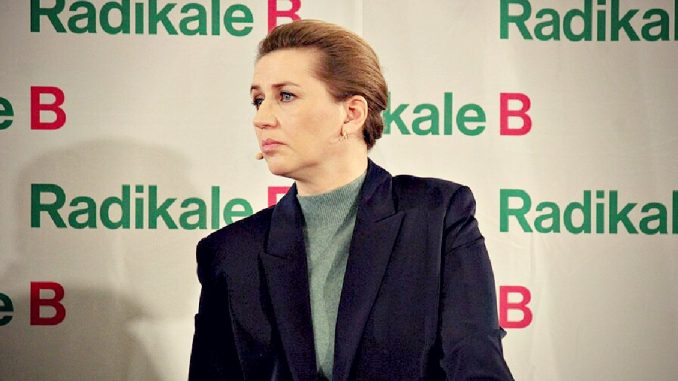
Metter Freriksen, former Danish PM – Photo by Christian Ursilva/Wiki Commons
Published March 25, 2026
Mette Frederiksen has formally submitted her government’s resignation after her coalition suffered a significant setback in Denmark’s general election, triggering uncertainty over the country’s political future and the start of complex coalition negotiations.
Frederiksen handed her resignation to King Frederik X after her three-party government failed to secure a parliamentary majority, a standard constitutional step following elections but one that underscores the scale of the electoral blow.
Historic Loss Despite Remaining Largest Party
While Frederiksen’s Social Democratic Party remained the largest single party, the result marked its worst performance in more than a century, winning roughly 21–22% of the vote and about 38 seats—down sharply from previous elections.
The broader left-leaning “red bloc” secured around 84 seats in Denmark’s 179-seat parliament, falling short of the 90 needed for a governing majority. The right-leaning opposition also failed to reach a majority, leaving the election outcome inconclusive.

Frederiksen breaks bread with Swedish, Norwegian, and Finnish leaders.
Political Deadlock and Kingmaker Role
The fragmented result has placed the centrist Moderates party, led by former Prime Minister Lars Løkke Rasmussen, in a kingmaker position, holding enough seats to determine the direction of the next government.
With neither bloc able to govern alone, Denmark now faces potentially prolonged coalition talks that could reshape its political alignment.
Voter Backlash and Key Issues
Analysts point to a mix of domestic concerns behind the weak showing, including:
- Rising cost-of-living pressures
- Immigration policy debates
- Controversial government decisions
- Fatigue after seven years of Frederiksen’s leadership
Some policies—such as the abolition of a public holiday and past controversies like the mink cull—also contributed to declining support.
Future Remains Uncertain
Despite the resignation, Frederiksen is not out of the running. As leader of the largest party, she could still attempt to form a new coalition government and potentially secure a third term as prime minister.
“I’m ready to take on the responsibility,” Frederiksen said following the vote, acknowledging that forming a government would be difficult.
For now, she is expected to remain as a caretaker leader while negotiations continue.
Broader Implications
The election highlights growing political fragmentation in Denmark, with gains among both left- and right-wing parties and increasing voter volatility.
The outcome also reflects a broader trend across Europe, where traditional parties are facing pressure amid economic concerns and shifting voter priorities.
🧩 The Core Analysis: A Government Rejected, A Mandate Lost
The resignation of Mette Frederiksen following Denmark’s election is less a procedural step and more a clear signal from voters: the governing direction of the past several years has run out of public support.
Although Frederiksen’s party technically finished first, the sharp drop in voter backing tells a deeper story. In parliamentary systems, survival is not measured by plurality alone but by the ability to command confidence. That confidence has eroded. The electorate did not deliver a workable majority to her coalition, and in doing so, effectively rejected continuity.
A “Win” Without Authority
Remaining the largest party might appear politically survivable on paper, but the reality is far less stable. A government that cannot assemble a majority is a government without a mandate to push policy. This is especially significant given the breadth of dissatisfaction reflected across multiple issues—from economic strain to unpopular reforms.
The election result exposes a growing disconnect between leadership priorities and voter expectations. When a ruling coalition loses ground this decisively, it is rarely about a single policy misstep. It reflects accumulated frustration.
Policy Fatigue and Public Pushback
Several decisions under Frederiksen’s leadership appear to have contributed to this moment:
- Economic pressures that many voters feel were not adequately addressed
- Controversial domestic policies that triggered public backlash
- A perception of centralized decision-making with limited accountability
- Fatigue after extended one-party dominance in leadership
These factors combined to create an environment where voters were not simply choosing alternatives—they were signaling a desire for a different governing approach.
Fragmentation Signals a System Under Strain
The fractured outcome, with neither bloc securing a majority, points to a broader shift. Voters are no longer consolidating around traditional power centers. Instead, support is dispersing across smaller or alternative parties, reflecting skepticism toward established leadership structures.
This fragmentation often emerges when the public feels that major parties are no longer responsive. It forces political systems into coalition-building exercises that can dilute policy clarity and slow decision-making—outcomes that may further frustrate voters.
The Kingmaker Dynamic
The position now held by Lars Løkke Rasmussen underscores another key takeaway: power is shifting away from dominant parties toward smaller, strategically positioned actors.
When a centrist or breakaway party becomes the deciding force, it typically indicates that voters are searching for balance—but also that they are unwilling to give any single group unchecked authority.
🔗 The Synthesis: A Reset Driven by Voters
The resignation of Mette Frederiksen and the fractured election outcome together point to a broader political shift: voters are no longer willing to grant extended leeway to governments they believe are out of step with everyday realities.
Across the reporting, a consistent picture emerges—not of a sudden collapse, but of a gradual erosion of support that finally reached a breaking point at the ballot box. Economic strain, controversial decisions, and leadership fatigue converged into a result that denies any single bloc clear authority to govern.
A Mandate Rewritten
This election did not produce a clean transfer of power—but it did redraw the boundaries of political legitimacy. The electorate allowed no party or coalition to move forward unchecked. Instead, it imposed constraints, forcing leaders into negotiation, compromise, and accountability.
For Frederiksen, remaining politically relevant does not equate to governing freely. Any path forward would require concessions that reflect the message voters just delivered: policies must better align with public expectations, and leadership must become more responsive.
The Rise of Conditional Support
The emergence of Lars Løkke Rasmussen as a central figure in coalition talks highlights a key transformation—support is no longer absolute; it is conditional.
Voters appear to be distributing power deliberately, ensuring that no single party dominates. This forces collaboration, but it also reflects a deeper hesitation to fully trust established leadership structures. The “kingmaker” dynamic is not accidental; it is the result of a fragmented but intentional electorate.
Governance Under Constraint
The next government—whoever leads it—will operate under tighter limits:
- Policies will need broader consensus to pass
- Coalition partners will demand tangible influence
- Public scrutiny will likely intensify, not diminish
This environment reduces the likelihood of sweeping reforms and increases the importance of incremental, broadly acceptable decisions. It also raises the political cost of missteps, as governments without strong mandates have less room for error.
A Signal Beyond Denmark
While rooted in national dynamics, the implications extend further. The election reflects a wider pattern: voters are increasingly skeptical of prolonged incumbency and less tolerant of policies perceived as disconnected from economic or social concerns.
The result is a political landscape where authority must be continuously earned, not assumed.
🏁 The Final Word: Accountability Restored
SOURCES: THE GATEWAY PUNDIT – JUST IN: Denmark PM Frederiksen RESIGNS After Poor Showing in Election
THE WALL STREET JOURNAL – Danish Prime Minister in Limbo After Poor Election Result
BLUE NEWS – Frederiksen resigns from government after election defeat
EURACTIV – Mette Frederiksen’s bad win



hello world
hello world