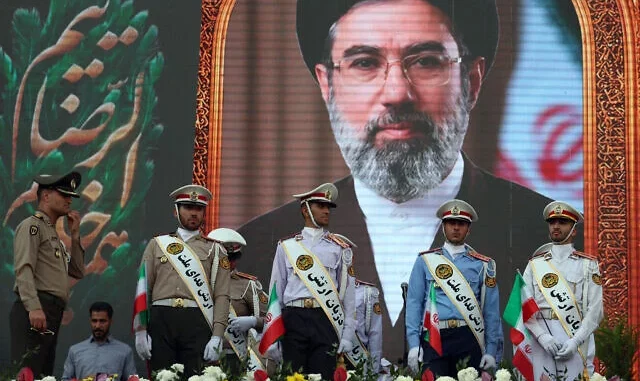
Iranian army soldiers stand in front of a picture of Iran’s Supreme Leader Ayatollah Mojtaba Khamenei during a pro-regime rally in Tehran, Iran, on April 29, 2026. (AFP)
Published May 11, 2026
WASHINGTON – New reports indicate Iran’s Supreme Leader has met directly with senior military officials to issue updated strategic “guiding measures,” signaling continued centralized control over the country’s military operations amid ongoing regional tensions.
According to Iranian state-linked media and international reporting, the briefing involved top commanders and focused on operational direction, readiness, and ongoing military planning.
1. Direct Involvement at the Highest Level
The key takeaway from the reports is the level of direct involvement from Iran’s top leadership in military affairs.
Rather than delegating decisions entirely to field commanders, the Supreme Leader reportedly issued “guiding measures” to the armed forces, reinforcing centralized command over strategic direction.
In simple terms, this suggests that major military decisions are still being shaped at the highest level of authority.
2. Focus on Continued Military Operations
The briefing reportedly included instructions tied to ongoing military activity and strategic planning.
While official language is carefully worded, the direction given to commanders emphasizes:
- Maintaining operational readiness
- Continuing established military objectives
- Adjusting strategy based on current conditions
Analysts note that this type of messaging typically signals continuity rather than de-escalation.
3. Military Readiness Under Review
Senior commanders also reportedly updated leadership on the current status of Iran’s armed forces.
That includes assessments of:
- Operational readiness
- Coordination across military units
- Response capabilities under current conditions
In practical terms, this suggests a system actively evaluating its ability to sustain or expand operations if needed.
4. Regional Implications of Centralized Command
A centralized briefing of this nature sends a clear signal across the region.
It indicates:
- Military authority remains tightly controlled
- Strategic decisions are being coordinated at the top level
- Iran’s leadership is actively engaged in operational oversight
For neighboring countries and global observers, this level of involvement often influences how they assess risk and prepare their own responses.
5. Messaging as a Strategic Tool
Beyond the military content itself, the wording of the reports plays a role in shaping perception.
Terms like “guiding measures” and “strategic direction” are often used to communicate:
- Stability within command structure
- Continuity of policy
- Control over military operations
In simple terms, the message is meant not only for internal coordination but also for external signaling.
🔍 Critical View: Iran’s Military Briefings and What They Signal in Plain Terms
When you strip away the official language, the key issue here is straightforward: Iran’s top leadership is staying directly involved in military decisions, and that matters because it shows how tightly controlled and strategically focused the system remains during regional tension.
From this point of view, the most important takeaway is not just what was said in the briefing, but what it represents.
1. Centralized Control Still Drives Decisions
One of the clearest points is that military strategy is still being directed from the very top.
That means:
- Major decisions are not left only to field commanders
- Strategy is shaped at the highest level of leadership
- Coordination is tightly controlled rather than loosely distributed
In simple terms, this is a system where one center of power sets the direction, especially during conflict or pressure.
Supporters of this structure argue it creates consistency and discipline in decision-making, especially when situations are unstable.
2. Military Readiness Is Always the Priority
Another key focus is readiness.
The reports highlight ongoing attention to:
- Operational strength
- Unit coordination
- Ability to respond quickly
From this perspective, the message is clear: maintaining military readiness is not occasional—it is continuous.
That reflects a mindset where security and defense are treated as permanent priorities, not temporary concerns.
3. Messaging Is Also Strategy
Even the wording used in these briefings matters.
Phrases like:
- “guiding measures”
- “strategic direction”
- “confronting adversaries”
are not just descriptions—they are signals.
They communicate:
- Confidence in control
- Continuity of policy
- Willingness to maintain pressure if needed
In simple terms, the messaging is meant to show strength and stability, not uncertainty.
4. Why Leadership Involvement Matters
When top leadership is directly involved in military coordination, it sends a strong message internally and externally.
Internally:
- It reinforces unity in command
- It reduces confusion in decision-making
- It keeps the system aligned under one direction
Externally:
- It signals that decisions are not fragmented
- It shows the country is actively managing military posture
- It makes outside governments adjust their expectations carefully
In plain language: it reduces guesswork for allies and opponents.
5. Stability Through Control vs. Flexibility
This approach has one clear advantage and one clear trade-off.
Advantage:
- Strong control can mean faster, more unified decisions during crisis situations
Trade-off:
- Less flexibility at lower levels of command
- Heavier reliance on central approval for major moves
Supporters argue that in high-pressure environments, control is more important than speed at lower levels.
👥 On the Ground: Iran Military Briefings and What It Means in Real Terms
When you take away the official language and look at it in simple, real-world terms, this situation is about one thing: how tightly a country is controlling its military decisions during a tense period, and what that signals to everyone watching.
Here’s what it looks like on the ground.
1. Decisions Come From the Top, Not the Bottom
The key point is that major military direction is still being handled at the highest level.
That means:
- Senior leadership sets the direction
- Military commanders carry out instructions
- Big strategic choices are not made independently in the field
In simple terms: the system runs from the top down, especially when things are sensitive or unstable.
On the ground, that usually means fewer surprises—but also less flexibility for lower-level commanders.
2. Military Focus Stays Constant, Not Occasional
Another clear takeaway is that military readiness is not treated as a temporary issue.
Instead, it is:
- Regularly reviewed
- Constantly adjusted
- Kept as a top priority
This creates a system where the armed forces are always in “active planning mode,” even if nothing dramatic is happening at the moment.
In plain language: the military is always being kept ready, not just switched on during crises.
3. Clear Messaging Is Part of the Strategy
The way things are described—terms like “guiding measures” or “strategic direction”—is also important.
On the ground, this kind of language usually serves two purposes:
- Inside the system: it keeps everyone aligned and following the same plan
- Outside the system: it sends a message of control and stability
So even the wording is part of how leadership manages perception.
4. Why Central Control Matters in Practice
When leadership is directly involved in military direction, it changes how the system behaves:
- Orders are more unified
- Decisions are less fragmented
- The chain of command is clearer at the top
For everyday operations, that can reduce confusion because everyone knows the direction is coming from one central authority.
But it also means a lot depends on that top level making the right calls quickly.
5. How Other Countries Read This Situation
On the ground, outside countries are not just looking at the military briefing itself—they are watching what it means.
They usually ask:
- Is command stable or changing?
- Is decision-making active or uncertain?
- Is the military posture defensive or preparing for more action?
Even small signals from leadership can influence how other nations position themselves, especially in a tense region.
6. Stability vs. Pressure: The Real Balance
From a practical standpoint, there is always a balance:
- Strong control can mean stable direction during pressure
- But it can also mean slower adjustment if conditions change quickly
Supporters of this approach see centralized control as a way to avoid confusion and keep order during uncertain times.
🎯 The Final Word:
In simple terms, the key takeaway is that strong, centralized leadership and clear control over the military are seen as essential for keeping a country stable, especially during tense or uncertain times. From this point of view, having top leaders directly involved helps avoid confusion, keeps decisions consistent, and sends a clear signal both inside and outside the country that the system is functioning in an organized way.
The main idea is that in high-pressure situations, fragmented decision-making can create mistakes or mixed signals, while a single clear chain of command reduces uncertainty. When everyone follows one direction, it becomes easier to coordinate actions quickly and maintain order, especially in situations where timing and discipline matter.
This perspective also emphasizes that stability is not just about reacting to events, but about preventing disorder before it starts. Strong leadership involvement is seen as a way to ensure that military and political actions stay aligned, even when conditions are unpredictable or fast-moving.
At the same time, this approach acknowledges that central control places a lot of responsibility on a small group of leaders. That means decisions at the top carry more weight, and the overall system depends heavily on their judgment. But supporters of this structure argue that in serious or high-risk environments, this level of control is necessary to avoid confusion and maintain steady direction.
In the end, the argument is straightforward: when a country is facing pressure, clear leadership, unified command, and strong coordination are viewed as the best way to maintain stability and prevent uncertainty from spreading within the system.