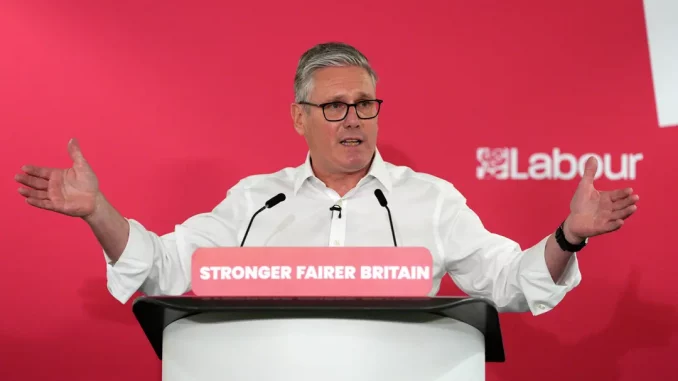
U.K. Prime Minister Keir Starmer gives a speech at Coin Street Community Centre in London, England, on May 11, 2026.Carl Court—Getty Images
Published May 11, 2026
LONDON – Pressure is mounting inside the UK’s ruling Labour Party as Prime Minister Keir Starmer faces an intensifying backlash following heavy election losses, with reports of internal moves to force a leadership change and growing questions over his political survival.
According to multiple reports, more than 60 Labour MPs are now calling for Starmer to set out a timetable for his departure, marking one of the most serious internal challenges since he took office.
1. Internal Revolt Builds Inside Labour
The political pressure is no longer coming only from opposition parties. It is now firmly inside Labour itself.
Senior MPs and party insiders are openly questioning Starmer’s leadership after what they describe as disappointing election results, including significant losses in local councils and weakening support in traditional Labour strongholds.
Reports indicate that some lawmakers are pushing for an “orderly transition” of leadership, arguing that the party needs a reset before the next general election cycle.
2. Election Losses Trigger Leadership Questions
The unrest follows a difficult set of election results that saw Labour lose hundreds of council seats and fall behind rival parties in several regions.
Analysts say the results have intensified concerns within the party about voter confidence and strategic direction, particularly as emerging political movements gain ground in key constituencies.
In simple terms: the election results didn’t just hurt Labour politically—they triggered a deeper debate about whether the current leadership can recover public support.
am.
3. Starmer Pushes Back Against Resignation Calls
Despite the growing pressure, Starmer has publicly rejected calls to step down, insisting he will remain in office and continue leading the government.
He has argued that changing leadership now would create instability and distract from policy priorities, while urging party unity in the face of internal division and external political competition.
However, critics inside his own party say the response has not been enough to calm tensions, with some describing the leadership approach as “too little, too late.”
4. Leadership Challenge Mechanisms Under Scrutiny
Unlike other political systems with clear removal processes, Labour’s internal rules make it difficult—but not impossible—for a sitting leader to be replaced mid-term.
Reports suggest that if enough MPs formally support a challenge, it could trigger a leadership contest, though the threshold for action remains politically complex and uncertain.
This has led to speculation that any change in leadership would require either a coordinated internal push or voluntary resignation from Starmer himself.
5. Rising Pressure from All Sides
The leadership debate is now being fueled by multiple factors:
- Poor election performance
- Internal party divisions
- Growing dissatisfaction among MPs
- Pressure from rising opposition parties gaining voter support
At the same time, Starmer still has backing from senior figures who warn that a leadership change could destabilize the government and hand momentum to political rivals.
6. A Party at a Crossroads
The situation now places Labour in a difficult position: maintain stability under its current leadership or risk a leadership contest that could reshape the party mid-term.
Supporters of Starmer argue continuity is essential for governance. Critics argue that without change, the party risks further electoral setbacks.
🔍 Critical View: Starmer Leadership Crisis and What It Says About Party Stability
From this perspective, the growing pressure on Keir Starmer inside his own party is not just normal political disagreement—it is a sign of deeper problems with leadership, direction, and public trust after recent election losses.
At the core of the issue is a simple idea: when a party loses elections and confidence starts to drop, strong leadership is expected to either correct course quickly or make way for someone who can.
1. Election Results Are Driving the Pressure
The recent election setbacks are the main trigger for the unrest inside Labour.
From this point of view:
- Losing seats and support weakens authority
- Poor results raise doubts about strategy
- Voters start questioning whether promises match performance
In simple terms: when results are bad, leadership naturally comes under scrutiny.
Supporters of change argue that continuing with the same leadership after major losses risks repeating the same mistakes.
2. Internal Division Shows Lack of Unified Direction
Another concern is the growing split inside the party itself.
Reports of MPs pushing for a leadership change suggest:
- Lack of agreement on strategy
- Frustration with current direction
- Competing ideas on how to regain voter trust
From this perspective, a divided party struggles to present a clear message to the public, which can weaken support even further.
In simple terms: voters find it hard to trust a team that looks internally divided.
3. Leadership Accountability Is the Key Issue
A central argument here is accountability.
When a leader takes a party into an election and the results are weak, critics believe there are only two responsible options:
- Fix the strategy quickly and show improvement
- Or step aside to allow new leadership to reset direction
The concern raised is that staying in place without clear recovery could deepen political damage over time.
4. Stability vs. Change Debate
Inside Labour, there are two competing views:
Stability argument:
- Changing leadership now could create chaos
- Continuity is needed to govern effectively
- Public may view internal conflict negatively
Change argument:
- Current leadership has already been tested at the ballot box
- Public support has weakened
- A reset is needed to rebuild credibility
From this viewpoint, the question is whether stability is actually helping or simply delaying necessary change.
5. Public Trust Is the Real Issue
Beyond party politics, the bigger concern is voter confidence.
When election results are weak:
- Trust in leadership declines
- Policy messaging becomes less effective
- Opposition gains momentum
In simple terms: without public trust, even strong policy ideas struggle to gain support.
👥 On the Ground: Labour Leadership Crisis and What It Looks Like in Real Life
When you strip away the political language, the situation inside Labour right now is basically about one thing: a party trying to recover from election losses while struggling to agree on who should lead and how to move forward.
Here’s what it looks like on the ground in simple terms.
1. Election Losses Change Everything Fast
After a bad election result, things inside a political party change quickly.
On the ground, that means:
- MPs start questioning leadership decisions
- Local support networks feel less confident
- Party strategy suddenly becomes a topic of conflict instead of unity
In simple terms: when voters reject a party at the polls, internal pressure builds immediately.
2. MPs Start Thinking About Survival, Not Loyalty
When election results are weak, MPs begin to worry about their own seats next time.
That leads to:
- More criticism of leadership
- Less patience for long-term explanations
- Increased calls for change or reset
On the ground, this is less about ideology and more about political survival. MPs start asking: “Can we win again like this?”
3. Leadership Becomes the Main Target
In situations like this, the party leader becomes the focus of frustration.
That usually happens because:
- The leader represents overall strategy
- The leader is responsible for election performance
- Changing leadership feels like the fastest way to reset momentum
So even if problems are broader than one person, the pressure tends to land on the top job.
4. Party Division Becomes Visible
On the ground, division doesn’t stay hidden.
It shows up as:
- Mixed messaging from different MPs
- Public disagreements or briefings through media
- Competing ideas about the party’s future direction
When that happens, the public sees a party that is not fully aligned—and that can weaken confidence further.
5. Public Reaction: Confusion and Fatigue
For ordinary voters, this kind of political fight often feels repetitive.
What they see is:
- Internal arguments instead of solutions
- Focus on leadership instead of everyday issues
- Uncertainty about what the party actually stands for right now
In simple terms: people tune out when politics looks like internal conflict rather than problem-solving.
6. The Pressure Loop Inside the Party
On the ground, this creates a cycle:
- Bad election results create pressure
- Pressure leads to leadership challenges
- Leadership conflict creates more uncertainty
- Uncertainty affects public confidence
It becomes a loop that is hard to break without a clear reset or clear improvement in direction.
🎯 The Final Word:
In simple terms, the key takeaway is that election results matter, and when a party performs poorly, leadership naturally comes under pressure to take responsibility and show a clear path forward. From this point of view, stability is important, but it cannot come at the cost of ignoring voter feedback or internal loss of confidence. Supporters of change argue that strong leadership means being accountable when results are weak and being willing to reset direction if needed, rather than letting uncertainty drag on. Critics may worry about disruption, but the underlying idea is straightforward: a political party needs clear leadership, unity, and a message that reconnects with voters, or it risks losing support over time.