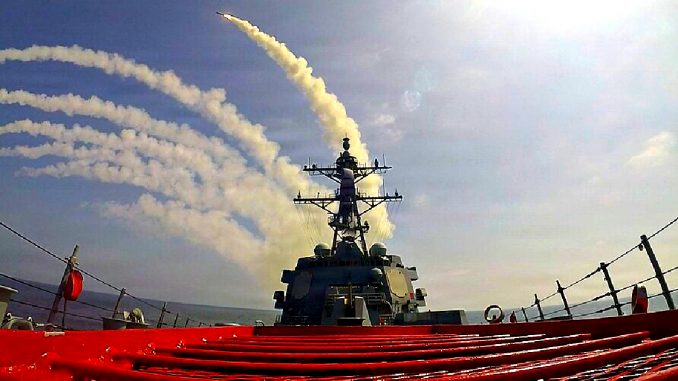
Arleigh Burke-class guided-missile destroyer USS Frank E. Petersen Jr. (DDG 121) fires Tomahawk Land Attack Missiles during operations in support of Operation Epic Fury – U.S. Navy Photo/Wiki Commons
Published May 11, 2026
BERLIN/WASHINGTON – Germany is renewing efforts to purchase American-made Tomahawk cruise missiles, a move that underscores rising security concerns in Europe and growing friction within NATO over defense priorities, according to multiple reports.
The renewed push, first reported by the Financial Times and confirmed by Reuters, involves Berlin seeking to acquire the long-range Tomahawk missile system along with its Typhon ground-based launchers from the United States.
German officials are reportedly attempting to convince the Trump administration to approve the deal, which would significantly enhance Berlin’s long-range strike capability. The proposal was originally submitted in 2025 but has not yet received a formal response from Washington.
Pistorius Expected to Push Deal in Washington
German Defense Minister Boris Pistorius is expected to travel to Washington in an effort to revive discussions, contingent on securing high-level talks with U.S. Defense Secretary Pete Hegseth, according to the reports.
The visit comes amid what analysts describe as increasingly strained relations between the United States and key European allies, particularly following disagreements over military deployments and broader geopolitical tensions.
NATO Tensions and Strategic Gaps
The push for Tomahawk missiles highlights what European defense planners see as a growing capability gap in long-range precision strike systems—an area long dominated by U.S. military power.
The Tomahawk, a long-range cruise missile designed for deep-strike missions, has become a critical component of U.S. naval and strategic operations, with production recently expanded under a seven-year contract with defense contractor Raytheon.
The renewed German interest follows concerns that NATO’s European members lack sufficient independent deterrence capability against potential threats, particularly from Russia.
Broader Geopolitical Context
The development also comes amid heightened tensions within NATO, including disagreements over U.S. troop deployments in Europe and broader strategic coordination. Some European leaders have expressed concern over perceived unpredictability in U.S. defense commitments.
At the same time, Washington has not publicly indicated whether it will approve the sale, and defense officials on both sides of the Atlantic have declined to comment.
Strategic Implications
If approved, the deal would mark one of Germany’s most significant upgrades to its long-range strike capabilities in decades, potentially reshaping the balance of power within NATO’s European defense structure.
However, experts caution that approval is uncertain given competing U.S. priorities, strained diplomatic relations, and existing demand for Tomahawk systems from other allies.
🔍 Critical View: Germany’s Missile Push and What It Really Signals
Germany’s renewed push to acquire U.S.-made Tomahawk cruise missiles is being described as a routine defense upgrade. But when you look closer, it highlights several long-running issues in European security planning, spending priorities, and reliance on the United States.
Below is a deeper breakdown of what this move really means in simple terms.
1. Heavy Dependence on the United States
At the center of this issue is one simple reality: Europe still depends heavily on the United States for its most advanced military capabilities.
The Tomahawk missile system is not a basic weapon. It is a long-range precision strike tool used for strategic military targets. Germany does not currently produce anything equivalent at scale.
So instead of developing a fully independent system, Germany is once again looking to the U.S. for:
- Technology
- Equipment
- Approval for purchase
In practical terms, this means Europe cannot fully control its most powerful military options without U.S. involvement. That raises a basic question: how independent is “independent defense” if key tools still come from abroad?
2. Strategic Autonomy: More Talk Than Reality
European leaders have often used the phrase “strategic autonomy,” meaning Europe should be able to defend itself without relying on outside powers.
But this missile deal shows a gap between that idea and reality.
To put it simply:
- Europe wants independence
- But still needs American systems to achieve it
Germany seeking Tomahawks instead of building a comparable system at home suggests that true independence is still far off. It is easier and faster to buy than to develop, but that choice comes with long-term dependence.
3. Cost vs. Practical Needs
Another concern is cost and priorities.
Tomahawk missiles and their launch platforms are extremely expensive, both to buy and maintain. These are not “everyday defense tools”—they are high-end strategic weapons.
Critics question whether this kind of spending matches Europe’s current situation, where governments are also dealing with:
- Rising cost of living pressures
- Energy security challenges
- Social welfare and domestic budget strain
- Industrial and infrastructure demands
In simple terms, the debate is whether money is being focused on the most urgent needs or on high-end military prestige systems.
4. NATO’s Internal Capability Gap
This move also reflects an imbalance inside NATO.
The United States remains the dominant provider of long-range strike capability, intelligence systems, and advanced missile technology. Many European countries, including Germany, rely on that American backbone.
Germany’s interest in Tomahawks highlights a key issue:
Europe is not operating at the same military level across all members.
Some countries have modern forces, but Europe as a whole still lacks unified, high-end strike capability. That creates dependence on the U.S. not just politically, but operationally in real-world conflict scenarios.
5. Political Dependence and Approval Risk
Even if Germany is willing to spend the money, the deal still requires U.S. approval.
That means:
- Germany cannot simply decide to acquire these weapons independently
- Washington has final say on whether the sale happens
- Political relations can directly affect military capability plans
This creates a long-term planning issue. Defense strategies are supposed to be stable and predictable, but dependence on foreign approval introduces uncertainty.
If relations shift, access to key systems can also shift.
6. Industrial Strategy: Buy vs. Build
A deeper long-term issue is industrial development.
By repeatedly purchasing advanced systems from the United States, European defense industries risk falling behind in certain high-end technologies.
The trade-off looks like this:
Buying from the U.S.:
- Faster access
- Proven systems
- Lower short-term development cost
Building locally:
- Takes years or decades
- Very expensive upfront
- But increases long-term independence
Germany’s decision reflects the short-term path—but that path may slow down Europe’s ability to compete in advanced defense technology over time.
7. Geopolitical Signaling
Finally, this move also sends a signal beyond just defense needs.
It shows that Europe is preparing for a more uncertain global environment and wants stronger deterrence capability. However, it also signals continued alignment with the United States as the central pillar of Western military power.
In other words, even as Europe talks about independence, it is still reinforcing the same transatlantic structure.
👥 On the Ground: Germany’s Missile Push — What It Really Means in Everyday Terms
Germany’s renewed interest in buying U.S. Tomahawk cruise missiles can sound like distant geopolitics, but on the ground it translates into very practical issues: money, control, security confidence, and long-term dependence.
Below is a clearer, expanded breakdown of what this looks like outside of government meetings and defense briefings.
1. Better Military Capability — But Not Full Control
From a military perspective, Tomahawk missiles give Germany something it does not fully have today: long-range precision strike power.
In simple terms, this means the ability to hit targets far away with high accuracy.
But the important detail is not just the weapon itself—it is who controls the system behind it.
Even if Germany buys and operates it:
- The system is built and designed in the United States
- Software updates and technical support are tied to U.S. systems
- Some operational approvals and integration rules still depend on Washington
So on the ground, German forces may use the capability—but they do not fully own the independence of it.
That creates a practical limit: powerful tools, but not fully self-contained control.
2. Big Spending That Competes With Domestic Needs
For ordinary taxpayers, the biggest impact is not strategic—it is financial.
These systems are extremely expensive. And defense budgets are not unlimited.
That leads to a basic trade-off:
- Money spent on advanced missiles
- Versus money spent on domestic priorities like:
- roads and infrastructure
- policing and internal security
- energy costs and subsidies
- healthcare and social programs
From a ground-level perspective, people often ask a simple question:
If security at home feels stable, why is so much money going into long-range strike weapons abroad?
This is where public support often becomes divided—not because people oppose defense, but because they question balance.
3. Dependence on the U.S. Still Shapes European Defense
One of the most important realities is that Europe’s defense structure still leans heavily on the United States.
That shows up in three ways:
- Technology dependence – key systems are American-made
- Approval dependence – major sales require U.S. permission
- Supply dependence – parts and upgrades are controlled externally
So even though Germany is one of Europe’s strongest economies, its most advanced military capability still relies on outside systems.
On the ground, that creates a simple reality: Europe is strong, but not fully self-sufficient.
4. Public Perception: “Does This Affect My Life?”
For most people, defense decisions only matter if they connect to daily life.
But missile deals rarely do.
So what the public often sees is:
- Government announcements about billion-euro weapons deals
- Little visible change in daily safety or services
- Long timelines before any real operational impact
This creates a gap between political messaging and public understanding.
To many citizens, the reaction is straightforward:
“This is important, but how does it help me right now?”
5. Strategic Risk: Reliance in a Crisis
Another on-the-ground concern is what happens during a real emergency or conflict.
If key systems depend on another country:
- Access to spare parts could be delayed
- Software updates could be restricted
- Operational approval could be politically influenced
This does not mean systems would be shut off—but it does mean decisions are not fully in local hands.
For planners, that is a vulnerability. For the public, it translates into uncertainty about how independent national defense really is under pressure.
6. Europe’s Practical Choice: Fast Security vs. Long-Term Independence
Germany’s decision reflects a common government trade-off:
Option A: Buy from the U.S.
- Fast deployment
- Proven systems
- Immediate capability boost
- But continued dependence
Option B: Build domestically
- Takes years or decades
- Very expensive upfront
- Slower results
- But greater independence later
On the ground, governments often choose speed and reliability—especially when security concerns are rising. But that choice reinforces long-term reliance.
7. What This Feels Like for Ordinary People
If you strip away strategy and politics, the public impact comes down to a few simple feelings:
- Security is being strengthened in theory
- But daily life does not visibly change
- Large sums are being spent on systems controlled abroad
- And Europe is still not fully self-reliant in defense
That combination often leads to a quiet concern: not about whether defense matters, but about whether the system is becoming more independent or just more expensive while still dependent.