Manuel Elias/United Nations via AP
Published March 11, 2025
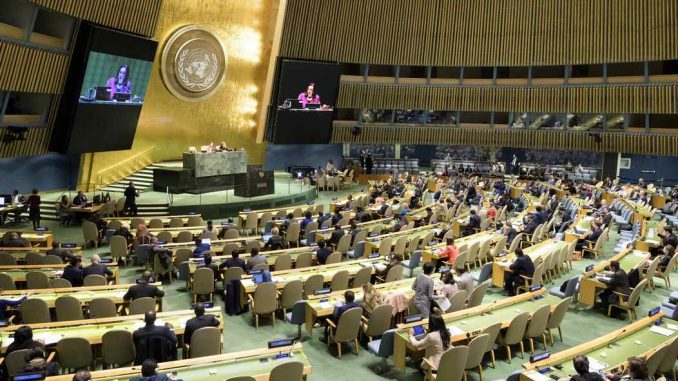
In a striking moment at the United Nations, the United States reportedly cast the only vote opposing a document tied to gender policy because it failed to clearly define a simple word: woman. The incident highlights a growing clash between traditional definitions rooted in biology and the increasingly dominant ideology of gender identity in international institutions.
A Debate Over a Basic Definition
At the heart of the controversy is language used in a UN resolution addressing gender-related issues. Critics argue that the document relies heavily on modern diversity, equity, and inclusion (DEI) frameworks while deliberately avoiding a clear definition of “woman.”
For many observers, this omission is not accidental. By avoiding a biological definition, international bureaucracies can interpret gender as a fluid identity rather than a sex-based category. That shift has sweeping implications for law, policy, sports, healthcare, and women’s protections.
The United States delegation reportedly objected to this ambiguity, arguing that policies affecting women should be grounded in clear, biological reality rather than ideological language.
DEI’s Expanding Influence in Global Institutions
The debate illustrates how DEI concepts—once largely confined to universities and corporate HR departments—have become deeply embedded within international organizations.
Across UN agencies, language increasingly centers on terms such as “gender identity,” “gender expression,” and “intersectionality.” Critics argue that these frameworks often override longstanding definitions based on biological sex.
Supporters claim the language promotes inclusivity and protects marginalized groups. However, opponents contend that such policies blur critical distinctions and undermine protections originally designed for women.
Why the Definition Matters
The refusal to define “woman” has practical consequences beyond semantics.
Women’s rights advocates who favor sex-based definitions argue that vague language can affect:
-
Women’s sports, where biological differences impact fairness
-
Women’s shelters and prisons, where safety concerns arise
-
Healthcare research, which depends on biological sex differences
-
Legal protections, originally created to safeguard women as a sex-based class
Without a clear definition, policies may become open to reinterpretation in ways many governments never intended.
America’s Lone Vote
The U.S. vote against the document stands out precisely because it was alone. Historically, Western nations often vote together at the UN. In this case, however, the United States reportedly broke ranks, signaling a growing divide among democracies over gender ideology.
Supporters of the vote see it as a defense of biological truth and women’s rights. Critics see it as resistance to evolving global norms around gender identity.
Either way, the moment underscores a larger ideological struggle playing out across international institutions.
The Bigger Picture
The dispute reflects a broader tension between traditional understandings of sex and rapidly evolving ideological frameworks in global governance.
For decades, international agreements on women’s rights were built on the assumption that “women” referred to biological females. As gender ideology gains traction, that assumption is increasingly challenged.
Whether the UN ultimately clarifies its language—or continues to avoid defining key terms—will likely shape future debates about women’s rights, legal protections, and the reach of DEI ideology worldwide.
 Implications
The decision by the United States to stand alone against a document at the United Nations that does not clearly define the term “woman” carries several broader implications for international policy, cultural debates, and the future of women’s rights.
1. Growing Conflict Over Biological Reality
One of the most immediate implications is the widening divide between governments that insist on biological definitions and institutions increasingly adopting ideological language about gender.
If international bodies continue to avoid defining “woman” as a biological category, policies may gradually shift away from sex-based protections that have historically formed the basis of women’s rights law.
This creates a risk that basic legal categories could become fluid or politically negotiable rather than grounded in biological fact.
2. Erosion of Women’s Sex-Based Protections
Ambiguous terminology may weaken protections originally designed specifically for women.
Areas potentially affected include:
-
Women’s athletics
-
Female-only shelters and safe spaces
-
Sex-specific medical research
-
Legal protections against discrimination
If the category of “woman” is redefined or left undefined, policies meant to protect biological females could be diluted or reinterpreted.
3. Increasing Politicization of International Institutions
The vote also highlights concerns that global organizations are becoming more ideological in their policymaking.
Critics argue that when international bodies adopt activist language without clear definitions, they move away from neutral governance and toward promoting specific social theories. This risks undermining confidence in institutions that were originally intended to facilitate cooperation among nations with diverse cultural values.
4. Rising Sovereignty Tensions
Another implication is the potential for stronger resistance from national governments.
Countries may increasingly challenge international policies that attempt to reshape domestic laws, especially when those policies conflict with cultural traditions, scientific definitions, or constitutional principles.
The United States’ lone vote signals that some governments may push back against what they view as ideological overreach within global institutions.
5. Cultural Debate Moving Into Global Governance
The dispute shows that debates once confined to universities, social media, and domestic politics are now shaping international agreements.
Questions about identity, language, and biology are no longer just cultural debates—they are influencing global policy frameworks that affect law, education, and civil rights across multiple countries.
6. Precedent for Future International Documents
Perhaps the most important implication is precedent. If international organizations can pass major documents without clearly defining fundamental terms like “woman,” similar language may appear in future agreements.
Over time, that language could influence treaties, development programs, and international funding priorities.
Overall Significance
The lone vote by the United States signals a deeper struggle over whether international policy should be grounded in longstanding biological definitions or evolving ideological frameworks.
As global institutions continue to shape policy language, the outcome of this debate may have lasting consequences for women’s rights, national sovereignty, and the credibility of international governance.
 Overall Takeaway:
SOURCES: REDSTATE – DEI is Alive and Well at the UN As US Is Only Nation to Vote Against Doc That Can’t Define ‘Woman’