AP Photo/Vahid Salemi
Published May 12, 2026
🧭 Headline Brief
Kuwait has accused Iran of launching a failed covert attack on a strategic island hosting a China-backed port development, marking a sharp escalation in Gulf tensions already strained by ongoing regional conflict dynamics and recent military incidents across the Persian Gulf.
According to Kuwaiti officials, the alleged operation targeted an island tied to a major infrastructure project involving Chinese investment, suggesting the strike may have carried broader geopolitical implications beyond Kuwait–Iran relations. The incident reportedly involved infiltration attempts that were intercepted by Kuwaiti security forces, preventing what authorities describe as a potential sabotage operation.
Iran has not officially confirmed the attack and has previously denied similar allegations, while Tehran’s broader posture in the region has remained highly confrontational amid the wider 2026 Gulf conflict environment.
Escalation Context
The accusation comes at a time of heightened instability in the Gulf, with multiple recent reports of:
- Maritime and drone-related incidents involving Iranian-linked operations in Kuwait and surrounding waters
- Increased targeting of infrastructure tied to U.S. and allied logistics networks
- Intensifying competition over strategic maritime routes, especially near the Strait of Hormuz
Recent reporting also highlights a pattern of cross-border covert actions, retaliatory strikes, and infiltration attempts, contributing to fears that the conflict could widen further across Gulf states.
Strategic Stakes
The reported target—an island hosting a China-supported port project—adds a significant geopolitical layer. China’s involvement in Gulf infrastructure has increasingly intersected with regional security tensions, making such sites potential flashpoints for broader power competition involving Iran, Gulf states, and external powers.
🧩 Context Signal
The allegations from Kuwait come amid a broader and increasingly complex pattern of tensions across the Gulf region, where state-on-state confrontation is increasingly blending with covert operations, maritime disruption, and infrastructure targeting.
At the center of this episode is Kuwait’s claim that Iranian-linked operatives attempted to strike or infiltrate a strategically important island tied to a China-backed port development project. While details remain under review and have not been independently verified, the accusation fits into a wider regional backdrop in which Gulf states have repeatedly expressed concern over Iranian activity near key shipping lanes and energy infrastructure.
Relations between Iran and Gulf Cooperation Council states have remained strained for years, marked by cycles of diplomatic engagement followed by escalation involving proxy groups, naval incidents, and cyber or sabotage allegations. Meanwhile, Kuwait has generally maintained a more cautious diplomatic posture compared to some of its neighbors, making the seriousness of these allegations particularly notable.
The reported connection to a Chinese-linked port project adds an additional layer of geopolitical sensitivity. China has expanded its infrastructure and investment footprint across the Gulf under broader trade and logistics initiatives, meaning strategic installations increasingly sit at the intersection of regional rivalries and global economic interests.
Taken together, the incident—whether fully confirmed or still under investigation—reflects a region where infrastructure, maritime routes, and foreign investment sites are becoming central points of strategic pressure, raising the risk that isolated incidents could carry wider diplomatic and security consequences.
🌍 Field Reality
On the ground, situations like this are rarely as clear-cut as early headlines suggest. What is known publicly is still limited, and much of the narrative is being shaped through official statements, wire reports, and rapidly circulating media claims, which often reflect competing interests in a high-tension region.
Kuwaiti authorities are presenting the incident as a foiled infiltration or attack tied to Iranian operatives, but so far there is no independently verified evidence released publicly that confirms the full operational details—such as scale, intent, or exact capability involved. In cases like this, early descriptions often change as investigations progress, evidence is reviewed, and diplomatic pressure builds.
From a regional standpoint, incidents involving Iran are frequently disputed in the immediate aftermath, with Tehran typically denying direct involvement in operations that Gulf states attribute to it. This pattern has repeated across maritime incidents, sabotage accusations, and proxy-linked activities in recent years.
For Kuwait, the political sensitivity is high because any confirmed security breach tied to a foreign state would represent a significant escalation. However, Kuwait also has incentives to frame incidents cautiously to avoid immediate military escalation while still signaling deterrence and internal control.
The added detail involving a China-linked port project introduces another layer of uncertainty. Infrastructure tied to China abroad has, in multiple regions, become part of broader geopolitical competition narratives—sometimes amplifying how incidents are interpreted even before full facts are established.
In practical terms, what “field reality” usually looks like in these moments is:
- Partial intelligence fragments being released selectively
- Early accusations outpacing verified forensic confirmation
- High diplomatic signaling layered on top of ongoing investigations
- And significant gaps between official claims and independently confirmed operational facts
Until more evidence is made public, this incident should be viewed as an evolving security allegation inside a highly contested information environment, rather than a fully established account of a confirmed state-level attack.
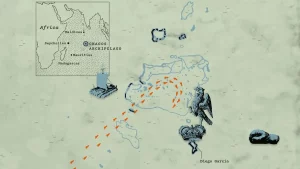
Kuwait accused Iran on Tuesday of sending an armed paramilitary Revolutionary Guard team to launch a failed attack earlier this month on an island in the Middle East nation home to a China-funded port project.
🔍 Global Lens
📌 Closing Signal
What is emerging from this incident is less about a single confirmed event and more about a pattern of escalating mistrust and repeated security alarms in the Gulf. Whether the Kuwaiti allegations are fully substantiated or still being verified, the situation highlights how quickly regional incidents now move from localized security concerns into wider geopolitical flashpoints.
At the center remains the tension between Iran and Gulf states, where suspicion, deterrence signaling, and past proxy conflicts continue to shape how new incidents are interpreted. Even limited or unconfirmed events tend to be viewed through the lens of prior escalations, which increases the risk of rapid diplomatic or military signaling before full facts are established.
For Kuwait, the immediate priority is likely containment—both operational and diplomatic—ensuring that any confirmed security breach is addressed without triggering broader escalation in an already sensitive regional environment. Public messaging in such cases often serves a dual role: reassuring domestic audiences while signaling deterrence externally.
The involvement of a China-linked infrastructure site also underscores how China has become indirectly entangled in regional security dynamics through its global investment footprint. Even when not a direct party to conflicts, its projects can sit inside contested strategic geography, making them part of the broader risk landscape.
Ultimately, the key takeaway is that the Gulf is operating in a high-alert, low-transparency security environment, where incidents—verified or not—can rapidly influence diplomatic posture, military readiness, and international perception. Until independently confirmed details emerge, this episode remains part of an ongoing pattern: a region where uncertainty itself is a driving force of escalation risk.