Life-size installation featuring an actor portraying President Donald Trump draws crowds as Tehran intensifies its propaganda campaign amid tensions with Washington.
by Diana Zapata • News Writer /Editorial Specialist
Published October 23, 2026
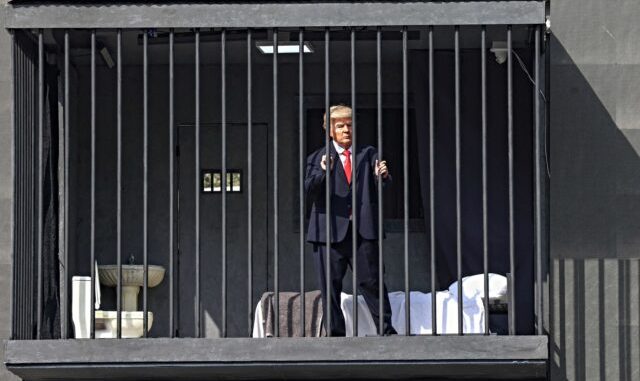
TEHRAN, Iran — Iranian authorities have erected a striking political display featuring a man dressed as U.S. President Donald Trump inside a mock prison cell suspended above a busy square in Tehran, turning the American leader into the centerpiece of a public propaganda campaign.
The installation, located in Tajrish Square in northern Tehran, features an actor wearing a Trump mask, a dark suit and the president’s signature red tie. The performer moves around the cell, grips its bars and sits on a bed as pedestrians and motorists stop to watch, take photographs and record videos.
Despite the dramatic imagery, Trump has not been imprisoned in Iran. The display is a staged political installation, not an actual arrest or detention of the U.S. president.
Tehran Turns Trump Into a Propaganda Target
The installation includes a bed and other furnishings designed to resemble a prison cell, while nearby electronic screens display messages accusing the United States of committing war crimes.
Iranian municipal authorities say the campaign is intended to remind the public of Tehran’s demands for justice over deaths and destruction associated with the conflict involving the United States and Israel.
Iran has accused Washington of responsibility for attacks on civilian sites, including a school and a wedding gathering. Those accusations form part of Tehran’s broader effort to portray Trump and the U.S. military campaign as criminal. The allegations should be distinguished from independently established legal findings.
The display has prompted mixed reactions among people passing through the square. Some have taken selfies and joked about the performer’s fictional imprisonment, while others have shouted insults and expressed hostility toward the American president.
A Symbolic Escalation in U.S.-Iran Hostility
The spectacle reflects the depth of hostility between Tehran and Washington amid the wider Middle East conflict.
Iran has long used public murals, billboards and other political imagery to criticize the United States and communicate its opposition to American military power. The Trump installation takes that approach further by using a live performer and a three-dimensional setting rather than relying solely on static images.
The campaign also demonstrates how political messaging can turn a foreign leader into a symbol of national anger. By depicting Trump behind bars, Iranian authorities are presenting their preferred image of accountability and punishment without any actual judicial proceedings against him being represented by the installation.
The display comes as Washington and Tehran remain sharply divided over the conflict, its consequences and the conditions under which diplomatic engagement might resume.
💬 Overall Takeaway:
Iran’s suspended prison display is more than a provocative image of Donald Trump behind bars. It is a political message designed to channel public anger, reinforce Tehran’s accusations against Washington and portray the United States as responsible for the suffering caused by the conflict.
But symbolic punishment is not the same as legal accountability. The installation provides evidence of Iran’s political messaging and its hostility toward Trump, not proof that a court has found the U.S. president guilty of war crimes.
Ultimately, the display underscores how deeply the conflict has moved beyond military confrontation into a battle over public opinion, national legitimacy and competing narratives of justice. Whether that messaging influences diplomatic outcomes remains uncertain, but it illustrates the growing difficulty of reducing tensions between the two governments.