

Published July 11, 2026
TEHRAN — Tensions between the United States and Iran escalated dramatically Saturday after Iran’s newly installed Supreme Leader, Ayatollah Mojtaba Khamenei, vowed to avenge the death of his father and predecessor, Ayatollah Ali Khamenei, prompting President Donald Trump to reiterate his warning that “1,000 missiles are locked and loaded” if Iran attempts to assassinate him.

In his first public statement since assuming Iran’s highest office, Mojtaba Khamenei issued a written message declaring that vengeance for his father’s death was “the will of our nation” and “must inevitably be carried out.” The statement came following memorial ceremonies for Ali Khamenei, who was killed in a joint U.S.-Israeli airstrike earlier this year during the Iran war.
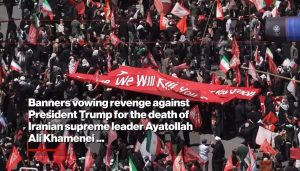
Unlike previous Iranian leaders who frequently addressed the nation in televised appearances, Mojtaba’s message was released only in text form. Reports indicate he has yet to make a public appearance since taking power, fueling continued speculation about his condition following injuries reportedly sustained during the strike that killed his father.
Trump Issues Stark Warning
The Iranian leader’s remarks came just hours after President Trump revealed that he had issued standing military instructions in the event Iran attempts to assassinate him.
Posting on Truth Social, Trump wrote that if Tehran carries out such an attack, “1,000 Missiles are Locked and Loaded”, with thousands more prepared to follow, warning that Iran’s military capabilities would be “completely decimated and destroyed.”
Trump’s warning follows years of reported threats against him stemming from the 2020 U.S. drone strike that killed Iranian General Qassem Soleimani, as well as the recent conflict that resulted in the death of Iran’s longtime supreme leader.
Trump Warns Iran: ‘1,000 Missiles’ Ready if Tehran Attempts Assassination
Rhetoric Raises Regional Tensions
The exchange of public threats comes despite ongoing efforts by regional mediators, including Qatar and Oman, to preserve a fragile ceasefire and restart negotiations between Washington and Tehran.
Analysts warn that increasingly aggressive rhetoric from both governments risks undermining diplomatic efforts at a time when tensions remain exceptionally high across the Middle East. Although U.S. and Iranian officials have signaled interest in continuing indirect talks, deep mistrust continues to dominate relations between the two countries.
Leadership Transition Under the Spotlight
Mojtaba Khamenei assumed leadership following the death of his father, who ruled Iran for nearly four decades. His first official message focused almost entirely on promises of retaliation rather than reconciliation, signaling that Iran’s new leadership may maintain a confrontational posture toward the United States and Israel.
Whether the new supreme leader ultimately pursues military retaliation, expands support for regional proxy groups, or returns to negotiations remains one of the biggest unanswered questions facing the region..
⚠️ Implications:
The exchange of threats between President Donald Trump and Iran’s new Supreme Leader, Ayatollah Mojtaba Khamenei, carries significant implications for U.S.-Iran relations, Middle East security, global diplomacy, and the risk of renewed military conflict. Here’s a breakdown of the key implications by category:
🚀 1. The Risk of Direct U.S.-Iran Conflict Increases
- Mojtaba Khamenei’s pledge of revenge and Trump’s warning that “1,000 missiles are locked and loaded” represent one of the most direct exchanges of threats between the two nations in recent years.
- Public declarations of retaliation reduce political room for compromise and increase pressure on both governments to stand by their statements.
- Any future attack—whether carried out directly by Iran or by an Iran-backed proxy—could rapidly escalate into a broader military confrontation.
🔍 Implication: The Middle East faces a heightened risk of miscalculation, where a single incident could trigger a large-scale conflict involving the United States and its regional allies.
🛡️ 2. Deterrence Becomes the Central Strategy
- Trump’s warning is intended to establish a clear deterrent by signaling that any assassination attempt would be met with overwhelming military force.
- The public nature of the statement leaves little ambiguity about how the United States says it would respond to such an attack.
- Iran, meanwhile, must weigh its rhetoric against the potential consequences of provoking direct U.S. military action.
⚠️ Implication: Strong deterrence may discourage direct aggression, but it also raises the stakes should either side misjudge the other’s intentions.
🌍 3. Diplomatic Efforts Face New Obstacles
- The exchange comes as mediators such as Qatar and Oman continue trying to preserve dialogue between Washington and Tehran.
- Calls for revenge from Iran’s new leadership may complicate efforts to restart negotiations over regional security and Iran’s nuclear program.
- Public threats from both sides deepen mistrust and make diplomatic compromise more politically difficult.
🧩 Implication: Regional mediators may face an increasingly difficult challenge keeping both governments engaged in diplomacy while preventing further escalation.
⚔️ 4. Iran’s Leadership Transition Signals Continuity
- Mojtaba Khamenei’s first major public message focused on retaliation rather than reconciliation, suggesting continuity in Iran’s confrontational posture toward the United States and Israel.
- The statement may reassure hardline supporters within Iran while signaling resolve to regional allies and proxy groups.
- Observers will closely watch whether Iran’s new leadership matches its rhetoric with concrete actions.
🛡️ Implication: The leadership transition may not result in a significant shift in Iran’s foreign policy, prolonging regional tensions and strategic competition.
💸 5. Global Markets Could React to Rising Tensions
- Escalating rhetoric between Washington and Tehran often affects global energy markets, particularly because of the strategic importance of the Strait of Hormuz.
- Investors and shipping companies remain sensitive to any developments that could disrupt oil exports or maritime trade.
- Even without military action, heightened geopolitical uncertainty can increase market volatility.
📉 Implication: Continued tensions could contribute to higher energy prices, increased shipping costs, and broader economic uncertainty if the security situation deteriorates.
🌐 6. Security Around U.S. Officials Is Likely to Increase
- The renewed exchange of threats is expected to keep U.S. intelligence and law enforcement agencies focused on protecting current and former government officials.
- Authorities may increase monitoring of potential threats linked to Iran or affiliated groups.
- American allies could also strengthen security at diplomatic missions and military installations throughout the region.
🧨 Implication: The public war of words is likely to result in heightened security measures and closer intelligence cooperation, even if neither side immediately resorts to military action.
💬 Overall Takeaway:
The exchange of threats between President Donald Trump and Iran’s new Supreme Leader marks a dangerous new chapter in the already volatile relationship between Washington and Tehran. With Iran’s leadership publicly vowing revenge for the death of Ayatollah Ali Khamenei and Trump responding that “1,000 missiles are locked and loaded” if Iran attempts to assassinate him, both sides have adopted rhetoric that leaves little room for error or misunderstanding.
While neither statement guarantees immediate military action, the escalating war of words underscores how fragile the current security environment remains. Any attack by Iran or an Iran-backed proxy could trigger a swift and overwhelming U.S. response, while continued threats risk undermining ongoing diplomatic efforts to stabilize the region. As a new Iranian leadership takes shape and the United States maintains its deterrence posture, the Middle East remains on edge, with the potential for a single miscalculation to ignite a broader regional conflict.




