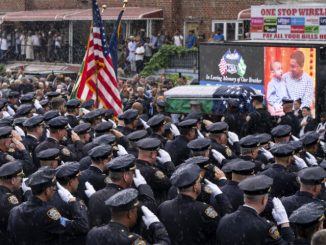
NYPD officers defend themselves as pro-Palestinian rioters charge at them with a barricade. Mayor Zohran Mamdani has ordered the specialized response unit disbanded. His plan creates an unarmed civilian de-escalation division with no power to make arrests. Screen grab courtesy of FreedomNewsTV via X.
Reported by:

Cherry Meigh Timbol
News Content Editor
Published November 28, 2026
New York City Mayor Zohran Mamdani has followed through on one of his major campaign promises, announcing the disbanding of the New York Police Department’s Strategic Response Group (SRG), a specialized unit responsible for crowd control, major emergencies and counterterrorism operations.
The announcement, made on November 16 alongside NYPD Commissioner Jessica Tisch, marks a significant change in how New York City intends to handle protests and public demonstrations. It has also reignited an important debate about the balance between protecting civil liberties and maintaining public safety.
For Mamdani, the decision represents the fulfillment of a political commitment. He has argued that officers responding to peaceful demonstrations should not operate under the same structure used to address terrorist threats.
The mayor’s administration plans to replace the protest-related functions of the SRG with a new civilian-led Community Dialogue and De-escalation Division (CDDD), operating under the Mayor’s Office of Community Safety. The division will consist of unarmed civilians without arrest powers.
However, the restructuring does not mean police officers will disappear from protest scenes.
The NYPD will establish a 30-member First Amendment Support Team (FAST), consisting of uniformed officers trained in communication and de-escalation. A separate Patrol Support Division will also provide officers trained in crowd management and retain the ability to make arrests when necessary.
The department’s counterterrorism responsibilities will be transferred to its Intelligence and Counterterrorism Bureau.
The decision comes amid renewed public discussion about confrontations between demonstrators and police officers. Images and videos of officers facing aggressive crowds, including incidents involving demonstrators pushing against police barricades, have raised questions about how authorities should respond when demonstrations become violent.
While critics of the Strategic Response Group have accused the unit of excessive force and aggressive crowd-control tactics, supporters argue that specialized police officers are necessary when large gatherings turn dangerous.
This is where Mamdani’s plan faces its biggest test.
A civilian-led de-escalation team may help prevent confrontations before they escalate. Dialogue and communication are important tools, particularly when dealing with peaceful protesters exercising their constitutional rights. But preventing violence also requires the ability to respond effectively when individuals become physically aggressive or threaten public safety.
There is a difference between protecting the right to protest and allowing violent behavior to go unanswered. Both principles must be respected if public confidence in law enforcement is to be maintained.
Commissioner Tisch has defended the restructuring, saying the changes will not diminish the NYPD’s ability to protect New Yorkers or leave officers without the resources necessary to confront serious threats.
The administration has also announced restrictions on certain crowd-control tactics, including prohibitions on tear gas, long guns and kettling during First Amendment activities.
Ultimately, Mamdani’s decision will be judged not simply by whether he fulfills a campaign promise, but by whether his new approach works when confronted with difficult situations on the streets of New York.
Reforming police practices is a legitimate responsibility of city leadership. However, public safety cannot depend on the assumption that every demonstration will remain peaceful.
New Yorkers have the right to express their political views, organize demonstrations and criticize their government. Police officers, meanwhile, have the responsibility to protect themselves, fellow officers and the public when situations become dangerous.
The challenge for Mamdani is to demonstrate that a system built around dialogue and de-escalation can protect those rights without weakening the city’s ability to maintain order.
For now, his administration has made its position clear. Whether the new structure delivers the promised improvements remains to be seen.