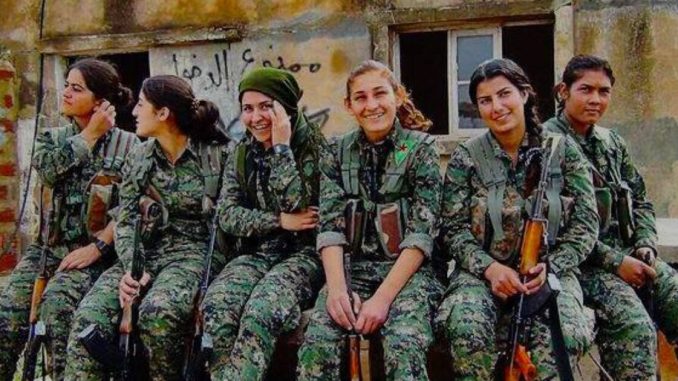
The Kurdish-led Syrian Democratic Forces, whose ranks included Kurdish and Christian fighters, other minorities and all-female units, once protected Rojava in northeast Syria, a haven for minorities fleeing Islamist persecution. The region now falls under the Damascus government of Ahmed al-Sharaa, the former commander of al-Qaeda’s Syrian affiliate, whose constitutional declaration makes Islamic jurisprudence the principal source of legislation. Photo courtesy of Sauti Ya Ujamaa.
Reported by:

Cherry Meigh Timbol
News Content Editor
Published November 28, 2026
Syria’s changing political and legal landscape is raising concerns about religious freedom and minority protections in the country’s predominantly Kurdish northeast, where Christians, religious converts and other minority communities could face new challenges as the region becomes increasingly integrated into the central government’s legal and administrative system.
A report published on November 27, 2026, has raised questions about the future of the region’s previously established secular legal framework and the potential consequences of applying Syria’s national laws, which place Islamic jurisprudence at the center of legislation.
The concerns come amid continuing efforts by the transitional government of President Ahmed al-Sharaa to consolidate authority across Syria following the collapse of Bashar al-Assad’s government in December 2024.
A shift in the legal framework
Under the constitutional declaration introduced in March 2025, Islamic jurisprudence is identified as the principal source of legislation. The declaration also establishes Islam as the president’s required religion while formally recognizing freedom of belief, subject to public-order provisions.
The development has attracted attention from religious minorities and human rights observers, particularly because the legal framework could affect matters involving marriage, inheritance, religious identification and freedom of conscience.
In northeastern Syria, Kurdish-led authorities previously maintained a distinct administrative and legal system that emphasized secular governance and included protections for different religious and ethnic communities.
However, the gradual integration of Kurdish-controlled institutions into the Syrian state has created uncertainty over which legal provisions and administrative arrangements will ultimately govern the region.
Concerns among Christians and religious converts
Christian communities are among those watching the developments closely.
One particularly sensitive issue involves people who have converted from Islam to Christianity. Although religious conversion is not explicitly prohibited under Syria’s current legal framework, converts may encounter difficulties obtaining official recognition of their religious identity.
A July 2026 report by the European Union Agency for Asylum documented differences between government-controlled and formerly Kurdish-controlled areas. It noted that several conversions to Christianity had reportedly taken place in Kurdish-controlled northeastern Syria without resulting in consequences for the converts.
The possibility of changes to the region’s legal arrangements therefore raises questions about whether the relative freedom previously experienced by these individuals will continue.
Church communities also face concerns about their ability to maintain religious education, operate schools and preserve their cultural traditions as national policies are introduced.
Kurdish autonomy and religious freedom
The issue extends beyond religious affairs.
For years, the Kurdish-led administration in northeastern Syria developed institutions that differed from those of the central government. These included local councils, women’s organizations, education systems and arrangements intended to accommodate the region’s ethnic and religious diversity.
The integration process has raised questions about the future of these institutions.
In September 2026, the Associated Press reported continuing tensions in northeastern Syria over Kurdish autonomy, education, security arrangements and the implementation of the agreement between Damascus and Kurdish-led forces.
These disagreements illustrate the wider challenges facing the region as it transitions toward greater central government control.
A broader question about minority protections
Syria’s transitional authorities have repeatedly faced international scrutiny over their ability to protect religious and ethnic minorities.
The United States Commission on International Religious Freedom reported in May 2026 that religious freedom conditions had deteriorated following Assad’s removal, citing sectarian violence and failures to establish effective protections for vulnerable communities.
At the same time, other assessments have emphasized that conditions differ considerably across Syria. The European Union Agency for Asylum has documented that Christians continue to hold positions in northeastern Syrian institutions and that religious communities have experienced different levels of security and social pressure depending on their location.
Consequently, concerns about the expansion of Islamic jurisprudence should be considered alongside the actual implementation of laws, the conduct of local authorities and the protections available to religious minorities.
The future remains uncertain
For Christians, converts and other minority communities in northeastern Syria, the central issue is whether political integration will preserve the freedoms and institutional protections they previously experienced.
The transition could reshape not only the region’s political administration but also its approach to education, family law, religious identity and individual freedoms.
Whether Syria’s national legal framework will fully replace the arrangements established under Kurdish-led administration remains an important question.
For now, the developments highlight a difficult challenge facing the country’s transitional leadership: establishing a unified national system while ensuring that religious and ethnic minorities retain meaningful protection under the law.