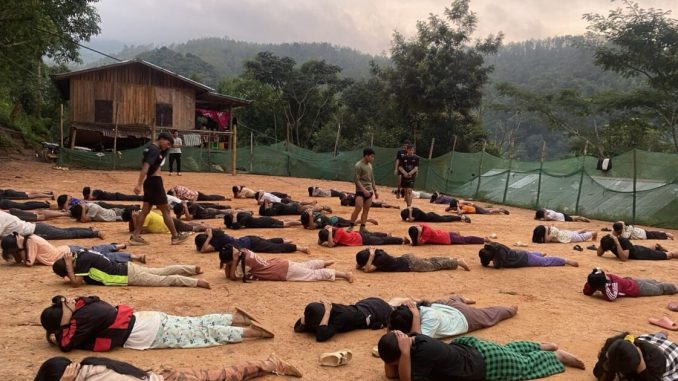
Burma civilians learn how to respond to government airstrikes. Photo courtesy of Free Burma Rangers.
Reported by:

Cherry Meigh Timbol
News Content Editor
Published September 21, 2026
NAYPYIDAW, Myanmar — Myanmar’s military-backed government is seeking greater international recognition and diplomatic engagement as fighting continues across the country and international organizations continue to document allegations of attacks against civilians.
The diplomatic push comes more than five years after the military seized power in February 2021, triggering widespread protests, armed resistance and a conflict involving the military, ethnic armed organizations and anti-junta forces.
Junta Seeks Greater Diplomatic Engagement
Myanmar’s military leadership has increasingly sought diplomatic contacts with neighboring countries and foreign governments as it attempts to strengthen its international position.
Min Aung Hlaing, who led the military following the 2021 coup, has subsequently moved into the country’s new political structure following elections organized under military rule.
The authorities have presented the electoral process as part of a transition toward a new political system. Critics, however, have questioned whether the process can be considered genuinely representative while major opposition groups remain excluded and fighting continues in large parts of the country.
The issue of international recognition remains particularly important for Myanmar’s military-backed government as it seeks greater diplomatic legitimacy and economic engagement.
UN Documents Alleged Attacks on Civilians
The diplomatic campaign is taking place while international investigators continue to document alleged abuses by Myanmar’s military.
The United Nations Independent Investigative Mechanism for Myanmar has reported evidence concerning alleged attacks on civilian locations, including homes, schools, medical facilities, religious buildings and camps housing displaced people.
The UN mechanism has said that aerial attacks have been an important part of the military’s campaign and that civilians have suffered deaths, injuries and destruction of property.
The investigators have also documented allegations involving arbitrary detention, torture and sexual violence.
Myanmar’s authorities have rejected the findings, arguing that international investigations rely on information from opposition groups and do not fairly represent the situation inside the country.
Conflict Continues Across Myanmar
Myanmar has remained divided by armed conflict since the military takeover in 2021.
The fighting involves the military, established ethnic armed organizations and newer resistance groups that emerged following the coup.
Millions of people have been displaced, while humanitarian organizations have warned about shortages of food, medical supplies and other essential assistance in conflict-affected areas.
The military has continued to conduct airstrikes and other military operations against areas where armed opposition groups operate. Opposition forces, meanwhile, have carried out attacks against military targets and government-linked infrastructure.
The competing claims make independent verification of individual incidents difficult, particularly in areas where journalists and humanitarian organizations have limited access.
Regional Governments Face Diplomatic Pressure
Myanmar’s neighbors have also faced difficult decisions over how to deal with the military-backed authorities.
ASEAN has maintained diplomatic engagement with Myanmar while continuing to call for an end to violence and progress toward a political settlement.
Malaysia has also pursued engagement with Myanmar’s leadership, including discussions involving the Rohingya refugee crisis and possible efforts to facilitate their eventual return.
Supporters of engagement argue that maintaining diplomatic channels can provide opportunities to address humanitarian issues and negotiate with the authorities.
Critics contend that diplomatic engagement without meaningful political change could strengthen the military government’s international standing.
Recognition Remains Uncertain
For Myanmar’s military-backed government, greater international recognition would provide an important diplomatic victory after years of isolation and criticism.
However, recognition remains complicated by the continuing armed conflict, allegations of abuses against civilians and questions surrounding the country’s political transition.
The government says it is pursuing a new political process, while opponents continue to reject military rule and call for a broader political settlement.
For ordinary civilians, meanwhile, the conflict remains the immediate concern. Continued fighting, displacement and alleged attacks on civilian areas have left large portions of the population facing a prolonged humanitarian crisis.
Myanmar’s attempt to strengthen its international position therefore comes at a critical moment. Whether diplomatic engagement can expand while the conflict continues will remain one of the central questions surrounding the country’s political future.
🧩 Bottom Line:
Myanmar’s military-backed government is seeking greater international recognition and diplomatic engagement while the country remains locked in a devastating civil conflict. The government disputes international allegations of attacks on civilians, while UN investigators have documented evidence of serious abuses and aerial attacks on civilian areas. The central challenge for Myanmar is whether diplomatic engagement can advance while the conflict and humanitarian crisis remain unresolved.
SOURCES: THE GATEWAY PUNDIT – Myanmar Junta Seeks Recognition as Civilian Bombings Continue