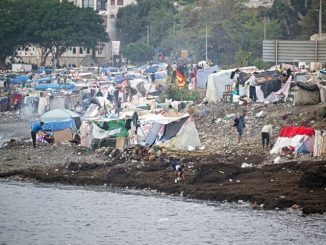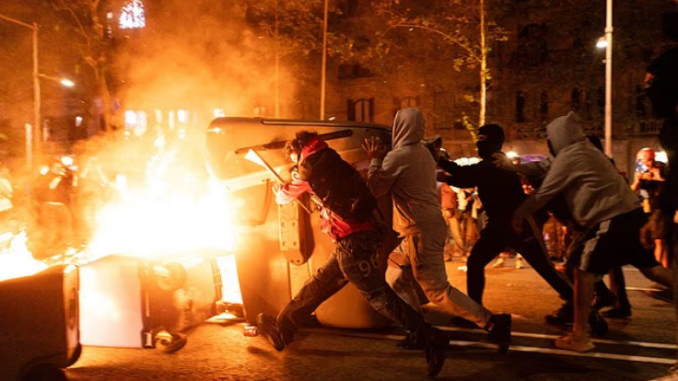
Trash containers burn in a central street during unrest following a demonstration for housing rights in Barcelona
Reported by:

Cherry Meigh Timbol
News Content Editor
Published October 6, 2026
MADRID — October 6, 2026 — Spain has been plunged into a fresh political crisis after Prime Minister Pedro Sánchez called a snap general election for November 29, just hours before large housing demonstrations erupted into violent clashes between protesters and police in Barcelona.
The election announcement came after Sánchez’s minority Socialist-led government suffered a major parliamentary defeat over emergency housing measures. The political setback has intensified pressure on the government while transforming Spain’s housing crisis into the central issue of the upcoming election.
The developments mark one of the most serious political challenges Sánchez has faced since returning to power. With the conservative People’s Party (PP) leading many polls and Vox gaining ground, the election could potentially produce a right-wing government.

Trash containers burn in a central street during unrest in Barcelona
Protests Spread Across Spain
The latest unrest follows days of demonstrations in more than 50 Spanish cities. Protesters are demanding lower rents, stronger protections for tenants, restrictions on property speculation and a major expansion of affordable housing.
The movement gained momentum following the eviction of 87-year-old Maricarmen Abascal from her Madrid home, where she had lived for decades. Her case became a powerful symbol of the difficulties facing elderly and lower-income tenants as housing costs have surged.
The controversy became even more politically explosive after reports that her rent would have increased by roughly 230 percent following the acquisition of her apartment building by an investment fund.
In Madrid, authorities estimated that approximately 70,000 people participated in Saturday’s demonstration, while organizers claimed a substantially higher figure. Protest camps have also appeared in central Madrid, evoking memories of Spain’s 2011 anti-austerity movement.

A protester throws stones at the police during clashes
Barcelona Protest Turns Violent
The most serious violence came Monday night in Barcelona.
A large demonstration organized around housing rights was initially peaceful. However, after the official march ended, groups of hooded individuals remained in the streets and began throwing stones, paving slabs, glass bottles and other objects at police.
Barricades were constructed using rubbish bins, bicycles, construction materials and other street objects. Several fires were also reported.
Catalan police ultimately moved against the groups, while foam projectiles were used during the clashes. Authorities reported 13 arrests, including one minor, and roughly 28 to 30 police officers suffering minor injuries.
The violence continued toward Plaça Catalunya and La Rambla, with burning bins and damage to street furniture and vehicles. Police eventually regained control around midnight.
Importantly, the violence represents only part of a much broader movement. Thousands of demonstrators across Spain have participated in peaceful protests demanding government action on housing.

Demonstrators clash with riot police overnight in Barcelona
Parliament’s Housing Defeat Triggered the Election
Sánchez’s decision to call an early election came after Parliament rejected two government housing decrees.
The proposed measures included stronger tenant protections and restrictions intended to address evictions and the growing pressure on the rental market. Conservative lawmakers opposed the government’s approach, arguing that Spain needs to build more homes rather than rely primarily on regulation.
The defeats exposed the weakness of Sánchez’s parliamentary position.
According to El País, the government has increasingly struggled to pass major legislation because it lacks a dependable majority in Congress. The housing votes therefore became more than a policy defeat—they demonstrated how difficult it had become for Sánchez to govern effectively.
Sánchez subsequently argued that Spain needs a stronger progressive majority to address housing and other social problems.

A demonstrator throws a brick toward police officers during a protest
Sánchez Bets on Housing to Revive His Political Fortunes
The prime minister’s election strategy is now increasingly clear: make housing the centerpiece of the campaign.
Sánchez is seeking to portray the election as a choice between expanding social protections and a potential conservative government involving the PP and Vox.
That strategy carries substantial risks.
The PP has been ahead of Sánchez’s Socialist Party in polling, while Vox has also increased its support. A combined conservative majority could therefore potentially end Sánchez’s time in government.
But housing could give the Socialists an issue capable of mobilizing younger voters and renters who feel increasingly excluded from Spain’s property market.
Reuters reported Tuesday that Spain faces a potential housing deficit approaching one million homes by 2028, while social housing represents only a small proportion of the country’s housing stock.

Protesters throw stones and projectiles at riot police lines during clashes
The Bigger Problem: Spain’s Housing Market
Spain’s housing crisis is not simply a political dispute over one eviction.
Rents have risen dramatically over the past decade. Reuters and AP reporting indicate that average rents have nearly doubled since 2016, while a significant share of renters spend a very large portion of their income on housing.
The crisis is particularly difficult for younger Spaniards, many of whom face a combination of high rents, stagnant purchasing power relative to property prices and limited access to home ownership.
The problem is also linked to Spain’s enormous tourism industry, short-term rentals, limited social housing and a shortage of new construction in areas experiencing strong demand.
Reuters reported that Spain’s housing pressures are being driven by several factors, including rising urban demand, short-term rentals, bureaucratic obstacles and labor shortages in construction.

Protesters hold a Communist Party flag as a bin burns during a demonstration
A Political Crisis Built Around a Social Crisis
The demonstrations have created an unusual political situation for Sánchez.
Normally, immigration, security and cultural issues can benefit conservative parties. But housing is different.
Public frustration over rent increases and evictions cuts across traditional political divisions. Some homeowners, renters, young people and older residents have all expressed concerns about affordability.
That gives Sánchez an opportunity to campaign on an issue where left-wing policies may enjoy broader public support.
At the same time, the opposition can argue that Sánchez has been in government for years and therefore bears responsibility for the failure to solve the problem.
The PP’s argument is essentially that Spain needs more construction and supply, rather than additional restrictions on landlords and investors.
The election will therefore become a referendum not only on Sánchez, but on two fundamentally different approaches to the housing crisis.
🧩 Bottom Line:
Spain’s housing crisis has evolved into a major political test for Prime Minister Pedro Sánchez. With rents and home prices outpacing incomes, nationwide protests and the government’s failure to pass key housing measures have pushed the issue to the center of the November 29 snap election.
Sánchez is betting that voters will reward his call for stronger tenant protections and housing intervention, while the opposition argues that Spain needs to dramatically increase housing construction and supply. The government’s approval of new emergency housing measures on October 6 may help demonstrate action, but it also underscores how difficult the crisis has become to resolve.
Ultimately, the election will be a referendum not only on Sánchez’s leadership, but on which approach Spaniards believe can make housing affordable again: tighter regulation and tenant protections, or faster construction and increased supply.
SOURCES: DAILYMAIL ONLINE – Protesters battle Spanish police as demonstrations over the country’s housing crisis escalate into violence hours after socialist PM announced snap election
THE IRISH TIMES – Spain’s prime minister calls snap election after protests over housing crisis