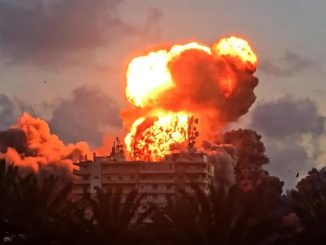
The Israeli army intensified strikes in southern Lebanon on Monday, as two far-right Israeli ministers called for escalation including attacks on Lebanese capital Beirut. © Abbas Fakih, AFP
Published May 25, 2026
JERUSALEM — Israeli Prime Minister Benjamin Netanyahu has ordered a significant escalation of military operations in Lebanon, vowing to “increase the blows” against Hezbollah as cross-border attacks intensify and an already fragile ceasefire continues to erode.
The announcement comes amid renewed Israeli airstrikes across southern and eastern Lebanon, including the Bekaa Valley, as well as continued tensions along Israel’s northern border, according to multiple international reports.
Israeli officials say Hezbollah has continued launching drones and rockets despite a U.S.-backed truce that took effect in April, prompting what Netanyahu described as a necessary expansion of Israel’s military response.
“We will crush them”: Netanyahu signals sharper military phase
Netanyahu issued a forceful video statement on Sunday, declaring that Israel is “at war with Hezbollah” and warning that operations will intensify in response to continued attacks.
“We will intensify our blows, increase our firepower, and we will crush them,” Netanyahu said, according to statements carried by international outlets.
Israeli military officials say operations have already expanded to strike Hezbollah infrastructure in multiple regions of Lebanon, with the Israeli Defense Forces targeting what it describes as weapons depots, drone facilities, and militant positions.
The escalation follows repeated Hezbollah drone attacks on Israeli military positions in the north, which Israeli officials say have resulted in casualties among troops.
Ceasefire under pressure as strikes expand beyond southern Lebanon
The conflict has persisted despite a U.S.-brokered ceasefire that was intended to stabilize the region following months of cross-border fighting.
According to reporting from France 24 and other outlets, Israeli strikes have increasingly extended beyond traditional southern Lebanon strongholds into deeper territory, including the Bekaa Valley and areas near Beirut’s southern suburbs.
Lebanese officials have reported significant civilian displacement as residents flee areas near expected strike zones, raising fears of a broader regional escalation.
Meanwhile, Hezbollah continues to claim responsibility for drone and rocket attacks targeting northern Israel, arguing it is acting in response to Israeli operations in Lebanon.
Regional stakes rise as diplomacy struggles to keep pace
The escalation comes at a sensitive moment for broader U.S.-led diplomatic efforts involving Lebanon, Israel, and indirect negotiations with Iran.
Analysts cited in Semafor report that the Lebanon front risks complicating ongoing diplomatic efforts, particularly as Washington attempts to maintain pressure for a wider regional stabilization agreement.
The U.S. has reiterated Israel’s right to self-defense while also urging restraint to prevent further destabilization.
However, officials on both sides acknowledge that the current cycle of strikes and counterstrikes has pushed the ceasefire to its breaking point.
🧩 Reading Between the Lines:
This is shifting from isolated clashes to sustained pressure
What’s happening now between Israel and Hezbollah is less about individual incidents and more about a steady pattern of escalation. Each strike is being met with a response, and each response is raising the ceiling a little higher than before. That kind of rhythm tends to harden expectations on both sides, making it harder to step back without losing face or leverage.
At the same time, the gap between diplomacy and reality on the ground is widening. Even as ceasefire language and negotiations continue, the fighting suggests neither side is fully acting within those boundaries anymore. In practical terms, actions are starting to matter more than agreements.
🔗 The Stakes: Why this is getting harder to pull back from
This conflict is no longer just about isolated strikes or short-term retaliation—it’s becoming a test of how far each side is willing to push without triggering something larger. What started as a back-and-forth along the border is now building pressure that neither Israel nor Hezbollah can easily ignore or walk back from.
Security pressure is driving every decision
For Israel, the core issue is straightforward: stopping repeated attacks on its northern communities and military positions. As long as rockets and drones keep coming in, the pressure to respond more forcefully doesn’t go away—it increases. That creates a cycle where each response is expected to be stronger than the last just to maintain deterrence.
Hezbollah is signaling persistence, not pause
Hezbollah’s continued operations suggest it is trying to keep pressure on Israel and remain a central player in the confrontation. But the longer this continues, the more it risks dragging Lebanon deeper into a conflict that its economy and internal stability are not well-positioned to handle.
The risk of a single misstep grows
The most dangerous part of the situation is how quickly things can shift. In conflicts like this, escalation usually doesn’t come from a planned decision—it comes from one strike that lands harder than expected or triggers a larger-than-intended response. Once that happens, it becomes difficult for either side to control the pace.
Diplomacy is losing ground to momentum
Even though ceasefire language and negotiations still exist, they are struggling to match what is happening on the ground. When both sides continue military action while talks are ongoing, agreements lose influence, and events on the battlefield start setting the terms instead.
Wider regional pressure is building quietly
Even countries not directly involved are watching closely, because instability between Israel and Lebanon tends to spill outward—affecting security planning, shipping confidence, and broader regional alignment. The longer this continues, the harder it becomes to contain the effects within a single front.
🏁 The Final Word:
What’s unfolding now is a conflict that’s steadily moving away from short, controlled exchanges and toward something more sustained and unpredictable. Israel is signaling it intends to keep increasing pressure until the attacks from Hezbollah stop or significantly decrease, while Hezbollah continues to show it can still respond and maintain pressure of its own. That back-and-forth is creating a cycle that neither side seems ready to break.
Diplomatic efforts are still being mentioned, but they are clearly struggling to keep up with the pace of events on the ground. When fighting continues even as ceasefire terms are discussed, those agreements lose their weight in practice, even if they remain in name.
The concern going forward is not just the current level of violence, but the possibility that each new exchange makes the next one more intense and harder to control. If that pattern continues, what started as a border conflict risks becoming a much broader and longer-lasting confrontation, with fewer options for stepping back once momentum takes over.
SOURCES: THE TIMES OF ISRAEL – Netanyahu orders IDF to ‘intensify blows’ against Hezbollah amid surge in drone attacks
FRANCE 24 – Israel pounds Lebanon with fresh air strikes, vows to ‘crush’ Hezbollah
SEMAFOR – Israel approves further plans in Lebanon offensive, despite ceasefire