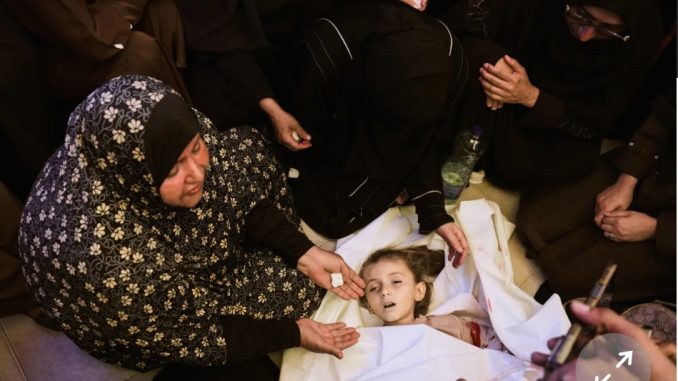
Relatives mourn around the body of a 6-year old Palestinian girl Menna Allah Abu Labda who was killed in an Israeli Strike during her funeral at Nasser Hospital in Khan Younis, Gaza Strip. May 25,2026
Published May 25, 2026
TEL AVIV — Military operations in Gaza have intensified in recent days as ceasefire negotiations remain stalled, raising new questions about the path toward ending the prolonged conflict and the political dynamics shaping decisions in Israel’s leadership.
Israeli forces have continued air and ground operations across multiple areas of Gaza, targeting what officials describe as remaining militant infrastructure. The renewed tempo of strikes comes as international mediators push for a revised ceasefire framework that would include hostage releases, expanded humanitarian access, and longer-term security arrangements.
Escalation on the Ground
Residents and aid groups report sustained airstrikes in parts of northern and central Gaza, with ongoing damage to already heavily affected infrastructure. Israel maintains that operations are focused on preventing regrouping by militant elements and securing strategic zones established during earlier phases of the war.
Military officials have said operations will continue “as long as necessary” until security objectives are met, while also emphasizing efforts to minimize civilian harm. Humanitarian organizations, however, continue to warn of worsening conditions for civilians trapped in active conflict areas.
Mourners react during the funeral of six-year-old Palestinian girl Mennatallah Abu Libda, who was killed in an Israeli strike on a tent encampment for displaced families, according to medics, in Khan Younis in the southern Gaza Strip May 25, 2026. REUTERS/Ramadan Abed Purchase Licensing Rights
Ceasefire Talks Remain Deadlocked
Diplomatic efforts led by regional and international mediators have so far failed to produce a lasting agreement. Key sticking points reportedly include:
- The release and status of remaining hostages
- Long-term governance arrangements in Gaza
- Security guarantees demanded by Israel
- Calls for a full withdrawal by Palestinian factions
Negotiators have described the talks as “fragile” and subject to repeated breakdowns, with temporary pauses in fighting failing to hold.
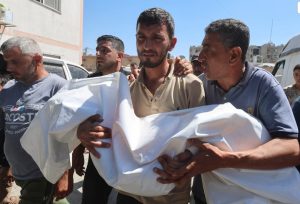
A mourner carries the body of six-year-old Palestinian girl Mennatallah Abu Libda, who was killed in an Israeli strike on a tent encampment for displaced families, according to medics, in Khan Younis in the southern Gaza Strip May 25, 2026. REUTERS/Ramadan Abed Purchase Licensing Rights
Political Pressure Inside Israel
Inside Israel, Prime Minister Benjamin Netanyahu faces mounting pressure from multiple directions — including families of hostages demanding a deal and political allies urging continued military pressure until Hamas is fully dismantled.
Critics, including opposition figures, argue that the timing and intensity of military operations are influenced by domestic political considerations as Israel approaches a politically sensitive period. Supporters of the government reject that framing, saying national security decisions are being driven solely by battlefield realities and intelligence assessments.
Analysts say the reality is likely more complex, with military strategy, diplomatic constraints, and domestic politics all intersecting in a highly volatile environment.

Palestinians carry the bodies of members of the Abu Malouh family killed in an Israeli air strike in Gaza, May 24, 2026 (AP Photo/Abdel Kareem Hana) (AP)
🧩 Reading Between the Lines:
On the surface, the official message is simple: Israel says it is targeting militants, protecting its security, and working within a ceasefire framework that is still fragile. But critics and analysts looking at the broader picture see a more complicated mix of war aims, politics, and timing.
1. “Ceasefire” doesn’t mean full peace
Even during ceasefire arrangements, fighting hasn’t fully stopped. Reports from multiple outlets show continued airstrikes and casualties in Gaza despite truce frameworks still technically in place.
Between the lines:
- A ceasefire is not functioning like a full stop to the war
- It’s more like a pause with exceptions, where each side says the other broke the rules
- That gives both sides justification to continue limited military action
2. Military pressure is also leverage
Israel has expanded control over parts of Gaza and maintained military positions while negotiations continue.
Between the lines:
- Control of territory = bargaining power in negotiations
- Military pressure is being used as a way to shape future political outcomes in Gaza
- The goal is not just battlefield gains, but leverage in talks over hostages, security, and governance
3. Domestic politics is part of the backdrop
Prime Minister Netanyahu is facing strong political pressure at home, including criticism over war goals, hostages, and leadership direction.
Between the lines:
- Leaders in war often think about public support and elections at the same time
- Continuing pressure on Gaza may strengthen political standing with some voters who want a hardline approach
- At the same time, others accuse the government of prolonging conflict instead of prioritizing a full deal
4. External diplomacy is pulling in different directions
The U.S. and regional actors are pushing for stabilization, while Israel insists on security conditions tied to dismantling militant threats.
Between the lines:
- Allies are not fully aligned on end goals
- One side is pushing for “stop the fighting first”
- The other is pushing for “finish the security mission first”
- That gap slows down any lasting agreement
5. The core tension underneath everything
Across reporting and analysis, the recurring issue is:
- Israel wants security guarantees and long-term control over threats
- Palestinians (and mediators) want a full end to military operations and withdrawal
- Neither side fully trusts the other to hold to a deal
🔗 The Stakes: What’s Really on the Line
At this point, the war is no longer just about short-term battles. What’s happening now is about who controls the future of Gaza, how Israel secures its borders, and whether diplomacy can actually stop a cycle of retaliation that keeps restarting.
1. Security vs. “endless war” risk
Israel says its military operations are aimed at eliminating remaining threats and preventing another large-scale attack like October 7.
But on the ground, reports show continued strikes in Gaza even under ceasefire frameworks, with civilian casualties still being reported.
What’s at stake:
- Israel wants long-term safety guarantees, not temporary pauses
- Critics worry the strategy risks turning a “limited war” into a permanent low-level conflict that never fully ends
2. Who controls Gaza after the fighting
One of the biggest unresolved issues is not just fighting — it’s what Gaza becomes afterward.
Negotiations have stalled over:
- Who governs Gaza
- Whether armed groups disarm
- Whether Israeli forces fully withdraw or stay in buffer zones
Between the lines:
- Israel pushing for security control or neutralizing threats first
- Palestinians and mediators pushing for governance changes and withdrawal
- No agreement yet on a shared end-state
3. Civilian cost and international pressure
Reports from major outlets continue to show civilian deaths in Gaza even during ceasefire periods, fueling global criticism.
What’s at stake:
- Israel’s international image and diplomatic support
- Humanitarian conditions inside Gaza
- Pressure from allies to reduce escalation or speed up a political deal
4. Politics inside Israel is part of the equation
The war is also shaping domestic politics.
Prime Minister Netanyahu faces:
- Pressure from families of hostages to prioritize a deal
- Pressure from hardline factions to keep military pressure high
- Public debate over whether the war should expand, pause, or end
Between the lines:
- Decisions are not just military — they are also political survival decisions
- Different groups inside Israel want very different endgames
5. Regional spillover risk
Even while Gaza dominates headlines, the wider region is unstable:
- Israel has ongoing conflict dynamics with Hezbollah in Lebanon
- Broader Middle East tensions remain high, tied to Iran and regional alliances
What’s at stake:
- A localized war staying contained vs. expanding into a wider regional conflict
- Energy markets, trade routes, and regional stability
🏁 The Final Word:
At this stage, the conflict in Gaza is stuck in a familiar pattern: fighting continues on the ground, talks continue off the battlefield, and neither side is willing to fully back down on what it sees as essential security and political demands. Israel maintains that sustained pressure is necessary to prevent future attacks and secure long-term safety, while critics argue that ongoing operations risk dragging the region deeper into an open-ended war with no clear exit. Ceasefire efforts exist, but they remain fragile and repeatedly tested by new rounds of violence. In simple terms, the situation is less about an approaching resolution and more about a difficult standoff where military action and diplomacy are moving at the same time—but not yet in the same direction.
SOURCES: REUTERS – Israeli fire kills six-year-old girl and a woman in Gaza, medics say
AP NEWS – A Palestinian woman and a young girl were killed in an Israeli airstrike in Gaza, officials say
AL JAZEERA – Israel escalates Gaza attacks as Netanyahu stalls ceasefire for polls