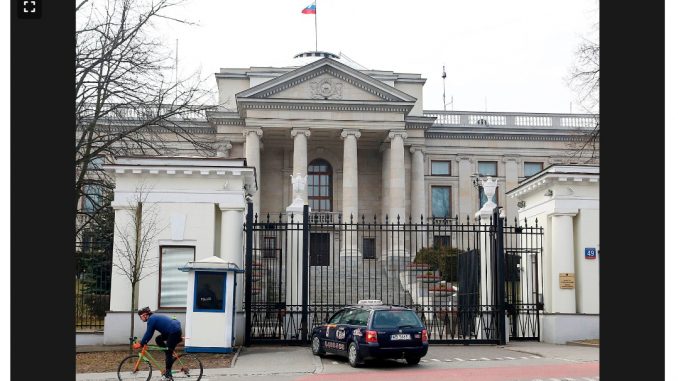
FILE – A taxi in front of the Russian Embassy in Warsaw, Poland, Monday, March 26, 2018.
Published July 16, 2026
WARSAW, Poland — July 16, 2026 — Polish authorities have charged an 18-year-old Ukrainian national with carrying out a series of alleged sabotage operations on behalf of Russian intelligence, accusing him of attempting to inflame historical tensions between Poland and Ukraine by vandalizing war memorials and planning additional disruptive acts.
According to Poland’s Internal Security Agency (ABW) and prosecutors, the suspect allegedly committed 47 criminal offenses between November 2024 and August 2025, including desecrating memorials honoring Polish victims of World War II massacres committed by the Ukrainian Insurgent Army (UPA). Authorities say the objective was not simple vandalism but part of a broader Russian-backed influence campaign designed to undermine relations between two of Moscow’s strongest regional opponents.
Polish Authorities Allege Russian Intelligence Recruitment
Prosecutors allege the suspect was recruited through an online network linked to Russian intelligence services and was compensated using cryptocurrency.
Investigators say the operation was intended to exploit one of the most sensitive historical disputes between Poland and Ukraine—the Volhynia massacres of 1943–1945, during which an estimated 100,000 Poles were killed by Ukrainian nationalist forces.
Authorities believe the vandalism was designed to provoke anger, deepen ethnic divisions, and weaken cooperation between Warsaw and Kyiv while Russia continues its war against Ukraine.
War Memorials Became Targets
According to investigators, the suspect allegedly desecrated memorials commemorating Polish civilians killed during World War II.
Officials say damaging the monuments was intended to inflame public emotions surrounding one of the most painful chapters in Polish-Ukrainian history.
Poland’s Internal Security Agency described the alleged acts as part of a broader campaign of sabotage and diversionary activities rather than isolated acts of vandalism.
Authorities Also Allege Drone Sabotage Plot
Beyond the vandalism allegations, prosecutors say the suspect also prepared additional sabotage operations.
According to investigators, authorities disrupted an alleged plan involving a drone before it could be carried out. Officials say the suspect was arrested before the operation was executed.
Polish authorities have not reported that the alleged plot caused injuries or damage, but they describe it as evidence that the suspect’s activities extended well beyond vandalizing memorials.
Historical Disputes Remain Highly Sensitive
The case comes at a time when relations between Poland and Ukraine have already been strained by disagreements over historical memory.
The legacy of the Ukrainian Insurgent Army (UPA) remains one of the most divisive issues between the two countries. While many Ukrainians view the organization as part of the struggle for independence, many Poles regard it as responsible for massacres of Polish civilians during World War II.
Analysts say Russia has repeatedly sought to exploit these historical grievances through disinformation campaigns and other hybrid tactics.
Poland Warns of Hybrid Warfare
Polish security officials have repeatedly warned that Russia is expanding the use of hybrid warfare, including sabotage, cyber operations, disinformation campaigns, and attempts to manipulate public opinion.
Authorities believe operations designed to deepen divisions between Poland and Ukraine fit a broader Russian strategy aimed at weakening Western unity and reducing support for Ukraine.
Earlier this month, senior Polish officials publicly warned that Russian agents were attempting to inflame emotions surrounding historical disputes between the two neighboring countries.
Investigation Continues
The suspect now faces numerous criminal charges as Polish prosecutors continue investigating the alleged Russian intelligence network behind the operation.
Authorities have not ruled out the possibility of additional arrests if evidence identifies other individuals connected to the alleged sabotage campaign.
Officials say protecting critical infrastructure, preserving public order, and preventing foreign interference remain top national security priorities as Poland continues supporting Ukraine amid Russia’s ongoing invasion.
👥 Public / Political Reactions:
🇵🇱 Polish Government
Polish authorities described the case as part of a broader campaign of Russian hybrid warfare aimed at undermining relations between Poland and Ukraine.
- The Internal Security Agency (ABW) said the suspect was allegedly recruited through an online network linked to Russian intelligence and paid using cryptocurrency.
- Prosecutors charged the 18-year-old Ukrainian national with 47 criminal offenses, including desecrating war memorials and preparing acts of sabotage.
- Officials said the alleged objective was to inflame ethnic and historical tensions between Poles and Ukrainians rather than simply vandalize property.
➡️ Position: Poland says the alleged operation was a foreign-backed attempt to destabilize society and weaken national security.
🇺🇦 Ukrainian Government
While Ukrainian officials had not issued a detailed response to the specific charges at the time of reporting, Kyiv has consistently rejected Russian efforts to sow division between Ukraine and its allies.
- Ukrainian authorities have repeatedly warned that Russia uses disinformation and covert operations to weaken international support for Ukraine.
- Kyiv continues emphasizing the importance of maintaining close cooperation with Poland despite ongoing disagreements over historical issues.
➡️ Position: Ukraine maintains that attempts to divide Warsaw and Kyiv ultimately benefit Russia and should not undermine bilateral cooperation.
🇷🇺 Russian Government
Russian authorities had not publicly commented on the charges at the time of publication.
- Polish prosecutors allege the suspect acted on behalf of Russian intelligence through an online recruitment network.
- Moscow has consistently denied accusations that it conducts sabotage or influence operations against European countries.
➡️ Position: Russia has not responded to the latest allegations and has generally denied involvement in similar accusations.
🌍 European Security Officials
European security officials continue expressing concern over alleged Russian hybrid operations across the continent.
- Intelligence agencies have warned that sabotage, cyberattacks, disinformation campaigns, and efforts to inflame social divisions remain key elements of Russia’s strategy.
- Officials say exploiting sensitive historical disputes is intended to weaken European unity and support for Ukraine.
➡️ Position: European security officials view hybrid threats as an ongoing challenge requiring close cooperation among allied nations.
👥 Public Response
The case has generated significant public discussion in both Poland and Ukraine.
- Many Poles expressed concern over the alleged targeting of war memorials honoring victims of the Volhynia massacres.
- Others warned that historical grievances should not be manipulated to damage modern cooperation between Poland and Ukraine.
- Analysts noted that the allegations come during an already sensitive period in bilateral relations, increasing public attention to the investigation.
➡️ Position: Public reaction reflects concern over both the alleged sabotage campaign and the need to prevent historical disputes from further straining Polish-Ukrainian relations.
🏛️ Broader Political Impact
The investigation has reinforced concerns about foreign interference in Europe.
- Polish authorities say the alleged operation fits a broader pattern of attempts to exploit historical and ethnic divisions.
- The case is expected to strengthen calls for enhanced counterintelligence cooperation, protection of cultural sites, and vigilance against hybrid threats.
- Governments across Europe are likely to continue monitoring similar activities aimed at undermining regional stability.
➡️ Position: The charges underscore growing concern that hybrid operations and foreign influence campaigns remain an active security challenge for Europe.
⚠️ Resulting Effects:
Poland’s decision to charge an 18-year-old Ukrainian national with allegedly carrying out sabotage on behalf of Russian intelligence has intensified concerns over hybrid warfare in Europe. Beyond the criminal case itself, the allegations have renewed attention to the vulnerability of historical issues, public institutions, and cross-border relations to foreign influence operations.
1. Security Concerns Over Hybrid Warfare Intensify
The case has reinforced warnings that hybrid threats extend beyond conventional military conflict.
🛡️ Polish security agencies are expected to continue expanding counterintelligence operations against suspected foreign influence networks.
🔍 Authorities are increasing efforts to identify individuals allegedly recruited through online platforms by foreign intelligence services.
🌍 European governments continue monitoring similar sabotage and disinformation activities across the region.
➡️ Result: Alleged foreign-backed sabotage → heightened focus on countering hybrid warfare.
2. Polish-Ukrainian Relations Face Additional Strain
The allegations involve one of the most sensitive historical issues shared by both countries.
🏛️ The vandalism of war memorials has renewed public attention to the legacy of the Volhynia massacres.
🤝 Leaders in both Poland and Ukraine are expected to continue working to prevent the incident from undermining broader bilateral cooperation.
📖 Analysts say foreign actors may seek to exploit historical disputes to weaken support for Ukraine.
➡️ Result: Sensitive historical issues → increased diplomatic and public attention to preserving bilateral relations.
3. Criminal Investigation Continues
The legal proceedings are expected to remain active.
⚖️ Polish prosecutors continue pursuing charges related to vandalism, sabotage, and alleged cooperation with a foreign intelligence service.
👮 Authorities have not ruled out additional arrests if evidence identifies other individuals connected to the alleged network.
📂 Investigators continue examining digital communications, financial transactions, and other evidence linked to the case.
➡️ Result: Ongoing investigation → potential for additional legal developments.
4. Protection of Cultural and Historical Sites May Increase
The alleged targeting of war memorials has raised concerns about protecting sites of historical significance.
🏛️ Authorities may strengthen security around monuments and memorials considered vulnerable to politically motivated vandalism.
🚔 Local governments could increase surveillance and cooperation with law enforcement.
🕊️ Cultural organizations continue emphasizing the importance of preserving historical sites from politically motivated attacks.
➡️ Result: Memorial vandalism allegations → stronger efforts to safeguard historical landmarks.
5. European Intelligence Cooperation Is Expected to Expand
The case highlights the importance of cross-border security cooperation.
🤝 Intelligence and law enforcement agencies are expected to continue sharing information on suspected foreign influence operations.
📡 Governments may strengthen coordination to identify sabotage networks operating across national borders.
🌐 The investigation could contribute to broader European discussions on responding to hybrid threats.
➡️ Result: Shared security concerns → closer international intelligence and law enforcement cooperation.
6. Public Awareness of Foreign Influence Campaigns Grows
The allegations have increased public attention to how foreign actors may attempt to manipulate social divisions.
📢 Citizens are becoming more aware of disinformation, covert recruitment, and efforts to exploit historical grievances.
👥 Security experts continue encouraging vigilance against attempts to inflame ethnic or political tensions.
🏛️ Governments are expected to continue public education efforts regarding hybrid threats and national resilience.
➡️ Result: High-profile sabotage case → increased awareness of foreign influence operations and the importance of protecting democratic institutions.
🔮 Future Outlook:
Poland’s prosecution of an alleged Russian-backed saboteur is expected to keep concerns about hybrid warfare and foreign interference at the forefront of European security discussions. As the criminal case moves through the Polish judicial system, authorities across Europe are likely to intensify efforts to detect and prevent similar operations aimed at exploiting historical divisions and undermining regional stability.
1. The Criminal Case Will Continue Through the Courts
The investigation remains active, and prosecutors are expected to continue presenting evidence against the accused.
⚖️ Court proceedings will determine whether the suspect is found guilty of the charges brought by Polish authorities.
👮 Investigators may continue examining digital communications, financial transactions, and alleged links to foreign intelligence networks.
📂 Authorities have not ruled out additional arrests if new evidence identifies other individuals connected to the alleged operation.
➡️ Outlook: Ongoing legal proceedings → potential for further criminal charges and new investigative findings.
2. Poland Is Likely to Strengthen Counterintelligence Measures
The case is expected to reinforce Poland’s focus on national security.
🛡️ Security agencies may expand surveillance of suspected foreign intelligence activities.
🔍 Authorities are likely to increase monitoring of online recruitment efforts and hybrid influence campaigns.
🏛️ Additional resources may be directed toward protecting critical infrastructure and culturally significant sites.
➡️ Outlook: Increased security efforts → stronger counterintelligence and protection against foreign interference.
3. Poland and Ukraine Will Seek to Preserve Their Partnership
Despite historical disagreements, both governments have strong strategic reasons to maintain close cooperation.
🤝 Warsaw and Kyiv are expected to continue coordinating on regional security and defense.
📖 Officials may work to prevent historical disputes from being exploited by outside actors.
🌍 Diplomatic dialogue is likely to remain focused on maintaining unity in the face of ongoing regional security challenges.
➡️ Outlook: Continued bilateral cooperation → efforts to prevent foreign influence from damaging Polish-Ukrainian relations.
4. European Governments Will Increase Focus on Hybrid Threats
The allegations are expected to influence security planning across Europe.
🌐 Intelligence agencies may strengthen cooperation to identify cross-border sabotage, cyber operations, and disinformation campaigns.
📡 Governments are likely to share intelligence more closely regarding suspected foreign influence activities.
🏛️ Additional policies aimed at improving resilience against hybrid warfare may be considered.
➡️ Outlook: Greater regional coordination → expanded efforts to counter foreign influence operations.
5. Historical Sites May Receive Greater Protection
The alleged targeting of war memorials has highlighted their vulnerability.
🏛️ Local authorities may increase security around monuments, memorials, and culturally significant locations.
🚔 Law enforcement agencies could enhance surveillance and rapid response capabilities at sensitive sites.
📖 Educational and cultural institutions may continue promoting historical dialogue to reduce opportunities for manipulation.
➡️ Outlook: Protection of heritage sites → stronger safeguards against politically motivated vandalism.
6. Hybrid Warfare Will Remain a Long-Term Security Challenge
European security officials expect foreign influence operations to remain an ongoing concern.
⚖️ Governments are likely to continue investing in counterintelligence, cybersecurity, and public awareness initiatives.
👥 Citizens may be encouraged to remain alert to disinformation and attempts to exploit ethnic or historical divisions.
🌍 The outcome of this case may shape future policies on responding to covert foreign operations throughout Europe.
➡️ Outlook: Continued vigilance → long-term efforts to strengthen national resilience against hybrid warfare and foreign interference.
🧩 Bottom Line:
Poland’s decision to charge an 18-year-old Ukrainian national with allegedly carrying out sabotage on behalf of Russian intelligence underscores growing concerns that the war in Ukraine extends far beyond the battlefield. According to Polish authorities, the alleged operation sought to exploit one of the most sensitive chapters in Polish-Ukrainian history by targeting war memorials and stirring ethnic tensions in an effort to weaken relations between two close regional partners.
While the criminal case will ultimately be decided by the Polish courts, the allegations have reinforced warnings that hybrid warfare—including sabotage, disinformation, cyber operations, and covert influence campaigns—has become an increasingly important element of Europe’s security landscape. Polish officials argue that such operations are designed to erode public trust, create political divisions, and undermine support for Ukraine.
The investigation also highlights the importance of continued cooperation among European intelligence and law enforcement agencies as they work to identify and disrupt foreign-backed influence networks operating across national borders.
➡️ Bottom Line: The alleged Russian-backed sabotage case is more than a criminal investigation—it reflects the broader challenge of protecting European societies from hybrid threats that seek to exploit historical grievances and weaken regional unity. As the investigation continues, governments across Europe are expected to remain vigilant against similar efforts to inflame tensions and destabilize democratic institutions.
SOURCES: WINNIPEG FREE PRESS – Poland charges man allegedly paid by Russia to inflame Polish-Ukrainian tensions
THE OSKALOOSA HERALD – Poland charges man allegedly paid by Russia to inflame Polish-Ukrainian tensions
GLOBAL BANKING & FINANCE – Poland charges Ukrainian with vandalising war memorials to stir ethnic tensions