Published February 20, 2025
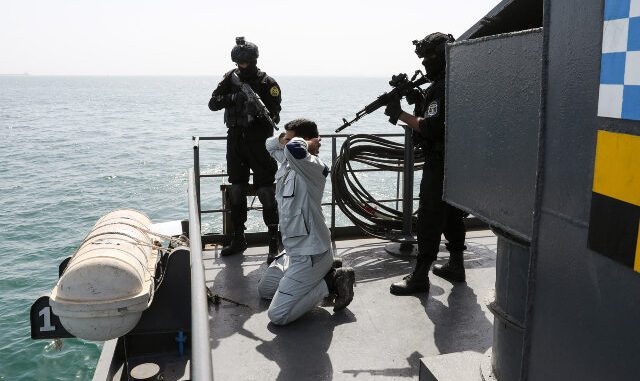
Iranian and Russian naval forces held joint exercises in the Gulf of Oman and the Indian Ocean on Thursday, risking unintended escalation with the growing American force in the region as President Donald Trump contemplates airstrikes against Iran.
In a significant development in Middle Eastern security dynamics, Russia and Iran have launched joint naval exercises in the Gulf of Oman and the northern Indian Ocean, underscoring deepening military cooperation between Moscow and Tehran at a time of heightened tension with the United States.
Details of the Naval Maneuvers
The combined naval exercises commenced on February 18–19, 2026, with forces from the Islamic Republic of Iran Navy, the Islamic Revolutionary Guard Corps Navy (IRGCN), and Russian naval units participating. According to Iranian military sources, the drills include a range of coordinated maritime operations such as:
-
Simulated rescue and anti‑piracy scenarios, including the mock liberation of a hijacked vessel.
-
Aerial reconnaissance and surface maneuvers to test coordination and command‑and‑control.
-
Tactical exercises to improve responsiveness and joint operations.
Iran’s Alvand destroyer, missile‑launching warships, helicopters, and special operations teams took part alongside Russian naval elements such as the Stoikiy corvette.
Iranian officials described the drills as aimed at strengthening maritime security and enhancing cooperation, particularly in protecting shipping routes and improving joint operational capabilities.
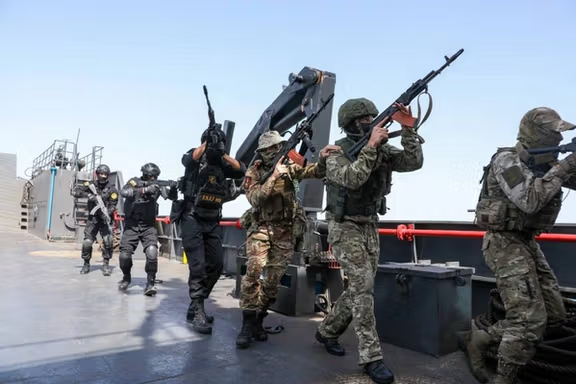
Russia and Iran conducted joint naval exercises on Thursday in the Gulf of Oman and the northern Indian Ocean
Strategic Context and Timing
The naval drills come amid renewed U.S.–Iran tensions, especially over Tehran’s nuclear program and diplomatic deadlock. The United States has responded to stalled talks and perceived provocations by reinforcing its military presence in the Middle East, deploying additional aircraft carriers and warships to the region.
U.S. officials have issued stern warnings to Iran, urging Tehran to make significant concessions in nuclear negotiations, with threats of military action looming if progress stalls. In turn, Iranian leadership has framed its military posture — including naval exercises — as defensive and aimed at protecting national sovereignty and maritime security.
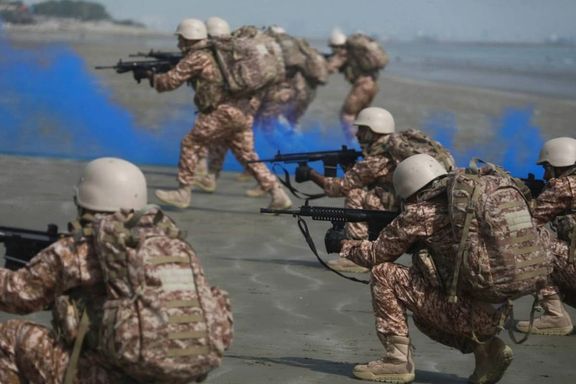
As tensions rise over Tehran’s nuclear program and the United States deploys warships near Iran.
Broader Regional and International Dimensions
While the recent drills involved Russia and Iran, broader iterations of these naval exercises — known as the “Maritime Security Belt” — historically include China as well, reflecting a recurring pattern of trilateral cooperation among Beijing, Moscow, and Tehran.
Analysts note that Moscow and Tehran may be using these joint maneuvers to signal strategic alignment and challenge U.S. naval dominance in a region that hosts vital shipping lanes — particularly the Strait of Hormuz, through which a significant portion of global oil exports transit.
Iran also temporarily closed parts of the Strait of Hormuz in separate live‑fire naval drills earlier in the week, intensifying concerns over security in the world’s most critical maritime chokepoint.
Diplomatic Overlays and Risks of Escalation
The exercises unfold alongside ongoing indirect nuclear negotiations between Tehran and Washington, mediated by Oman in Geneva. Despite some cautious progress reported in talks, disputes over enrichment limits and sanctions relief remain unresolved.
Russia, for its part, has publicly called for restraint and emphasized that the joint drills were planned well in advance, urging restraint amid escalating rhetoric.
However, Western defense analysts warn that such high‑profile military coordination in the same waters where U.S. naval forces have been mobilized — including carrier strike groups — increases the danger of accidental clashes and miscalculations with potentially broader consequences.
 Strategic Implications of Russia-Iran Naval Drills
The joint naval exercises between Russia and Iran carry several implications for global security and U.S. strategic interests:
1. A Direct Challenge to U.S. Naval Dominance
By coordinating high-profile maneuvers in the Gulf of Oman and the Strait of Hormuz, Russia and Iran are signaling a willingness to contest U.S. influence in critical maritime corridors. These waters are vital for global energy supplies, and any disruption could have immediate economic and military consequences. The U.S. may face pressure to increase its naval presence, diverting resources from other global priorities.
2. Strengthening Adversary Alliances
The drills demonstrate a growing military alignment between nations often positioned against U.S. interests. This strengthens their ability to coordinate in crises, conduct joint operations, and potentially counterbalance Western influence in the region. It also highlights the risks of emerging multi-national partnerships that could challenge the strategic balance in key theaters.
3. Risk of Escalation
With U.S. forces already in the region, the exercises raise the risk of miscalculation or accidental conflict. High-tension interactions in international waters could trigger unintended military responses, potentially escalating into larger confrontations. This underscores the importance of maintaining credible deterrence and rapid response capabilities.
4. Implications for Energy Security
The Strait of Hormuz is a chokepoint for roughly a fifth of the world’s oil supply. Any attempt to assert control or disrupt shipping could send global energy prices sharply higher, affecting both domestic energy markets and allies abroad. Maintaining freedom of navigation remains a strategic priority.
5. Message on U.S. Influence
The drills also serve as a political signal: Russia and Iran are demonstrating that U.S. influence is not absolute in the Middle East. By publicly showcasing their military coordination, they are asserting sovereignty and testing Washington’s responses, potentially shaping future diplomatic negotiations.
Bottom line: These naval exercises are more than routine maneuvers—they are a strategic statement, challenging U.S. regional dominance, strengthening adversarial coordination, and elevating the stakes for maritime security, energy stability, and geopolitical leverage.
 Overall Takeaway:
The Russia-Iran naval drills underscore a shifting balance of power in a strategically critical region. While framed as routine exercises, they send a clear message: adversaries are increasingly coordinating to challenge U.S. influence and assert control over key maritime corridors. For policymakers, military planners, and global markets, the exercises serve as a reminder that vigilance, readiness, and strong strategic presence are essential to safeguarding both national interests and regional stability. In an era where maritime dominance and energy security are intertwined, these maneuvers are more than displays of power—they are a test of deterrence, resolve, and the ability to respond decisively to emerging threats.
SOURCES: BREITBART – Iran Holds Joint Naval Drills with Russia, Fearing U.S. Strikes Imminent
THE HILL – Iran holds military drills with Russia amid tensions with US
THE KYIV INDEPENDENT – Russia, Iran hold naval drills as tensions rise over potential US strikes
IRAN INTERNATIONAL – Russia and Iran held joint naval drills in Gulf of Oman