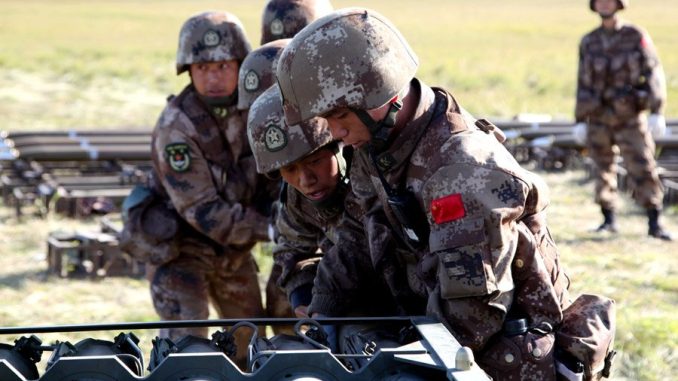
Soldiers from the People’s Liberation Army’s Northern Theater Command prepare for the Vostok-2018 military exercise in Russia’s Trans-Baikal region on Friday. Photo by Pan Mengqi/China Daily.
Reported by:

Cherry Meigh Timbol
News Content Editor
Published October 25, 2026
Russia has agreed to provide military equipment and specialized training to Chinese airborne forces in a partnership that could strengthen Beijing’s ability to conduct a military operation against Taiwan, according to leaked documents examined by researchers at the Royal United Services Institute (RUSI) and reported by The Washington Post in September 2025.
The reported cooperation highlights the growing strategic relationship between Moscow and Beijing. While Russia seeks Chinese economic and industrial support to sustain its war against Ukraine, China is gaining access to Russian military expertise that could help address specific weaknesses in its own armed forces.
Russia’s Military Assistance Could Strengthen China’s Taiwan Options
According to the RUSI analysis published on September 26, 2025, the reported arrangements include training for Chinese airborne troops, specialized parachute systems and equipment designed to support airborne operations.
The documents reportedly describe a package valued at more than $210 million, including amphibious assault vehicles, airborne armored personnel carriers, command vehicles and high-altitude parachute systems. The systems could help Chinese forces deploy troops and equipment beyond conventional amphibious landing zones.
The documents do not explicitly identify Taiwan as the target of the equipment program. Rather, defense analysts assessed that the capabilities could support a potential operation against the island, where China would face the challenge of moving forces ashore while confronting Taiwan’s defenses and the possibility of outside military intervention.
The Associated Press reported that the documents appeared genuine to the researchers who examined them but could not independently authenticate them. The available material also did not establish that China had completed payment for or received all the equipment.
Beijing’s Support Remains Important to Moscow’s War Effort
China’s relationship with Russia extends beyond military equipment. Trade, energy purchases and supplies of dual-use industrial goods have become important to Moscow as Western sanctions restrict its access to technology and markets.
Western governments have repeatedly raised concerns about Chinese companies supplying components and technologies that can be used by Russia’s defense industry. These include drone components, electronics and machine tools.
In October 2025, the Council on Foreign Relations reported that China had expanded support for Russia’s military-industrial capacity through drone supplies and other forms of cooperation, although the precise extent of some alleged intelligence assistance remained uncertain.
In May 2026, Reuters also reported that European intelligence agencies and documents indicated that approximately 200 Russian military personnel had received training in China during late 2025. The instruction reportedly covered drones, electronic warfare, army aviation and armored infantry. Some of the personnel subsequently returned to fight in Ukraine, according to the report.
Beijing rejected the allegations, maintaining that its position on the Ukraine conflict was objective and impartial. The Russian and Chinese defense ministries did not respond to Reuters’ requests for comment on the reported training arrangements.
The developments illustrate a two-way relationship: Russia can offer China specialized military expertise, while China’s industrial capacity and economic ties help Russia sustain its war effort.
Strategic Implications for Taiwan and the United States
For Taiwan, the reported cooperation raises concerns about China’s efforts to develop additional ways of deploying forces during a potential conflict.
An airborne operation would not replace the need to overcome Taiwan’s air defenses, protect supply routes and sustain troops after landing. However, the ability to insert specialized forces and armored vehicles could complicate Taiwan’s defensive planning.
The United States and its regional partners would also have to consider how a crisis in the Taiwan Strait could interact with Russia’s ongoing war against Ukraine. A conflict involving China could require Washington to manage simultaneous security demands in Europe and the Indo-Pacific.
Analysts have suggested that closer Russian-Chinese military cooperation could complicate Western defense planning, although the extent to which Moscow would directly support Beijing in an actual Taiwan conflict remains uncertain.
China-Russia Partnership Is Growing, but It Is Not a Formal Military Alliance
Despite their increasingly close relationship, Russia and China do not have a mutual-defense treaty equivalent to NATO’s collective-defense commitment.
A June 2025 analysis by the Center for European Policy Analysis described the relationship as a partnership with significant military and technological cooperation but also important limits. Both governments share interests in reducing Western influence, yet each retains its own strategic priorities and is not automatically committed to fighting the other’s wars.
That distinction matters when assessing the implications of the reported Taiwan-related training. Military cooperation can strengthen China’s capabilities without proving that Russia has promised to participate in a future conflict.
The available evidence supports the conclusion that Moscow and Beijing are deepening their defense relationship. It does not establish that China has decided to invade Taiwan or that Russia has committed to joining such an operation.