
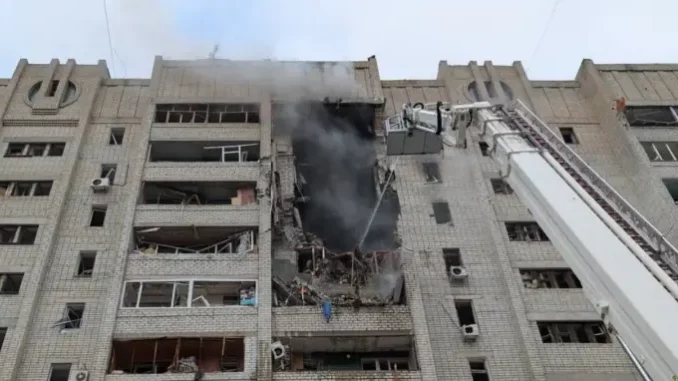
In the morning, the Russian army struck Kharkiv’s Saltivskyi district, hitting an apartment building. Two men were killed, and at least 21 people were injured, including a 5-year-old boy.
Reported by:

Cherry Meigh Timbol
News Content Editor
Published August 9 , 2026
Ukraine — A Russian strike on the Ukrainian city of Kharkiv killed two people and injured at least 21 others, including a 5-year-old boy, on Sunday, August 9, as Russia and Ukraine exchanged overnight drone and missile attacks that left casualties on both sides.
The strike hit a multi-story residential building in Kharkiv’s Saltivskyi district, destroying sections from the seventh through the 10th floors. The two men killed were reported to be 50 and 66 years old. Search-and-rescue operations remained underway.
Russian Strike Hits Residential Building
The Kharkiv attack caused significant damage to a residential high-rise in the city’s Saltivskyi district.
💥 Two men were killed in the strike.
🏢 Floors seven through 10 of the apartment building were destroyed.
👶 A 5-year-old boy was among at least 21 people injured.
🚑 Four injured people were hospitalized, while others received treatment at the scene.
Officials said 11 people suffered blast injuries, two were affected by carbon monoxide poisoning, and eight people—including a child—experienced acute stress reactions.
Odesa Also Hit Overnight
The Russian overnight assault extended beyond Kharkiv.
🚨 Odesa was struck, injuring eight people.
🏠 Residential buildings and vehicles were damaged.
🚀 Ukraine said Russia launched missiles and 202 drones toward the Odesa region.
🛡️ Ukrainian authorities reported that 174 drones were intercepted or suppressed across several parts of the country.
The attacks demonstrate the continued scale of Russia’s long-range aerial campaign against Ukrainian cities and infrastructure.
Ukraine and Russia Exchange Drone Attacks
The overnight strikes were not limited to Russian attacks on Ukraine. Moscow also reported a large Ukrainian drone assault against Russian territory.
🇷🇺 Russia’s Defense Ministry said its forces intercepted and destroyed 153 Ukrainian fixed-wing drones over Russia, occupied Crimea, and the Azov and Black seas.
In Russia’s Belgorod region, acting Governor Alexander Shuvayev reported that 13 people, including two children, were injured. Drone explosions reportedly damaged at least four apartment buildings and caused fires involving vehicles and a private home.
A Widening Cycle of Long-Range Strikes
The latest attacks illustrate how the war continues to increasingly rely on drones and long-range weapons far from the immediate front lines.
🎯 Russia continues striking Ukrainian population centers and infrastructure.
🛰️ Ukraine is increasingly conducting long-range drone operations against targets inside Russia.
⚠️ Civilian casualties remain a major consequence of the expanding aerial campaign.
Both sides have accused each other of attacks, while independent verification of battlefield claims remains difficult.
Human and Security Costs
The casualties in Kharkiv come as Ukraine continues facing sustained aerial pressure.
🏚️ Residential buildings remain vulnerable to missile and drone strikes.
👥 Civilian casualties are continuing on both sides of the border.
🚨 Emergency services are repeatedly being deployed following overnight attacks.
⚠️ The increasing range and scale of drone warfare are expanding the geographic risks of the conflict.
The Kharkiv strike is particularly significant because it directly hit a residential high-rise, producing casualties among civilians, including a young child.
International and Strategic Implications
The latest exchange comes amid continued fighting and growing reliance on long-range strike capabilities by both Moscow and Kyiv.
🌍 Further attacks could increase international pressure for negotiations.
🛡️ Ukraine is likely to continue strengthening its air-defense capabilities.
🚀 Russia may maintain large-scale missile and drone operations against Ukrainian targets.
⚔️ Ukraine is likely to continue seeking ways to strike military and strategic targets inside Russia.
The continuing attacks demonstrate that, despite diplomatic discussions surrounding the war, the military confrontation remains highly active.
👥 Public / Political Reactions:
⚠️ Resulting Effects:
The latest Russian and Ukrainian strikes are producing significant humanitarian, military, and geopolitical consequences. The attacks on Kharkiv, Odesa, and Russian regions demonstrate that the war’s long-range strike campaign remains intense, with civilians continuing to bear much of the immediate cost.
1. Rising Civilian Casualties
The strikes have resulted in deaths and injuries among civilians on both sides.
💥 Two people were killed in the Kharkiv attack.
👶 A 5-year-old child was among those injured.
🏠 Residential buildings were damaged in Ukraine and Russia.
➡️ Result: Intensifying airstrikes → increasing civilian casualties and humanitarian pressure.
2. Destruction of Residential Infrastructure
The attacks caused substantial damage to civilian properties.
🏢 Sections of a Kharkiv apartment building were destroyed.
🏠 Residential structures in Russia were also reportedly damaged.
🚗 Vehicles and private property were affected.
➡️ Result: Expanding strike campaign → greater destruction of civilian infrastructure.
3. Escalation of Drone Warfare
Both Russia and Ukraine continue to rely heavily on drones for long-range attacks.
🚀 Russia launched large-scale drone and missile attacks against Ukraine.
🛰️ Ukraine conducted extensive drone operations against Russian territory.
🎯 Strategic targets increasingly lie far from the front lines.
➡️ Result: Increased drone operations → broader geographic reach of the conflict.
4. Greater Pressure on Air Defenses
The scale of the attacks is placing additional demands on both countries’ defensive systems.
🛡️ Ukraine must defend major cities against waves of Russian drones and missiles.
🇷🇺 Russia is increasing efforts to intercept Ukrainian drones.
⚠️ Saturation attacks could challenge existing air-defense capabilities.
➡️ Result: Larger attack waves → increased pressure on air-defense networks.
5. Humanitarian and Emergency Pressure
Repeated attacks are placing sustained pressure on emergency services.
🚑 Medical teams are treating increasing numbers of casualties.
🚒 Firefighters and rescue workers are responding to damaged buildings.
👥 Displaced residents may require temporary shelter and assistance.
➡️ Result: Repeated strikes → greater humanitarian and emergency-service demands.
6. Increased Risk to Major Ukrainian Cities
The latest attack reinforces concerns about the vulnerability of urban areas.
🏙️ Kharkiv remains particularly exposed because of its proximity to Russia.
🌆 Odesa and other major cities remain vulnerable to long-range attacks.
⚠️ Civilian areas could face further strikes.
➡️ Result: Continued Russian aerial campaign → persistent danger to urban populations.
7. Expansion of the War Inside Russia
Ukrainian long-range drone attacks are increasingly bringing the effects of the war deeper into Russian territory.
🇷🇺 Belgorod and other Russian regions remain vulnerable to Ukrainian drone operations.
🎯 Military and strategic targets inside Russia could increasingly be targeted.
🏠 Civilian areas may also experience collateral damage.
➡️ Result: Ukrainian long-range strikes → wider geographic impact of the war.
8. Greater International Pressure
The civilian casualties and expanding aerial campaign could increase diplomatic pressure on both sides.
🌍 International governments may call for greater civilian protection.
🤝 Pressure for negotiations and ceasefire efforts could increase.
⚠️ Continued escalation could make diplomatic efforts more difficult.
➡️ Result: Rising humanitarian costs → stronger international pressure for de-escalation.
🔮 Future Outlook:
The latest wave of Russian and Ukrainian drone and missile attacks suggests that the Russia–Ukraine war is likely to remain highly active in the near term. Both sides are expanding their long-range strike capabilities while continuing to target military, logistical, and strategic infrastructure.
1. More Deep-Strike Drone Operations
Ukraine is expected to continue targeting military and logistical assets inside Russian territory.
🎯 Drone attacks may increasingly focus on airfields, ammunition depots, fuel facilities, and defense-related sites.
🛰️ Longer-range drones could allow Ukraine to reach targets farther from the front lines.
💥 Russia is likely to respond with additional strikes against Ukrainian cities and infrastructure.
➡️ Outlook: Expanding deep strikes → wider geographic reach of the war.
2. Continued Russian Missile and Drone Attacks
Russia is likely to maintain large-scale aerial attacks against Ukraine.
🚀 Kharkiv, Odesa, Kyiv, and other major cities could remain vulnerable.
🏭 Energy, transportation, and military infrastructure may remain key targets.
⚠️ Civilian casualties could continue if populated areas are hit.
➡️ Outlook: Sustained Russian bombardment → continued pressure on Ukrainian cities.
3. Escalation of Drone Warfare
Drones are becoming increasingly central to military operations.
🤖 Both sides may deploy larger numbers of drones.
📡 Electronic warfare and counter-drone technology will become increasingly important.
⚔️ Saturation attacks could challenge air-defense systems.
➡️ Outlook: Rapid drone expansion → increasingly intense and technologically complex warfare.
4. Greater Pressure on Air Defenses
The scale of attacks will continue testing both countries’ defensive capabilities.
🛡️ Ukraine will seek additional air-defense systems and interceptors.
🇷🇺 Russia will continue strengthening defenses around vulnerable regions.
💰 Both sides will face growing costs associated with protecting territory and infrastructure.
➡️ Outlook: More aerial attacks → greater demand for effective air defenses.
5. Rising Risk to Civilian Populations
Civilians are likely to remain exposed as strikes become more frequent and geographically dispersed.
🏠 Residential buildings could continue to be damaged.
👥 More communities may face displacement and emergency disruptions.
🚑 Rescue and medical services will remain under pressure.
➡️ Outlook: Continued aerial warfare → persistent humanitarian risks.
6. Strategic Infrastructure Under Greater Threat
Both Russia and Ukraine are likely to increase attacks against infrastructure that supports military operations.
⚡ Energy facilities could remain major targets.
🚆 Railways and supply routes may face increased attacks.
🏭 Defense and industrial facilities could become increasingly important objectives.
➡️ Outlook: Strategic targeting → greater disruption of military and economic networks.
7. Increased International Pressure
Continued civilian casualties could intensify international calls for negotiations.
🌍 Foreign governments may push for renewed diplomatic efforts.
🤝 Pressure for a ceasefire could increase.
🕊️ Humanitarian concerns may become more prominent in international discussions.
➡️ Outlook: Rising humanitarian costs → stronger pressure for diplomacy.
8. Uncertain Path to Resolution
A decisive breakthrough remains difficult while both sides continue military operations.
⚖️ Major differences between Moscow and Kyiv remain unresolved.
⚔️ Both sides continue seeking battlefield and strategic advantages.
⏳ Prolonged aerial attacks could keep the conflict active for months.
➡️ Outlook: Continued military confrontation → uncertain prospects for a lasting peace.
🧩 Bottom Line:
The latest wave of Russian and Ukrainian drone and missile attacks highlights the continuing escalation of long-range warfare and the growing danger faced by civilians on both sides. The deadly strike in Kharkiv, alongside casualties from Ukrainian drone attacks inside Russia, demonstrates that the conflict is increasingly extending beyond the traditional front lines.
🇺🇦 For Ukraine, the attacks reinforce the urgent need for stronger air-defense systems, additional interceptors, and greater protection for major population centers.
🇷🇺 For Russia, Ukrainian deep-strike drone operations demonstrate the growing ability of Kyiv to bring the consequences of the war deeper into Russian territory.
🛡️ For both sides, the expanding use of drones and missiles is placing greater pressure on air-defense networks, military infrastructure, energy facilities, and logistical routes.
🌍 For the international community, continued civilian casualties and expanding attacks increase pressure for diplomatic efforts while raising concerns about the war becoming even more geographically widespread.
👥 For civilians, residential areas remain dangerously exposed as both sides increasingly rely on long-range weapons and mass drone attacks.
⚠️ Bottom Line: Russia and Ukraine are entering an increasingly intense phase of long-range warfare, with drones and missiles becoming central to the conflict. Unless meaningful diplomatic progress leads to a reduction in hostilities, further attacks, civilian casualties, and infrastructure damage are likely to continue.
SOURCES: UNN – Russian strike on Kharkiv on August 9 — two killed, 21 injured, including a child
ANADOLU AJANSI – 2 killed, 42 injured in overnight strikes on Russia, Ukraine
UA NEWS – Three people were killed and 27 others were wounded in three regions as a result of Russian attacks




