
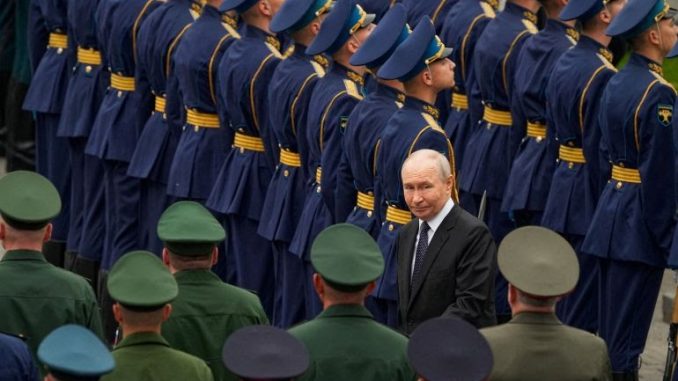
Russian President Vladimir Putin arrives for a wreath-laying ceremony marking the 85th anniversary of the Nazi German invasion into the Soviet Union in World War II, on the Remembrance and Sorrow Day at the Tomb of the Unknown Soldier by the Kremlin wall in Moscow, Russia June 22, 2026. Alexander Zemlianichenko/Pool via REUTERS TPX IMAGES OF THE DAY
Published July 4, 2026
After months of projecting confidence on the battlefield, Russia is confronting a new challenge as Ukraine increasingly relies on asymmetrical tactics designed to offset Moscow’s larger military and industrial advantages. Long-range drone strikes, sabotage operations, and precision attacks deep inside Russian territory are forcing the Kremlin to rethink how it protects critical infrastructure while sustaining its war effort.
Military analysts say Ukraine’s evolving strategy reflects the realities of a prolonged conflict in which direct conventional battles increasingly favor Russia’s numerical superiority. Instead, Kyiv appears focused on imposing costs through targeted operations that disrupt logistics, damage strategic assets, and undermine Russia’s sense of security.
A Shift in Ukraine’s Strategy
Unable to match Russia in manpower and ammunition production, Ukraine has expanded its use of domestically produced long-range drones and special operations.
Recent strikes have targeted ammunition depots, fuel storage facilities, military airfields, transportation hubs, and defense-related industries located hundreds of miles from the front lines. Ukrainian officials argue these operations are intended to weaken Russia’s military capabilities while reducing pressure on Ukrainian defensive positions.
Russia Responds
Russian authorities have acknowledged several drone incursions but maintain that air defense systems continue intercepting the majority of incoming attacks.
At the same time, Moscow has intensified missile and drone strikes against Ukrainian cities and infrastructure, insisting that its military objectives remain unchanged. Russian officials continue to express confidence that their forces retain the initiative despite Ukraine’s expanding use of unconventional tactics.
The Growing Role of Technology
The conflict has increasingly become a contest of innovation.
Ukraine has relied heavily on relatively inexpensive drones, electronic warfare, and intelligence-driven targeting to challenge a larger conventional force. These systems allow Kyiv to strike strategic locations without committing large numbers of troops to high-risk offensives.
Defense experts note that modern conflicts increasingly reward technological adaptation, making inexpensive unmanned systems capable of producing outsized strategic effects.
Strategic Implications
Ukraine’s approach reflects a broader military principle: when facing a stronger conventional opponent, smaller forces often seek to exploit vulnerabilities rather than engage head-on.
While these operations may not dramatically alter territorial control in the short term, they can force Russia to divert personnel, strengthen homeland defenses, and invest additional resources in protecting military infrastructure far from the battlefield.
 Final Thoughts:
The war in Ukraine has become more than a contest of military strength—it is a test of endurance, innovation, and national resolve. Ukraine’s growing use of asymmetrical tactics demonstrates that a smaller force can still challenge a larger adversary by exploiting vulnerabilities rather than confronting them head-on. At the same time, the conflict serves as a reminder that prolonged wars rarely produce clear winners. Every new tactic invites a countermeasure, extending the fighting and increasing the human and economic costs. Whether through diplomacy or continued military pressure, the ultimate goal should be a durable peace that preserves security and prevents an even wider conflict.




