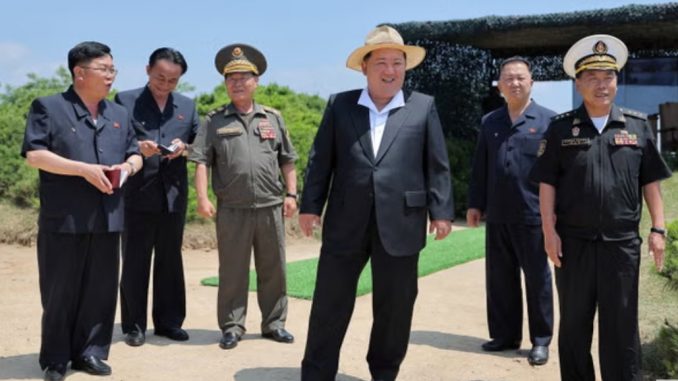
North Korean leader Kim Jong Un reacts on the day of an assessment of the newly built naval destroyer Kang Kon’s combat systems, including the test firing of a strategic cruise missile, at an unknown location in North Korea, 3 July 2026, in this picture released 5 July 2026 by North Korea’s official Korean Central News Agency (Reuters)
Published July 5, 2026
SEOUL — North Korean leader Kim Jong Un has supervised a series of naval weapons tests involving a newly developed destroyer, including cruise missile launches and evaluations of advanced electronic warfare systems, according to state media reports cited by multiple international outlets.
The exercises were conducted aboard the newly built 5,000-ton destroyer Kang Kon, which recently underwent repairs after a failed launch attempt last year. The tests included the firing of strategic cruise missiles as well as assessments of the ship’s radar systems, target detection capabilities, integrated fire control, and anti-aircraft and anti-submarine weapons systems.
During the inspection, Kim reportedly observed the missile launches and weapons demonstrations firsthand and reviewed the ship’s overall combat readiness. State media said he ordered officials to complete final trials and commission the vessel into active service within the coming months.
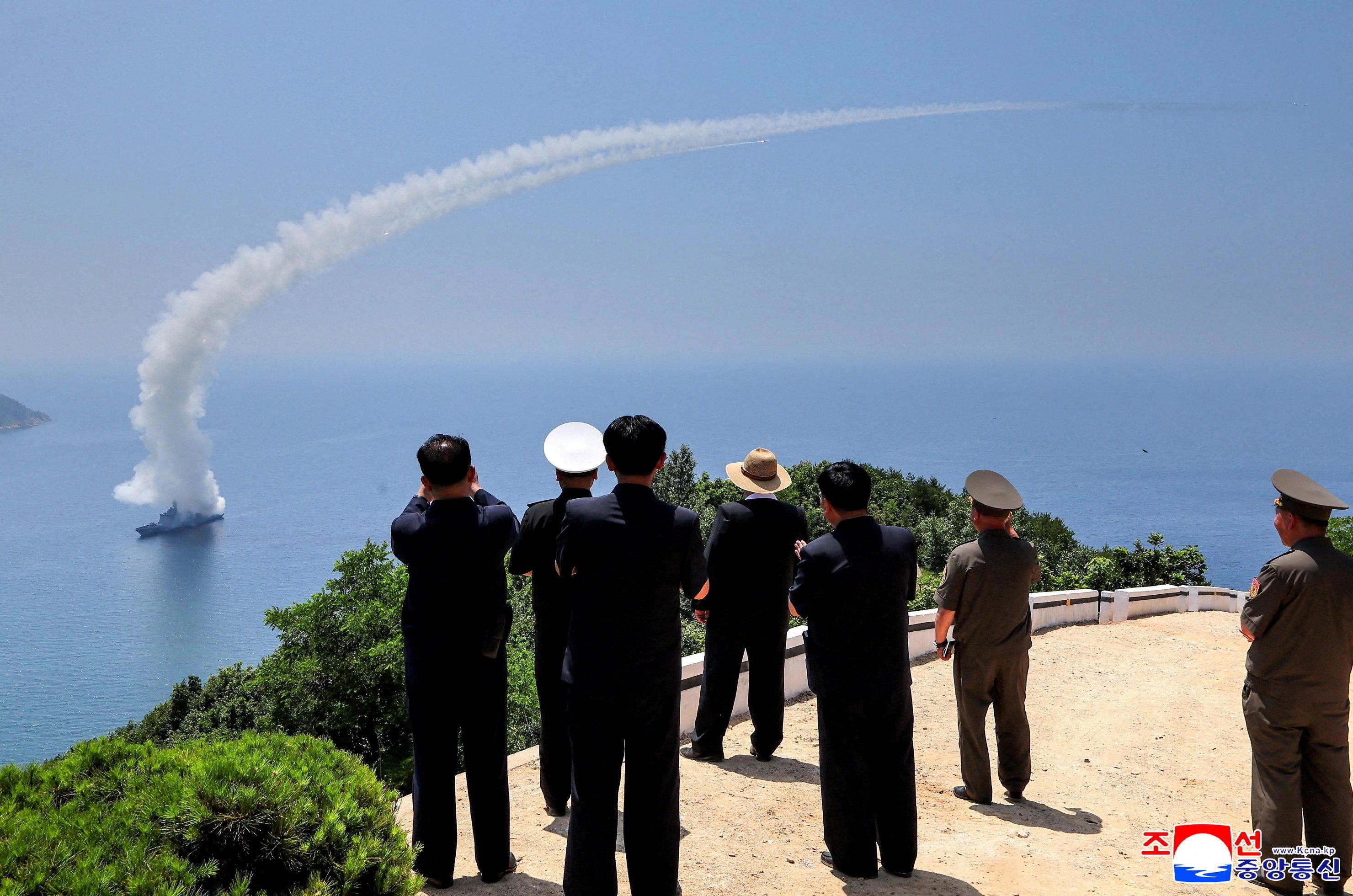 North Korean leader Kim Jong Un observes an assessment of the newly built naval destroyer Kang Kon’s combat systems, including the test firing of a strategic cruise missile, at an unknown location in North Korea, 3 July 2026, in this picture released 5 July 2026 by North Korea’s official Korean Central News Agency (Reuters)
The latest demonstrations mark another step in North Korea’s broader push to modernize and expand its naval capabilities, which have traditionally lagged behind its missile and land-based forces. The focus on destroyer-class vessels reflects a shift toward enhancing maritime strike capability and strengthening the country’s ability to project power beyond its coastline.
Officials in Pyongyang have emphasized that the naval program is part of a wider five-year military development plan aimed at improving strategic deterrence. This includes the development of larger surface vessels, expanded missile systems, and integration of electronic warfare technologies designed to counter regional surveillance and missile defense networks.
The Kang Kon is one of a new generation of destroyers that North Korea has showcased as part of its naval modernization effort. Another vessel of the same class was commissioned earlier this year, signaling an accelerated pace of development in the country’s shipbuilding program.
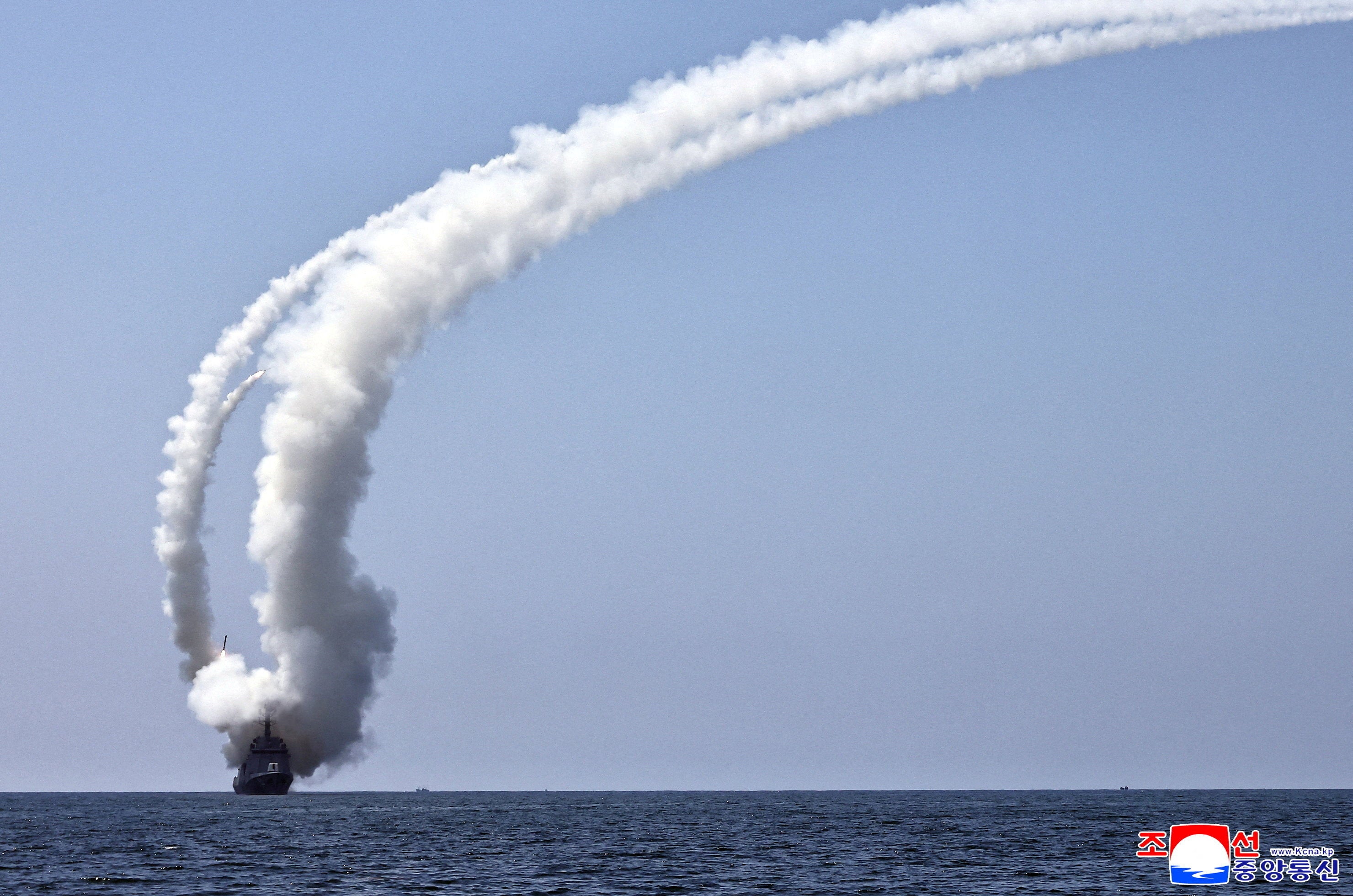
(Reuters)
South Korean officials and
Analysts note that while North Korea frequently highlights advances in weapons testing, questions remain over the operational readiness and technological sophistication of its new platforms. However, the repeated emphasis on naval missile systems suggests a strategic intention to diversify its deterrence capabilities beyond its established land-based missile arsenal.
The latest activity also comes amid heightened tensions on the Korean Peninsula, where military exercises and weapons demonstrations by both North Korea and its regional rivals have contributed to a sustained cycle of escalation and counter-escalation.
As North Korea continues to expand its naval capabilities, regional observers are closely monitoring whether the new destroyer program represents a significant shift in military balance or primarily serves as a symbolic demonstration of technological progress.
For now, Kim’s latest inspection underscores Pyongyang’s continued focus on military modernization and its determination to present itself as a developing multi-domain nuclear and missile power.
 Public / Political Reactions:
🇰🇵 North Korean Government
North Korea portrayed the naval destroyer tests as evidence of growing military self-reliance and strategic strength.
- State media reported that Kim Jong Un personally oversaw missile launches and electronic warfare evaluations aboard the newly developed destroyer.
- Officials emphasized that the exercises demonstrate progress in modernizing naval combat systems, including cruise missile integration and multi-role warship capability.
- The leadership framed the tests as part of a broader effort to strengthen national defense and deter external threats.
➡️ Position: Pyongyang presents the tests as a milestone in advancing naval deterrence and overall military modernization.
🇺🇸 United States
The United States expressed concern over North Korea’s continued weapons development and missile testing activities.
- Washington has consistently condemned North Korea’s ballistic and cruise missile launches as violations of UN Security Council resolutions.
- U.S. defense officials continue to monitor the expansion of North Korea’s naval and strategic weapons programs.
- Diplomatic efforts toward denuclearization remain stalled, with limited engagement between both sides.
➡️ Position: The U.S. views the tests as destabilizing actions that increase regional security risks.
🇰🇷 South Korea
South Korea responded by reaffirming its defense readiness and close coordination with allies.
- Seoul’s military stated it is tracking North Korean naval developments and missile activities in real time.
- Officials emphasized the importance of joint U.S.–South Korea defense cooperation in responding to evolving threats.
- The South Korean government warned that continued provocations could further escalate tensions on the Korean Peninsula.
➡️ Position: South Korea sees the tests as part of an ongoing escalation requiring strengthened deterrence.
🇯🇵 Japan
Japan expressed alarm over North Korea’s expanding missile and naval capabilities.
- Japanese defense officials highlighted the potential threat posed by cruise missile systems with improved range and precision.
- Tokyo continues to strengthen missile defense systems and regional surveillance cooperation.
- The government reiterated that North Korea’s weapons development poses a direct threat to regional stability.
➡️ Position: Japan views the developments as a serious security concern requiring enhanced defensive measures.
🌍 International Community
Global observers and security analysts reacted with caution, noting both the symbolic and strategic implications.
- The United Nations has repeatedly called for North Korea to halt weapons testing activities.
- Analysts suggest the naval demonstrations may serve both military modernization goals and domestic political messaging.
- Regional experts warn that continued tests could further strain diplomatic channels and deepen isolation.
➡️ Position: International actors remain concerned about escalation and the lack of diplomatic progress.
👥 Public and Expert Reaction
Reactions among analysts and observers have been mixed, focusing on both capability and intent.
- Some experts question the operational readiness of North Korea’s new destroyer-class vessels despite frequent demonstrations.
- Others note that even partially functional systems contribute to North Korea’s deterrence posture.
- Public discussion in regional media highlights concerns over rising military tensions in East Asia.
➡️ Position: Analysts remain divided between skepticism of capability and concern over strategic escalation.
 Resulting Effects:
North Korea’s latest naval destroyer tests and missile demonstrations have produced a series of strategic, regional, and diplomatic consequences. While Pyongyang frames the developments as defensive modernization, neighboring countries and global observers see them as part of a broader pattern of military escalation.
1. Expanded Naval and Missile Capabilities
The destroyer tests highlight North Korea’s continued push to modernize its military forces across multiple domains.
⚓ The integration of cruise missiles with naval platforms signals improved multi-role strike capability.
🚀 Electronic warfare and targeting systems suggest efforts to enhance survivability and combat coordination.
🧭 Naval modernization expands North Korea’s ability to project power beyond land-based missile systems.
➡️ Result: Weapons testing → gradual expansion of multi-domain military capability.
2. Heightened Regional Security Concerns
Neighboring states have responded with increased vigilance and defensive preparations.
🛡️ South Korea continues to monitor North Korean naval and missile activity in real time.
🎯 Japan has raised concerns over cruise missile range and potential strike capability.
🌏 Regional defense planning increasingly accounts for maritime-based missile threats.
➡️ Result: Weapons demonstrations → stronger regional defense posture and surveillance activity.
3. Increased Military Coordination Among Allies
North Korea’s activities are reinforcing defense cooperation between regional allies.
🤝 The United States and South Korea continue joint military coordination and intelligence sharing.
📡 Japan strengthens early-warning systems and missile defense integration with allies.
🚨 Combined exercises are increasingly focused on missile interception and maritime threats.
➡️ Result: North Korean testing → deeper allied military coordination in East Asia.
4. Diplomatic Stalemate Continues
The tests contribute to an already stalled diplomatic environment.
🕊️ Denuclearization talks remain inactive with no direct negotiations underway.
📉 Trust between North Korea and Western states remains extremely low.
⚖️ UN resolutions condemning missile tests remain unenforced diplomatically.
➡️ Result: Continued testing → prolonged diplomatic deadlock.
5. Strengthening of North Korea’s Deterrence Narrative
Domestically and internationally, the tests reinforce Pyongyang’s strategic messaging.
📢 State media portrays the destroyer program as evidence of technological progress.
🏛️ Leadership uses military demonstrations to reinforce internal political legitimacy.
⚔️ North Korea positions itself as a developing multi-domain nuclear and missile power.
➡️ Result: Military displays → reinforced deterrence posture and domestic messaging.
6. Rising Risk of Miscalculation in the Region
Experts warn that continued testing and counter-military responses increase the risk of tension escalation.
⚠️ Close monitoring and frequent military activity increase chances of misunderstanding.
📡 Expanded missile and naval operations raise alert levels across the region.
🌐 The security environment in East Asia remains highly sensitive and reactive.
➡️ Result: Ongoing escalation cycle → persistent regional instability risks.
 Future Outlook:
North Korea’s latest naval destroyer tests and missile launches suggest that Pyongyang is likely to continue expanding its military modernization program, particularly in naval and strategic weapons systems. The trajectory points toward sustained development activity alongside continued regional tension and limited diplomatic engagement.
1. Continued Weapons Testing and Naval Development
North Korea is expected to maintain an active testing schedule as it refines its new destroyer-class vessels and related systems.
⚓ Further sea trials and missile integration tests are likely for newly developed warships.
🚀 Cruise missile and electronic warfare capabilities may be tested in additional configurations.
🧭 Naval expansion will likely remain a central component of military modernization plans.
➡️ Outlook: Ongoing development → continued naval and missile testing activity.
2. Strengthening of Regional Missile Defenses
Neighboring countries are expected to further enhance their defensive readiness in response to North Korean advancements.
🛡️ South Korea will likely expand surveillance and interception capabilities.
🎯 Japan is expected to continue strengthening missile defense systems.
🤝 Coordination with the United States will remain central to regional deterrence.
➡️ Outlook: Persistent testing → expanded regional missile defense posture.
3. Stalled Diplomatic Engagement
Diplomatic progress on denuclearization and arms control is expected to remain limited.
🕊️ Direct talks between North Korea and Western countries are unlikely in the near term.
📉 Sanctions and political isolation will likely remain in place.
⚖️ International pressure is expected to continue through multilateral forums.
➡️ Outlook: Military focus → continued diplomatic stagnation.
4. Increased Military Signaling and Strategic Messaging
North Korea is likely to continue using weapons demonstrations as a form of strategic communication.
📢 State media will emphasize military achievements to reinforce domestic legitimacy.
⚔️ Demonstrations may be timed to coincide with regional political developments.
🌐 Testing activity will likely serve both technical and political objectives.
➡️ Outlook: Ongoing tests → sustained strategic signaling to domestic and international audiences.
5. Continued Regional Tensions and Security Competition
The security environment in East Asia is expected to remain highly sensitive.
⚠️ Military readiness levels across the region will likely stay elevated.
📡 Surveillance and intelligence monitoring will intensify among regional powers.
🌏 The cycle of testing and countermeasures is expected to continue.
➡️ Outlook: Mutual escalation dynamics → persistent regional tension.
6. Risk of Further Escalation Remains
While direct conflict is not imminent, the risk of miscalculation remains present.
🚨 Close military monitoring increases the chance of misunderstanding or misinterpretation.
🌐 Rapid technological development in missile systems raises strategic uncertainty.
📉 The absence of diplomatic channels increases long-term instability risks.
➡️ Outlook: Continued modernization → sustained risk of regional escalation.
 Bottom Line:
North Korea’s latest naval destroyer tests and missile launches underscore its continued push to modernize and diversify its military capabilities, even as international sanctions and diplomatic isolation remain in place. By showcasing advances in naval strike systems and electronic warfare, Pyongyang is signaling a shift toward more complex, multi-domain military operations.
For regional powers such as South Korea, Japan, and the United States, the developments reinforce existing concerns over missile defense readiness and long-term stability in East Asia. While North Korea presents these tests as defensive deterrence, neighboring countries view them as part of a broader pattern of escalation that increases security risks.
With diplomacy effectively stalled, the situation remains defined by military signaling, countermeasures, and rising mistrust. The trajectory suggests that without renewed negotiations or confidence-building measures, North Korea’s weapons development will continue to shape regional security dynamics in the months ahead.
SOURCES: THE INDEPENDENT – Kim Jong Un oversees cruise missile launch from North Korea’s new destroyer
JORDAN NEWS – North Korea Tests New Strategic Missile and Electronic Warfare Systems
REUTERS – North Korea’s Kim observed naval destroyer cruise missile launch, weapons tests, state media says