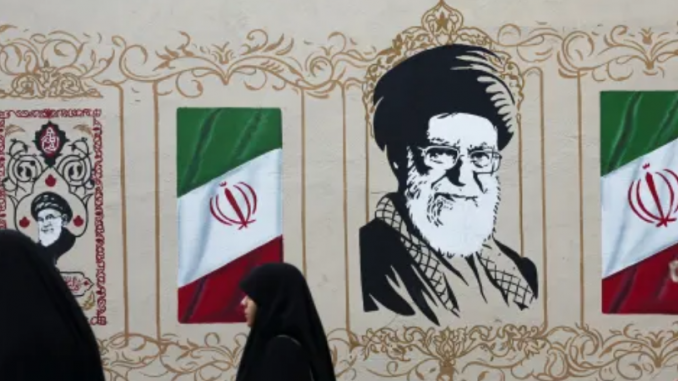
People walk by a mural depicting Iran’s late Supreme Leader Ayatollah Ali Khamenei, on a street in Tehran, Iran, August 13, 2026. [Majid Asgaripour/WANA via Reuters]
Reported by:

Cherry Meigh Timbol
News Content Editor
Published August 14, 2026
TEHRAN, Iran — Iran and the United States are locked in a growing confrontation over the Strait of Hormuz, with Tehran insisting it controls and manages the strategic waterway while President Donald Trump says the United States has “total control” and may keep it.
The competing claims came Thursday as the broader U.S.-Iran conflict continued and negotiations over the future of the strait remained unresolved. The dispute has raised concerns over global shipping and energy supplies because the waterway is one of the world’s most important routes for oil and liquefied natural gas.
Iran Rejects Trump’s Claim
Iran’s military rejected Trump’s assertion that the United States controls the Strait of Hormuz.
Iranian military spokesman Ebrahim Zolfaghari said American claims that vessels were freely passing through the waterway were false, maintaining that the strait remained under the “complete management and control” of Iran.
According to the Iranian military, commercial ships and tankers would not be able to safely pass without permission and supervision from Iranian forces.
The head of Iran’s Basij paramilitary force, Hossein Taeb, separately declared that the waterway was under Iranian control, according to Reuters reporting carried by Iran’s semi-official Fars news agency.
Iran’s position is that the strait will remain restricted until Tehran’s conditions are met.
Trump Says U.S. Has “Total Control”
Trump made the opposing claim Wednesday, saying the United States had “total control over the Strait of Hormuz.”
The president subsequently indicated that Washington could retain control of the strategic waterway.
Trump also described the U.S. naval blockade as a “wall of steel,” arguing that Iran was incapable of preventing American forces from maintaining the blockade.
The statements represent a dramatic escalation in the rhetoric surrounding the waterway, with both sides effectively claiming the strategic upper hand.
Strait Remains Largely Blocked
Despite the competing declarations, available shipping data indicate that commercial traffic through Hormuz remains severely reduced.
CBS News reported that only eight vessels transited the strait on Tuesday, below a 10-day average of roughly 12 and the lowest daily figure recorded since August 5.
Iran has maintained that the waterway will not return to normal commercial traffic until its conditions are accepted.
Those demands have included an end to the U.S. naval blockade, sanctions relief and the unfreezing of Iranian assets. Tehran has also demanded compensation related to the war.
A Critical Chokepoint for Global Energy
The Strait of Hormuz is strategically important because enormous quantities of energy supplies normally pass through the narrow waterway.
Before the current conflict, approximately one-fifth of global oil and liquefied natural gas flows moved through the strait, making prolonged disruption a potential threat to international energy markets.
Any sustained reduction in shipping could therefore affect fuel prices, insurance costs and supply chains well beyond the Persian Gulf.
The consequences are particularly significant for Asian economies that depend heavily on Middle Eastern energy exports.
U.S. Blockade Adds Pressure
The United States has responded to Iran’s restrictions by establishing a naval blockade around Iranian ports while maintaining that the operation is intended to protect freedom of navigation for non-Iranian shipping.
U.S. Defense Secretary Pete Hegseth said Thursday that the Navy could sustain the blockade indefinitely by rotating ships into and out of the region.
The Pentagon’s position suggests Washington is prepared for a prolonged confrontation if negotiations fail.
At the same time, maintaining a large naval force around one of the world’s busiest energy chokepoints creates additional risks of confrontation between American and Iranian forces.
Talks Remain Stalled
The dispute over Hormuz has become one of the central obstacles to broader efforts to end the war.
Iran has been negotiating with Oman over arrangements concerning the waterway, while Washington has sought to maintain pressure on Tehran through its blockade and sanctions.
Al Jazeera reported that wider U.S.-Iran peace negotiations have remained largely stalled while the separate discussions over Hormuz continue.
The disagreement is particularly difficult because the two sides appear to have fundamentally different interpretations of what reopening the waterway would require.
Washington wants unrestricted commercial navigation, while Tehran insists that the United States must first change its policies and accept Iranian conditions.
Risk to Global Markets
The uncertainty surrounding Hormuz has already created concerns across global energy markets.
Oil and gas traders are closely monitoring shipping activity because any further deterioration could push prices higher and increase pressure on countries dependent on imported energy.
The longer the standoff continues, the greater the potential economic consequences.
A prolonged closure could also force shipping companies to seek alternative routes, increasing transportation costs and extending delivery times.
The Larger Strategic Battle
The confrontation over Hormuz is about more than commercial shipping.
For Iran, maintaining influence over the waterway gives Tehran a powerful bargaining tool against the United States and its regional allies.
For Washington, allowing Iran to dictate access through the strait would represent a major strategic setback and potentially undermine the principle of freedom of navigation.
That makes the competing claims of control particularly significant.
Neither side appears willing to publicly concede the initiative.
Key Developments
- Iran says it controls and manages the Strait of Hormuz.
- Trump says the United States has total control of the waterway.
- Commercial traffic remains severely reduced.
- Iran says the strait will remain restricted until its conditions are accepted.
- The U.S. says its naval blockade can continue indefinitely.
- Diplomatic efforts involving Oman remain focused on reopening the waterway.
- The standoff threatens to keep pressure on global energy markets.
🧩 Bottom Line:
The battle over the Strait of Hormuz has become a high-stakes contest of military power, economic pressure and political leverage between Washington and Tehran.
Trump’s declaration that the United States has “total control” directly clashes with Iran’s insistence that the waterway remains under its authority. Meanwhile, the sharply reduced shipping traffic suggests that, regardless of which side’s rhetoric ultimately prevails, normal commercial passage through Hormuz has not been restored.
The central question now is whether the United States and Iran can reach an agreement that reopens the waterway—or whether the competing claims over Hormuz will become another trigger for a broader escalation.
For the global economy, the stakes extend far beyond Iran and the United States: the longer Hormuz remains effectively restricted, the greater the risk to energy prices, international shipping and global markets.
SOURCES: AL JAZEERA – Tehran says Strait of Hormuz “under Iran’s control” after Trump threatens U.S. might “keep it”
CBS NEWS – Tehran says Strait of Hormuz “under Iran’s control” after Trump threatens U.S. might “keep it”