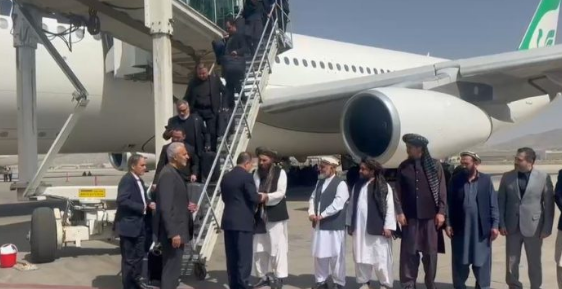
Iran’s Agriculture Minister Gholam-Reza Nouri has arrived in Kabul at the head of an Iranian delegation for meetings with Kabul officials, Iran’s embassy in Afghanistan said Wednesday.
Reported by:

Cherry Meigh Timbol
News Content Editor
Published August 14, 2026
KABUL, Afghanistan — Iran has sent its agriculture minister to Kabul for high-level talks with Taliban officials, signaling Tehran’s continued push to deepen economic, agricultural and trade relations with Afghanistan’s Taliban-led government.
Iranian Agriculture Minister Gholamreza Nouri Ghezeljeh arrived in Kabul on August 12 at the head of a delegation and was scheduled to meet senior Afghan officials while visiting Afghanistan’s international agriculture and livestock exhibition. Iranian and Afghan officials have described the visit as part of efforts to expand cooperation across multiple economic sectors.
The visit comes as Tehran and Kabul continue developing practical relations despite the Taliban government’s lack of broad international recognition.
Iran Targets Expanded Trade and Agricultural Cooperation
Nouri Ghezeljeh’s visit goes beyond agriculture.
The Iranian minister serves as Tehran’s representative on the Iran-Afghanistan Joint Economic Commission, making his trip an important vehicle for discussions on broader bilateral trade and economic cooperation. He said meetings with Afghan counterparts would focus on expanding engagement between the two countries.
Afghanistan’s Ministry of Commerce and Industry said Afghan Commerce Minister Nooruddin Azizi met Nouri Ghezeljeh in Kabul to discuss expanding economic, trade and agricultural cooperation.
Among the issues discussed were increasing exports of Afghan carpets and rugs to Iran, removing transit restrictions affecting Afghan goods traveling through Iranian territory, and reaching a quarantine agreement.
Those discussions could have direct implications for Afghan exporters, particularly businesses dependent on Iranian transit routes to reach regional markets.
Agriculture at the Center of the Talks
Agriculture is one of the main areas where Tehran appears to see opportunities for deeper cooperation.
Afghanistan International reported that Nouri had previously met Afghanistan’s deputy agriculture minister in Tehran in May 2025, when he offered Iranian agricultural technical and engineering services as well as modern technology to Afghanistan.
Iran also proposed establishing a joint committee in Kabul to coordinate agricultural cooperation and expressed interest in participating in development projects, improving farming practices and negotiating longer-term agreements designed to improve the livelihoods of Afghan farmers.
Khaama Press likewise reported that Iran and Afghanistan already maintain economic and trade ties involving agricultural products, while Tehran remains one of Afghanistan’s significant trading partners.
Tehran Seeks Broader Economic Engagement
The Iranian delegation’s presence in Kabul is part of a wider effort by Tehran to expand its economic relationship with Afghanistan.
Iran and Afghanistan have a long land border and extensive commercial connections. Iranian goods have historically supplied Afghan markets, while Afghanistan relies on Iranian territory and infrastructure for portions of its regional trade.
Iran has also sought to position itself as an important transit route for Afghanistan, particularly through its southern ports and transportation networks.
Previous Iranian statements have emphasized the potential for expanded trade, investment and regional connectivity between the two countries. The Tehran Times reported in 2025 that Iranian officials viewed stronger economic cooperation with Afghanistan as a means of developing longer-term regional partnerships.
Relations Have Become More Pragmatic
The growing economic engagement is notable because Iran and the Taliban have historically had a complicated relationship.
Iran is governed by a Shiite Islamist system, while the Taliban follows a Sunni Islamist ideology. The two sides have also had disputes over border security, Afghan migration and water resources.
Yet Tehran maintained its embassy in Kabul after the Taliban seized power in August 2021 and gradually expanded official contacts with the new authorities. The relationship has increasingly been driven by practical interests, including trade, security and regional connectivity.
That pragmatic approach has continued even amid serious disagreements.
Water and Border Issues Remain
Economic cooperation does not mean that all tensions between Tehran and Kabul have disappeared.
Water rights remain a major source of disagreement. Iranian officials have repeatedly pressed Afghanistan to implement existing agreements concerning water flows, while Taliban authorities have pointed to drought and water shortages as factors affecting the amount of water reaching Iran.
The two countries have also faced tensions over the treatment and deportation of Afghan migrants in Iran.
These disputes could complicate Tehran’s effort to build a deeper economic relationship with Kabul.
Taliban Builds Wider Regional Relationships
Iran is not the only regional power seeking closer relations with the Taliban authorities.
Afghanistan’s Taliban government has increasingly developed working relationships with neighboring and regional states despite continued international criticism and the absence of widespread formal recognition. Recent reporting has highlighted growing engagement between Kabul and countries including Russia, India and Iran.
The strategy gives Kabul additional economic and diplomatic channels at a time when Afghanistan continues to face severe financial and humanitarian pressures.
For Tehran, closer relations with Kabul also provide an opportunity to strengthen its position along its eastern border and expand its economic influence in Central and South Asia.
Iran’s Broader Strategic Calculations
The timing of the visit also carries political significance.
Nouri praised what he described as the Taliban’s supportive position toward Iran during recent confrontations involving the United States. He said historical, religious, linguistic and cultural connections could help provide a foundation for deeper relations between the two countries.
That rhetoric suggests Tehran sees the relationship with Kabul as extending beyond agriculture and commerce.
Iran appears interested in building a durable regional network of economic and political relationships at a time when it faces pressure from the United States and broader geopolitical competition in the region.
What the Visit Could Mean
- Greater bilateral trade: Tehran and Kabul are looking at ways to expand commerce and remove obstacles affecting Afghan exports.
- Agricultural modernization: Iran is offering technical expertise, training and agricultural technology to Afghanistan.
- Expanded transit: Removing restrictions on Afghan goods moving through Iranian territory could increase Tehran’s importance as a regional trade corridor.
- Closer political engagement: Continued ministerial-level visits indicate increasingly institutionalized relations between the two governments.
- Regional competition: Iran’s growing economic presence comes as Russia, India and other regional powers also seek stronger ties with Kabul.
- Persistent disputes: Water rights, migration and border issues remain potential sources of friction.
🧩 Bottom Line:
Iran’s decision to send Agriculture Minister Gholamreza Nouri Ghezeljeh to Kabul represents another step toward institutionalizing Tehran’s economic relationship with the Taliban.
The immediate focus is agriculture, trade, transit and investment, but the implications are broader. Iran is positioning itself as an important economic and regional partner for Afghanistan while the Taliban seeks relationships that can reduce its dependence on Western-backed institutions and international aid.
The emerging Iran-Taliban relationship is therefore less about ideology than pragmatism: trade, transit, agriculture, border security and regional influence are increasingly tying Tehran and Kabul together.
At the same time, disputes over water, migration and border issues mean the relationship remains transactional and potentially fragile, rather than a conventional alliance.
SOURCES: BREITBART NEWS – Iran Sends Official to Kabul, Seeking to Strengthen Financial Ties with Taliban, find othe rnews outlets as well
AFGHANISTAN INTERNATIONAL – Iranian Minister Visits Kabul As Tehran Seeks Closer Agricultural Ties
THE KHAAMA PRESS – Iran Agriculture Minister Arrives in Kabul for Talks