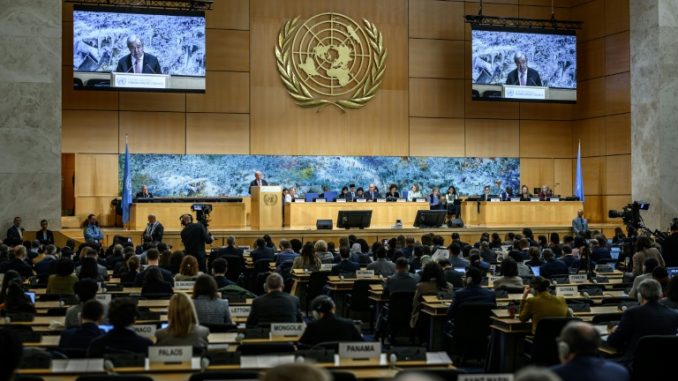
The UN Human Rights Council opened its latest session in Geneva on Monday (Fabrice COFFRINI)
Published February 23, 2025
Geneva, Switzerland — Venezuela’s top diplomat on February 23, 2026, called on the United States to immediately release former Venezuelan president Nicolás Maduro Moros and his wife Cilia Flores, describing their detention as illegal and insisting on a diplomatic resolution to the crisis.
Addressing the 61st session of the United Nations Human Rights Council in Geneva, Venezuelan Foreign Minister Yvan Gil Pinto demanded that the U.S. government free Maduro and Flores, whom Washington has detained since a U.S. military operation on January 3, 2026 ousted Maduro from power.
“The immediate release by the government of the United States of America of the constitutional president of the Bolivarian Republic of Venezuela, Nicolás Maduro Moros, and his wife, the first lady Cilia Flores,” Gil said in his speech, according to AFP reports.
Gil denounced the U.S. raid as an illegal military action that resulted in significant casualties and “arbitrary detention,” stressing the profound imbalance between the military capacities of the two nations. He insisted Venezuela is seeking dialogue and cooperation with the U.S. — “not through submission,” but on the basis of “sovereign equality.”
Context: Detention and Charges
Maduro, 63, who ruled Venezuela from 2013 until his removal earlier this year, remains in U.S. custody facing federal charges, including drug trafficking. He has pleaded not guilty and described himself as a “prisoner of war.”
His capture followed a U.S. military operation that led to his removal from Caracas. The mission prompted condemnation from Venezuelan authorities, who argue it violated international law and Venezuela’s sovereignty.
Venezuela’s Internal Developments
Gil also referenced a recent amnesty law passed by Venezuela’s legislature and touted by interim leader Delcy Rodríguez as a step toward national reconciliation. The law aims to free many political prisoners detained during years of unrest and post‑Maduro transition, though its scope and exclusions have drawn criticism from human rights groups and opposition figures.
Some protesters and detainees — particularly political prisoners excluded from the law’s provisions — have launched hunger strikes demanding broader release measures.
International Reaction
In Geneva, Gil also urged the international community to oppose what he called “unilateral coercive measures” against Venezuela, framing such actions as violations of international law that harm the economic and social rights of Venezuelans.
This diplomatic push for Maduro’s release comes amid heightened global tensions over U.S. actions in Latin America and Venezuela’s future political direction. International responses have varied, with some states advocating for negotiation and others urging respect for legal due process.
 Implications of Venezuela Demanding Maduro’s Release
-
National Security Concerns
The U.S. detention of Nicolás Maduro and Cilia Flores raises questions about American exposure to retaliatory actions. Latin America has historically reacted strongly to perceived violations of sovereignty, and Venezuelan authorities have already signaled a willingness to take countermeasures. This situation could strain U.S. military resources and intelligence operations in the region. -
Geopolitical Signal
Venezuela’s demand for immediate release signals a challenge to U.S. authority and international norms in the hemisphere. Other nations may interpret Washington’s actions as aggressive intervention, potentially emboldening anti-U.S. blocs or alliances that favor alternative power structures, such as increased cooperation with China, Russia, or non-Western partners. -
Legal and Diplomatic Precedent
Granting Maduro immunity or negotiating his release could set a precarious precedent. Future operations targeting political figures abroad might be constrained by international law or face higher political costs. Conversely, refusing negotiations risks prolonged tension and negative perception among allies who value adherence to international law. -
Domestic Messaging for the U.S.
Handling this crisis carefully is critical to maintaining credibility at home and abroad. Any misstep — whether seen as too lenient or too forceful — could fuel domestic debates over the role of U.S. foreign interventions, potentially undermining broader strategic initiatives in Latin America. -
Economic and Sanctions Implications
Prolonged conflict over Maduro could influence sanctions enforcement, trade negotiations, and investment in Venezuela and neighboring countries. Companies with exposure in Latin America may face heightened political risk, while humanitarian and reconstruction aid could become entangled in diplomatic friction.
 Overall Takeaway:
The Venezuelan demand for Nicolás Maduro’s release places the U.S. at a delicate crossroads of law, diplomacy, and regional security. How Washington responds will shape its credibility, influence, and ability to manage Latin American affairs in the months ahead. Careful navigation—balancing enforcement of legal accountability with respect for international norms and sovereignty—is essential to prevent escalation, maintain strategic leverage, and preserve both domestic and global confidence in U.S. leadership.
SOURCES: BARRON’S – Venezuelan Foreign Minister Demands ‘Immediate Release’ Of Maduro
FRANCE 24 – Venezuelan foreign minister demands ‘immediate release’ of Maduro
AL JAZEERA – Venezuela demands immediate release of Maduro from US custody
ENGLISH AL ARABIYA – Venezuelan foreign minister demands ‘immediate release’ of Maduro