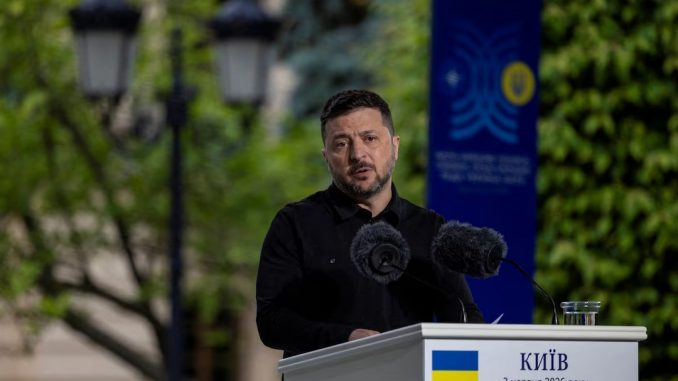
Ukrainian President Volodymyr Zelenskiy speaks during a joint press conference with NATO Secretary General Mark Rutte after talks, amid Russia’s attack on Ukraine, in Kyiv, Ukraine, June 3,… Purchase Licensing Rights
Published June 26, 2026
Ukrainian President Volodymyr Zelenskyy has authorized a 40-day campaign aimed at pressuring Russia to end the war, marking a significant escalation in Kyiv’s strategy as the conflict grinds on with no clear diplomatic breakthrough in sight.
The Ukrainian leader confirmed the move following consultations with his security services, saying the effort is designed to increase pressure on what he called the “aggressor state” through sustained military and strategic actions.
The announcement comes as Ukraine continues an expanded campaign of long-range strikes targeting Russian military infrastructure, including energy facilities and logistics hubs deep inside Russian territory — operations Kyiv has framed as central to weakening
Moscow’s war machine.
A Shift Toward Sustained Pressure
According to Zelenskyy, the 40-day initiative is not a single operation but a coordinated effort combining intelligence, military targeting, and continued strikes designed to influence Moscow’s decision-making.
Ukrainian officials have increasingly argued that sustained pressure on Russian infrastructure — particularly its energy sector — is essential to forcing the Kremlin toward negotiations.
In recent months, Ukraine has intensified drone and missile attacks on oil refineries and supply lines, disrupting fuel production and creating logistical strain inside Russia.
Targeting Russia’s War Infrastructure
The strategy reflects a broader shift in Ukraine’s approach: moving from defensive operations to a more proactive campaign aimed at degrading Russia’s ability to sustain its military operations.
Zelenskyy has previously said Ukraine’s strikes are intended to “bring the war back to Russia,” arguing that Kyiv must change the cost calculation for Moscow if peace is to be achieved.
Ukrainian officials say recent strikes have forced Russia to redistribute air defense systems to protect key cities and infrastructure, potentially exposing other regions to attack.
Moscow Unmoved, Diplomacy Stalled
The Kremlin has not publicly responded in detail to Zelenskyy’s latest announcement, but Russian officials have consistently rejected Ukraine’s framing of battlefield developments and insist that their military objectives remain unchanged.
Diplomatic efforts to end the war have largely stalled, despite intermittent discussions involving Western intermediaries. Recent proposals for ceasefire frameworks have failed to produce a breakthrough, with both sides remaining deeply divided over territorial and security demands.
Rising Stakes on Both Sides
The escalation comes amid warnings from analysts that the war is entering a more volatile phase, with both Ukraine and Russia increasingly relying on long-range strikes and asymmetric pressure campaigns rather than traditional frontline advances.
Ukraine’s allies in the West continue to provide military and financial support, but there is growing concern about the duration and sustainability of the conflict as it stretches into its fourth year.
For Kyiv, however, officials argue the strategy is simple: increase pressure until Moscow is forced to negotiate.
Whether the 40-day campaign achieves that goal remains uncertain — but it signals that Ukraine is preparing for a more aggressive and sustained phase of the war.
🧩 Reading Between the Lines: Ukraine’s 40-Day Pressure Strategy on Russia
More Than a Short-Term Campaign
President Volodymyr Zelenskyy’s approval of a 40-day campaign aimed at “influencing” Russia suggests a structured, time-bound escalation in Ukraine’s broader strategy. Rather than a single operation, the plan appears to reflect a coordinated effort to sustain military, intelligence, and strategic pressure over a defined period, signaling intent rather than a quick battlefield shift.
A Shift Toward Sustained Strategic Pressure
The framing of the campaign indicates Ukraine is continuing its move toward long-range and infrastructure-focused operations. By sustaining pressure over several weeks, Kyiv appears to be aiming to disrupt Russia’s operational stability while keeping momentum in both military and psychological terms.
Diplomacy Running Parallel to Escalation
While the campaign signals intensified pressure, it also runs alongside stalled diplomatic efforts. The timing suggests Ukraine is not abandoning negotiations entirely, but rather attempting to strengthen its position before any future talks by increasing the cost of continued conflict for Moscow.
Targeting the War’s Support Systems
The broader strategy points to an emphasis on degrading systems that support Russia’s war effort—logistics, energy infrastructure, and supply chains. This reflects a recognition that battlefield gains alone are unlikely to produce a decisive shift without affecting the underlying capacity to sustain operations.
A Defined Window of Escalation
The 40-day timeframe itself is notable. It implies a defined operational window, potentially designed to focus resources, maintain coordination among different agencies, and create a concentrated period of pressure that can be measured in outcomes rather than open-ended escalation.
🔗 The Stakes:Why This Story Matters
Ukraine’s decision to launch a 40-day campaign aimed at pressuring Russia underscores how the war is increasingly being shaped by sustained strategic operations rather than short, decisive battles. The move highlights an effort to shift momentum at a time when frontline gains have slowed and both sides are relying more heavily on long-range and indirect pressure tactics.
Escalation Without a Clear End Point
A key concern is that defined campaigns can still produce unpredictable outcomes once underway. While the 40-day timeframe suggests structure and planning, the actual impact may depend on how Russia responds militarily, economically, and politically. This creates uncertainty about whether the campaign will lead to de-escalation or further intensification.
Pressure on Russia’s War Infrastructure
Ukraine’s focus on sustained pressure reflects a broader strategy aimed at weakening Russia’s ability to maintain prolonged military operations. If effective, such efforts could strain logistics, energy systems, and supply chains—but they also risk prompting retaliatory escalation from Moscow.
Diplomacy Under Strain
The campaign also comes at a time when diplomatic pathways remain limited. With negotiations stalled, battlefield dynamics are increasingly influencing political calculations on both sides. This raises questions about whether pressure campaigns help move parties toward talks or further entrench their positions.
Risk of Broader Regional Impact
As the conflict continues to rely on long-range strikes and asymmetric tactics, the potential for spillover effects grows. Infrastructure disruptions, cross-border incidents, and intensified retaliation could broaden the conflict’s impact beyond the immediate front lines.
The Bigger Picture
Ultimately, the 40-day campaign reflects a war entering a more calculated but also more uncertain phase. Both sides are attempting to reshape the conditions of the conflict without a clear indication of when or how it will end.
🏁 The Final Word:
President Volodymyr Zelenskyy’s approval of a 40-day campaign to pressure Russia signals a continued shift toward sustained, coordinated efforts designed to influence the trajectory of the war beyond the battlefield. While Ukrainian officials frame the initiative as part of a broader strategy to increase pressure on Moscow, the effectiveness and consequences of the campaign will depend heavily on Russia’s response and the evolving conditions of the conflict. As both sides continue to rely on long-range and asymmetric tactics, the war appears set to remain defined by escalation management rather than any immediate path toward resolution.
SOURCES: BLOOMBERG – Zelenskyy orders 40-Day Campaign to Influence Russia to End War
REUTERS – Ukraine’s Zelenskiy says he approved 40-day campaign to ‘influence’ Russia to end the war