Published January 27, 2025
Washington, D.C. — The United States is facing intense political conflict following the fatal shooting of 37‑year-old Minneapolis resident Alex Pretti by federal immigration officers during an enforcement operation in Minnesota. The incident has sparked national outrage, allegations of mishandling, and growing tensions that could affect federal government funding.
Circumstances of the Shooting
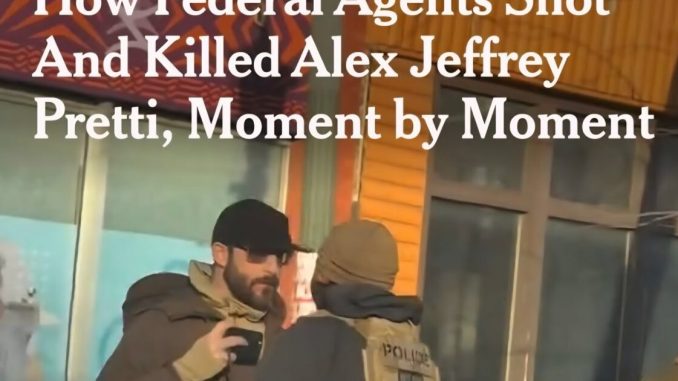
Alex Pretti was killed by federal agents — including Customs and Border Protection (CBP) and Immigration and Customs Enforcement (ICE) officers — during a high-profile enforcement sweep in Minneapolis. Federal officials initially claimed Pretti posed an imminent threat to officers. Eyewitnesses, however, reported that Pretti was holding only a cellphone and may have been assisting a woman when the confrontation occurred.
Family members of Pretti have strongly challenged the official account, asserting that he did not pose a threat and calling for full transparency and accountability from federal authorities. Local community groups have held vigils and demanded an independent investigation into the circumstances of the shooting.
Federal and Local Response
In response to the shooting, President Donald Trump stated that his administration is “reviewing everything” regarding the incident. Trump emphasized that he does not want to see violence on U.S. streets but reaffirmed support for federal immigration enforcement.
Meanwhile, Minnesota Governor Tim Walz and Minneapolis Mayor Jacob Frey have publicly called for the reduction of federal agents in the city, citing escalating tensions and disruptions in neighborhoods. Both leaders stressed that heavy federal enforcement operations without local coordination can increase the risk of civilian harm.
The Department of Homeland Security (DHS) confirmed that an internal review of the Minneapolis enforcement operation is underway. Federal authorities also pledged to preserve all evidence, including body-camera footage, to support any investigations into the incident.
Political Fallout — Risk of Government Shutdown
The shooting has intensified partisan divisions in Congress, particularly around the Department of Homeland Security funding bill. Senate Democrats have vowed to withhold support for DHS funding until there is meaningful accountability for federal enforcement actions that led to Pretti’s death. This opposition increases the risk of a partial government shutdown if lawmakers cannot pass critical funding measures in time.
Senate Majority Leader Chuck Schumer emphasized that Democratic lawmakers will demand concrete reforms to federal immigration operations, including stricter use-of-force protocols, mandatory training on de-escalation, and better coordination with local authorities. Republicans face mounting pressure to negotiate a compromise, balancing law enforcement priorities with public demand for transparency and accountability.
Public Reaction and Community Impact
The Minneapolis shooting has sparked widespread public protests in Minnesota and other major cities. Demonstrators have called for federal oversight, the removal of heavily armed agents, and stronger protections for civilians in neighborhoods affected by immigration enforcement sweeps.
Community organizations and civil rights groups are advocating for long-term reforms, including improved officer training, increased transparency in federal operations, and independent review boards to monitor use-of-force incidents. Legal experts warn that failure to address these systemic issues could erode public trust in federal enforcement agencies.
Schools, workplaces, and local government offices have also expressed concern about the impact of federal operations on community safety and mental health. Residents report heightened anxiety and fear, particularly in neighborhoods with high federal enforcement activity.
Federal investigations by the DHS and the FBI are ongoing. Courts have issued orders to preserve all evidence and ensure independent review of officer actions. Meanwhile, local and federal authorities continue discussions on how to balance immigration enforcement with community safety.
As this situation unfolds, it highlights key national debates about federal authority, civil liberties, and accountability. The Minneapolis shooting has become a focal point for policymakers, activists, and the public, raising urgent questions about enforcement practices and the protection of American citizens’ rights.
BREAKING: Full video of the altercation from a better angle right up until the suspect is shot. You can see the suspect jump on the back of what may be another protestor before being pulled off. Crazy footage. pic.twitter.com/rsxLOXFSUO
— Kim “Katie” USA (@KimKatieUSA) January 24, 2026
The Times effort to set a false narrative paid off with a dramatic reading by Mika Brzezinski on Morning Joe on MSNOW Monday (click link to view, embedding blocked.)
What happened afterward when CBP officers tried to detain Pretti and a scrum ensued leading to Pretti being shot and killed is open to interpretation. It appears Pretti, knowing he had a concealed gun on him, resisted being detained. An officer apparently saw and removed Pretti’s gun from his rear waistband. Speculation is the gun accidentally discharged after being removed, setting off a reaction by other officers to draw their weapons and shoot Pretti several times, killing him.
 Implications
The fatal shooting of Alex Pretti carries significant legal, political, and policy implications that extend well beyond Minneapolis.
1. Federal Use-of-Force Standards
The incident places renewed scrutiny on federal law-enforcement use-of-force protocols, particularly during immigration operations conducted in public spaces. Investigators will closely examine whether officers followed escalation and de-escalation guidelines, how crowd control was handled, and whether the use of pepper spray and lethal force aligned with DHS policy. The findings could lead to revised training standards or operational rules nationwide.
2. Armed Civilians at Protest or Enforcement Scenes
Pretti’s possession of a concealed handgun introduces complex legal questions. While lawful concealed carry is permitted in many states, the case highlights the heightened risks when armed civilians become physically involved in volatile law-enforcement encounters. The outcome of the investigation may influence future guidance on how officers assess perceived threats during chaotic situations involving legally armed individuals.
3. Federal–Local Authority Tensions
The shooting has intensified tensions between federal agencies and state and local governments. Minnesota officials’ calls for reduced federal presence reflect broader concerns over federal operations conducted without local coordination. This case may accelerate efforts by cities and states to challenge or restrict certain federal enforcement activities within their jurisdictions.
4. Congressional Oversight and DHS Funding
The incident has already impacted congressional negotiations over Department of Homeland Security funding. Lawmakers are using the case to argue for stronger oversight mechanisms, mandatory reporting on use-of-force incidents, and conditional funding tied to compliance with accountability measures. Failure to resolve these disputes could result in delays or disruptions to federal operations.
5. Public Trust and Community Relations
Public confidence in federal law enforcement is a central issue emerging from the case. Conflicting interpretations of video evidence and the rapid escalation of force have fueled distrust, particularly in communities that already feel vulnerable during enforcement operations. Long-term damage to public trust could complicate future federal actions and increase resistance or non-cooperation at the community level.
6. Legal Precedent and Civil Liability
Depending on investigative findings, the case could result in civil litigation or criminal charges, potentially setting legal precedents for federal officer accountability. Court rulings may clarify standards around officer responsibility when detaining civilians during fast-moving, multi-party confrontations.
 Overall Takeaway:
The shooting death of Alex Pretti during a federal immigration enforcement operation in Minneapolis has become a defining test of accountability, authority, and restraint in federal law enforcement. What began as a street-level confrontation escalated rapidly into a fatal outcome, raising unresolved questions about decision-making, use of force, and the management of chaotic public encounters.
As federal investigators review body-camera footage, eyewitness video, and officer actions, their findings will carry consequences not only for those directly involved, but also for how similar operations are conducted nationwide. The case sits at the intersection of immigration enforcement, civilian involvement, lawful firearm possession, and public safety—areas where clear boundaries and disciplined judgment are critical.
Beyond the legal outcome, the incident has already reshaped political debates, strained federal–local relations, and influenced congressional deliberations over Department of Homeland Security oversight and funding. Community reaction underscores the fragile trust between law enforcement and the public, a trust that can be quickly eroded when force is perceived as excessive or poorly justified.
Ultimately, the conclusions reached by investigators will determine whether systemic changes follow or whether the case stands as another contested episode in an increasingly polarized national landscape. Until then, the Minneapolis shooting remains a focal point in the broader conversation about enforcement authority, civil liberties, and the responsibilities carried by both officers and civilians in moments of crisis.
SOURCES: THE GATEWAY PUNDIT – New York Times Spins False Narrative on Actions by Alex Pretti Leading Up to His Shooting Death by CBP Officers in Minneapolis
THE HILL – White House says 3 federal reviews underway after Pretti killing in Minneapolis