The vital waterways of Hormuz hold the key to a good share of the world’s oil transport.
Published March 11, 2025
Tensions in the Middle East escalated dramatically this week after Iran’s Islamic Revolutionary Guard Corps (IRGC) issued a controversial warning tied to one of the world’s most critical oil chokepoints—the Strait of Hormuz.
According to multiple reports and Iranian state media statements, the IRGC declared that any Arab or European country that expels the ambassadors of the United States and Israel will be granted “complete freedom and authority” to pass through the Strait of Hormuz.
The statement comes amid the intensifying conflict involving Iran, the United States, and Israel, and represents a striking attempt by Tehran to pressure other nations into taking a diplomatic stance against Washington and Jerusalem.
A Strategic Shipping Route at the Center of Global Energy
The Strait of Hormuz is one of the most important maritime passages in the world. Roughly one-fifth of global oil shipments travel through the narrow waterway, making it a crucial artery for the global energy market.
Located between Iran and Oman, the strait connects the Persian Gulf to the Gulf of Oman and the Arabian Sea. Any disruption to traffic through the corridor can have immediate effects on global oil prices and international trade.
Recent reports indicate that tensions have already slowed or disrupted traffic through the region, with ship operators and insurers becoming increasingly cautious due to threats and military activity.
IRGC Issues Conditional “Safe Passage”
Iran’s Revolutionary Guard made its position clear:
Countries that expel U.S. and Israeli diplomats will receive full freedom to transit the strait.
The message appears designed to leverage Iran’s geographic control over the strait as a political weapon. Analysts say the move is intended to push governments—especially in Europe and the Middle East—to distance themselves from Washington and Israel amid the escalating regional conflict.
The IRGC also warned that if military strikes against Iran continue, the country could prevent oil exports from leaving the region altogether.
Oil Markets and Military Warnings
The announcement immediately raised alarm across global markets and governments. Oil prices have surged amid fears that a prolonged disruption in the Strait of Hormuz could severely affect supply chains and energy prices worldwide.
At the same time, the United States has warned Iran against interfering with oil shipments. U.S. leadership has signaled that any attempt to shut down the strait or block shipping could trigger significant military retaliation.
The confrontation has already intensified the wider regional crisis, with missile strikes, naval threats, and military mobilizations reported across the Gulf region.

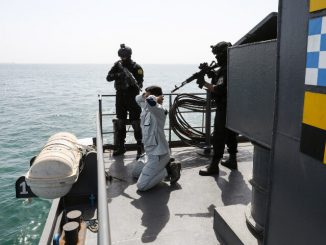
IRGC Iranian fighters seize a cargo ship back in 2025 – photo from social media X.
A Dangerous Diplomatic Escalation
Iran’s conditional offer effectively ties global shipping access to a geopolitical demand—the expulsion of American and Israeli diplomats. Critics say the move highlights Tehran’s willingness to weaponize geography and global energy infrastructure in pursuit of political leverage.
With the Strait of Hormuz carrying a massive share of the world’s oil supply, any sustained disruption could have profound consequences for energy markets, global inflation, and international security.
For now, the situation remains volatile as the world watches closely to see whether the escalating rhetoric will translate into further military action—or whether diplomatic pressure will bring the crisis back from the brink.
 Implications of Iran’s Threats on the Strait of Hormuz
The IRGC’s recent statement carries serious implications for global security, energy markets, and international diplomacy. From a standpoint that prioritizes stability, the warning signals several key concerns:
-
Geopolitical Leverage as a Weapon
By linking shipping access to the expulsion of U.S. and Israeli diplomats, Iran is explicitly turning a critical global trade artery into a bargaining chip. This sets a dangerous precedent: any nation in the region could be coerced into taking sides under the threat of economic disruption. The Strait of Hormuz is vital not only for oil shipments but also for global economic stability; using it as leverage undermines international norms and maritime law. -
Heightened Risk of Military Conflict
The statement effectively raises the stakes for potential military confrontation. Any attempt to enforce this “conditional safe passage” could spark clashes with U.S. or allied forces operating in the region. Even minor miscalculations—accidental strikes on commercial vessels or naval forces—could escalate into a broader conflict. -
Global Energy Security Threatened
With roughly one-fifth of the world’s oil passing through the Strait of Hormuz, disruption—even temporary—can send crude prices skyrocketing and ripple through economies worldwide. Nations dependent on Gulf oil would face inflationary pressures, potentially destabilizing markets and forcing hard choices in foreign policy. -
Diplomatic Coercion vs. Sovereign Decision-Making
Iran’s messaging pressures other nations to take sides in the U.S.-Israel-Iran geopolitical contest. This is a direct challenge to the principle of sovereign decision-making in foreign policy. Nations may be forced to weigh economic access against diplomatic and security commitments, creating tension within alliances and international coalitions. -
Signals to Regional Allies and Adversaries
By framing the strait as a “reward” for countries aligning with Tehran’s agenda, Iran is attempting to realign power dynamics in the Middle East. This could embolden hostile actors while signaling vulnerability to those seeking protection under U.S.-aligned security structures.
 Overall Takeaway:
Iran’s IRGC threat to condition safe passage through the Strait of Hormuz on the expulsion of U.S. and Israeli diplomats underscores the region’s growing volatility. This move is a stark reminder that global energy security and maritime freedom are inextricably linked to the stability of nations willing to defend them.
The international community faces a critical choice: either allow coercion to dictate the flow of commerce and embolden aggressive actors, or reaffirm commitments to secure trade routes and uphold the rules-based order. Failure to respond decisively risks not only economic disruption and rising oil prices but also a dangerous escalation that could draw multiple nations into conflict.
In an interconnected world, safeguarding vital chokepoints like the Strait of Hormuz is not optional—it is essential for the protection of global commerce, strategic alliances, and long-term peace. Nations that act with foresight, strength, and unity will ensure that critical trade routes remain open, predictable, and free from intimidation.
SOURCES: THE GATEWAY PUNDIT – Unhinged Iranian IRGC Says Any Nation Who Expels US and Israeli Ambassadors Will Be ‘Allowed’ to Navigate the Vital Shipping Route of the Strait of Hormuz
THE FINANCIAL NEWS – Iran: “Passage through Hormuz allowed if US and Israeli ambassadors are expelled”
INVESTING LIVE – Iran signals Hormuz safe passage to countries expelling U.S. and Israeli diplomats
BUSINESS STANDARD – IRGC offers conditional free passage via Hormuz, vows to decide war’s end