Published March 24, 2026
Unidentified drone swarms breaching U.S. military airspace have sparked alarm among defense officials, raising urgent questions about national security vulnerabilities and foreign surveillance threats.
Coordinated Drone Activity Over Sensitive Bases
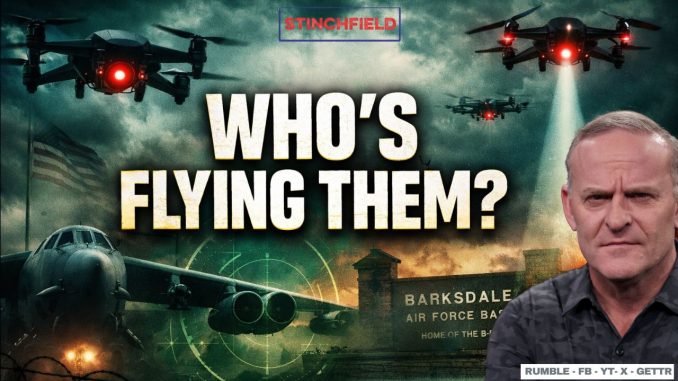
A series of alarming incidents involving unidentified drones has been reported over multiple U.S. military installations, including Barksdale Air Force Base, a key hub for America’s nuclear-capable bomber fleet.
According to multiple reports, as many as a dozen or more drones were observed flying in coordinated patterns over the base across several days in March 2026. Witnesses described the aircraft as:
- Operating in tight, controlled formations
- Remaining airborne for extended periods
- Demonstrating advanced maneuverability
Base operations were reportedly disrupted, with heightened security measures and temporary restrictions put in place.
Not Isolated: Incidents Spread Across the U.S.
The Louisiana घटना is not an isolated case.
Similar drone activity has also been detected over Fort McNair, a highly sensitive military installation located in the nation’s capital and home to senior officials.
These incursions suggest a pattern of deliberate probing, rather than random or recreational drone use.
Why Experts Are Concerned
Defense analysts say the nature of these incursions raises red flags:
- The drones appeared to evade standard countermeasures
- Flight behavior indicated coordination and planning
- Targets included strategically important military sites
This has led to growing concern that the drones may be part of a larger intelligence-gathering effort, potentially aimed at testing U.S. air defense systems and response times.
Who Could Be Responsible?
While officials have not publicly identified a culprit, several theories are being considered:
Foreign Adversaries
Nations such as China, Russia, and Iran have heavily invested in drone technology and could be conducting surveillance missions.
Non-State Actors
Armed groups and proxy networks have increasingly adopted drone warfare, raising the possibility of irregular threats testing U.S. defenses.
Domestic Sources
Though less likely, authorities have not ruled out the possibility of unauthorized domestic operations, including sophisticated private drone use.
Classified U.S. Operations
Some observers speculate whether the activity could be tied to undisclosed internal testing, though this remains unconfirmed and controversial.
A Dangerous Gap in Defense
One of the most troubling aspects of the situation is the limited ability to neutralize drones over U.S. soil.
Strict legal and safety constraints often prevent the military from immediately destroying unidentified aerial systems, leaving officials with fewer response options such as:
- Electronic interference
- Surveillance and tracking
- Post-incident investigation
This creates a potential vulnerability, especially if the drones are being used to map defenses or prepare for future operations.
🔍 Analyst Insight:
From a strategic standpoint, these incursions show clear indicators of intentional probing rather than random activity.
Key takeaways:
- Patterned Surveillance Behavior
The repeated flights over Barksdale Air Force Base and Fort McNair suggest systematic intelligence gathering, not isolated घटनाएं. - Testing U.S. Response Capabilities
The drones’ persistence indicates a likely effort to measure reaction time, detection limits, and coordination between defense systems. - Technology Gap Exposure
The apparent ability to evade countermeasures highlights a potential gap between evolving drone capabilities and current U.S. defenses. - Low-Cost, High-Impact Strategy
Drone swarms represent a cost-effective way to challenge high-value military assets, shifting the balance in modern surveillance tactics. - Escalation Without Attribution
The ambiguity of drone origin allows actors to operate below the threshold of direct confrontation, making response and deterrence more difficult.
👥 Human Element:
Behind the headlines are the men and women stationed at these bases—individuals tasked with safeguarding some of the nation’s most critical الدفاع assets.
For them, these घटनाएं are not abstract.
They represent:
- Real-time uncertainty
- The pressure of responding to unknown aerial threats
- And the unsettling reality that potential adversaries may be watching, learning, and adapting
In high-stakes environments like Barksdale, where strategic bombers are housed, even a small неизвестный aircraft overhead can carry enormous implications.
 A Growing Security Dilemma:
These incidents also highlight a difficult reality:
Defending domestic airspace against drones is far more complicated than many assume.
Legal restrictions, safety concerns, and technological limitations often prevent immediate neutralization. As a result, response options are limited to:
- Monitoring and tracking
- Electronic interference
- Post-incident investigation
This creates a dangerous gray zone—one that can be exploited by actors willing to test boundaries.
🎯 Conclusion:
What’s unfolding is not just a series of воздушные anomalies—it is a warning.
The repeated appearance of coordinated drone swarms over highly sensitive U.S. military installations suggests that someone is testing the perimeter—and finding it penetrable.
Whether the source is foreign, covert, or something else entirely, the pattern is clear:
These are not random events.
They are calculated.
They are persistent.
And they are happening over some of the most strategically important locations in the United States.
At a time when global tensions remain high and technological warfare is rapidly evolving, ignoring or downplaying such incursions would be a serious mistake.
The fundamental responsibility of any government is to protect its territory, its armed forces, and its people. When unidentified systems can repeatedly enter restricted airspace with limited consequence, it raises a deeper question:
👉 Is the U.S. fully prepared for the next phase of modern threats—or already behind it?
Until clear answers emerge, one reality cannot be ignored:
The sky is no longer a secure boundary—and America’s adversaries may already know it.