Published March 12, 2025
Recent open‑source blockchain data and expert analysis suggest that large‑scale cryptocurrency movements involving Iranian accounts have accelerated amid the ongoing conflict in the Middle East — raising questions among analysts about whether state actors are using crypto to fund proxy operations, evade sanctions, or preserve capital.
Blockchain Tracking & Open‑Source Intelligence
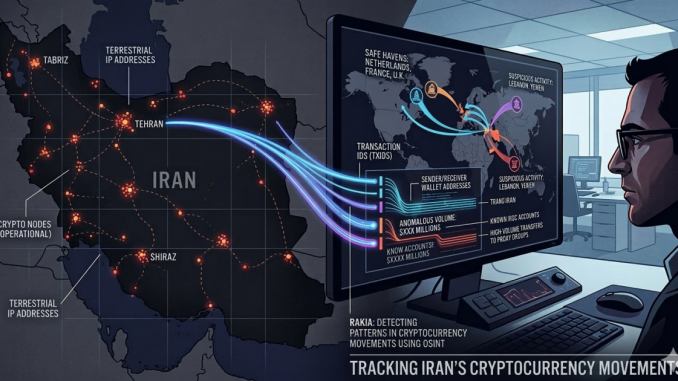
According to Omri Raiter, the CEO of Rakia — a firm that analyses public blockchain signals — unusual patterns have emerged in on‑chain data coinciding with the region’s geopolitical tensions. Raiter’s team tracked millions to hundreds of millions of dollars moving through cryptocurrency wallets linked to Iranian IP addresses, even during periods when large parts of the country experienced internet shutdowns.
While blockchain transactions are public, ownership and intent are often opaque because wallets are pseudonymous. However, analysts observe that:
- Thousands of transaction nodes remained active even during a reported nationwide internet blackout, which could suggest coordinated or government‑controlled operations rather than ordinary retail trading.
- Transfers traced to and from Iranian IP regions have some destinations in countries viewed as “crypto safe havens,” including European jurisdictions.
Raiter cautioned that while the transaction volumes and patterns appear noteworthy, connecting individual wallets to specific groups — like proxy forces or militant organizations — requires financial records that aren’t available on the blockchain alone.
Iran’s Broader Cryptocurrency Activity
Independent blockchain firms have documented significant crypto flows involving Iran in recent years:
- Chainalysis reports that in 2025, sanctioned and illegal crypto activity tied to Iran and the Islamic Revolutionary Guard Corps (IRGC) exceeded several billion dollars, part of a much larger global surge in sanctions‑related crypto flows.
- Reuters noted that geopolitical events such as airstrikes triggered sharp spikes in crypto outflows from Iranian exchanges, including millions moving offshore within short windows as users reacted to heightened uncertainty.
These movements — whether driven by private citizens, businesses, or state‑linked entities — underscore how digital assets are deeply integrated into Iran’s broader financial ecosystem, especially as traditional banking infrastructures face sanctions and restrictions.
Sanctions, Compliance, and Regulatory Scrutiny
Globally, authorities are increasingly interested in how crypto may be used to evade financial controls:
- The U.S. Department of Justice has been reported to investigate whether major cryptocurrency platforms were used to help sanctioned actors, including Iranian entities, move funds internationally — a probe that sparked public debate over exchange compliance and regulatory obligations.
- Major exchanges like Binance have been embroiled in controversies over alleged lax oversight of Iran‑linked crypto transactions, leading to legal actions and increased scrutiny from regulators.
These developments reflect broader concerns about anti‑money‑laundering (AML) and know‑your‑customer (KYC) practices in the crypto industry — particularly in the context of geopolitical tensions and sanctions enforcement.
 Public / Political Reactions
🧑⚖️ U.S. Government and Regulatory Response
Federal investigation: The U.S. Justice Department is actively probing whether Iran used major crypto platforms like Binance to evade U.S. sanctions and move funds internationally — including accusations of over $1 billion in transactions flagged to wallets tied to Iranian‑linked groups. Binance has denied wrongdoing and even filed a defamation lawsuit against The Wall Street Journal over the claims.
- Senatorial scrutiny: U.S. lawmakers have supported increased scrutiny of crypto flows tied to sanctioned actors. Independent inquiries — including from Senator Richard Blumenthal — seek clarity on compliance failures by exchanges and whether enforcement is sufficient.
- Treasury tracking: U.S. Treasury officials publicly stated they are tracking capital flight from Iran tied to elites and possibly state actors, emphasizing digital asset tracking as part of sanctions enforcement.
These reactions reflect growing political emphasis on digital asset oversight — especially where sanctions, national security, and foreign policy intersect.
🌍 Public Opinion & Market Reaction
- Market volatility: Crypto prices and trading volumes have been highly reactive to geopolitical events involving Iran. In some periods, Iran’s domestic crypto trading plummeted sharply after airstrikes or conflict escalation, suggesting public fear and capital flight.
- Investor behavior: Online crypto communities have shared data showing surges of funds exiting Iranian exchanges during periods of military escalation, illustrating how participants attempt to protect assets amid uncertainty.
- Civilian reliance: Independent analytics suggest many Iranians increasingly view crypto — particularly Bitcoin — as a hedge against hyperinflation and a collapsing currency amid prolonged economic stress, influencing public usage patterns separate from geopolitical narratives.
In other words, public sentiment varies widely: from cautious withdrawal amid conflict to seeing crypto as a survival tool amid economic hardship.
🏛️ International & Diplomatic Reactions
Sanctions enforcement emphasis: Western governments and international bodies are heightening focus on digital asset networks that might circumvent economic sanctions. Reuters noted U.S. investigators are actively reviewing exchange connections to Iranian entities and policy responses.
Exchange industry defense: Crypto firms under scrutiny (e.g., Binance) have pushed back legally or through public statements, arguing full cooperation with regulators and emphasizing their compliance efforts.
These reactions highlight an ongoing global debate: whether cryptocurrency is merely an economic tool for civilians under distress or also a vector for sanctioned capital flows that requires more regulation.
 Resulting Effects
1. National Security and Strategic Vulnerabilities
The accelerated use of cryptocurrency by state-linked Iranian entities exposes new vulnerabilities for U.S. and allied national security interests. Funds moving through pseudonymous wallets could potentially support proxy operations, circumvent sanctions, or finance asymmetric warfare. Even if direct attribution remains complex, the mere capacity to mobilize capital outside traditional oversight represents a strategic risk, prompting calls for tighter monitoring of blockchain networks.
2. Economic and Financial Implications
The growing reliance on crypto in Iran highlights the limits of conventional financial controls. This demonstrates how nations or actors under sanctions can leverage digital assets to bypass global banking systems. The resulting effect is a pressure point on global markets and financial institutions, as regulators must now track not only traditional currency flows but also decentralized and semi-anonymous crypto networks.
3. Regulatory and Diplomatic Consequences
Governments are being compelled to strengthen cross-border regulatory cooperation. Sanctions enforcement now requires not just diplomatic coordination but also technical capability to trace and interdict illicit digital transactions. This drives policy innovation, such as enhanced blockchain forensics, exchange reporting mandates, and coordinated international sanctions enforcement.
4. Broader Geopolitical Ramifications
Unchecked crypto flows could embolden other sanctioned or hostile actors to adopt similar strategies, potentially destabilizing regional balance. The ripple effect is not only immediate — funding conflict or circumventing economic pressures — but also longer-term, as nations must anticipate adversaries exploiting the same tools. This dynamic could reshape strategic planning and defense priorities for years to come.
 Future Outlook
1. Increasing Focus on Digital Asset Oversight
The trend of sanctioned or hostile actors using cryptocurrency is likely to accelerate regulatory attention. Governments and financial authorities may implement stricter know-your-customer (KYC) protocols, enhanced blockchain surveillance, and international cooperation to detect illicit flows. Exchanges that fail to comply could face legal consequences or restricted access to global markets, creating pressure to standardize oversight globally.
2. Escalating Geopolitical Tensions
As Iran and other sanctioned entities continue to exploit digital assets, regional tensions may deepen. The ability to move capital outside conventional channels could embolden adversarial strategies, increasing the likelihood of proxy conflicts or economic maneuvering. Strategic planners may need to anticipate these non-traditional threats alongside conventional military or diplomatic challenges.
3. Implications for Global Finance
Digital currencies may continue to challenge traditional financial infrastructure. Central banks and international regulators will likely explore new safeguards to prevent circumvention of sanctions and maintain economic stability. The outcome could be a more tightly regulated crypto ecosystem, where transparency, compliance, and monitoring become central to global financial security.
4. Strategic Preparedness
Countries and institutions may increasingly adopt proactive risk mitigation measures, including investments in blockchain intelligence, scenario planning, and policy frameworks to counter potential misuse of digital assets. The emphasis will be on preventing exploitation before it threatens national or economic security, rather than reacting after vulnerabilities are exposed.
 Bottom Line
While blockchain activity clearly shows substantial crypto transfers originating from and heading to Iranian addresses, determining the purpose and ultimate beneficiaries requires deeper investigation beyond what public ledgers can reveal alone. Analysts emphasize that:
- Cryptocurrencies are traceable in terms of transaction flows, but attribution to specific individuals or groups remains complex without corroborating data.
- Both private actors and state‑linked entities may use crypto to mitigate financial isolation, hedge against economic instability, or navigate sanctions, but intent must be interpreted carefully.
As global regulatory bodies and blockchain analytics firms refine their tools and methodologies, the transparency of cryptocurrency — once seen as a barrier — is increasingly aiding investigations into cross‑border financial networks and sanction evasion schemes.