Published April 22, 2026
A growing wave of alarm is building across the international community as reports continue to surface detailing the plight of Iranian women and Christian converts allegedly facing execution under the country’s strict interpretation of Islamic law. Critics say the situation highlights a broader pattern of repression inside Iran—and raises serious questions about why global leaders have not responded more forcefully.
According to commentary circulating in conservative media and eyewitness testimonies, several cases involve women accused of anti-government activities or violating religious codes, with some allegedly receiving death sentences after trials that activists claim fall short of international standards for due process.
The issue has gained momentum as more personal stories emerge, including accounts from individuals who say they were targeted not only for political views, but also for their religious beliefs.
Women “At risk” amid expanding crackdown
Human rights advocates continue to warn that Iran maintains one of the harshest judicial systems in the world when it comes to capital punishment. Women, in particular, are seen as increasingly vulnerable—especially those who participate in public demonstrations or challenge state-imposed social restrictions.
Observers point to a pattern in which female protesters are arrested, interrogated, and in some cases subjected to severe penalties. While Iranian authorities often deny or downplay these allegations, independent groups argue that evidence from multiple cases suggests a systematic effort to deter dissent.
Critics also highlight the role of morality laws, which have placed women at the center of cultural and political tensions in recent years.
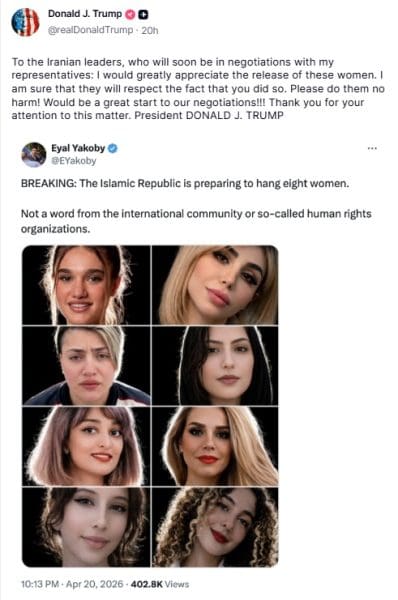
A picture of eight beautiful women in Iran who are scheduled to be executed is being shared across the Internet. President Trump noticed the post and shared it on Truth Social.
Christians targeted for their faith
Alongside concerns about women’s rights, reports of religious persecution continue to draw scrutiny. In a firsthand account, Marziyeh Amirizadeh described her experience as a Christian convert in Iran, claiming she was arrested, imprisoned, and faced the possibility of execution for practicing her faith.
She recounted living under constant threat, with authorities pressuring her to renounce Christianity. Her eventual release, she said, came only after significant international attention and diplomatic pressure.
Cases like hers have been cited by advocacy groups as evidence that religious freedom remains severely restricted.
A long history of repression
The current concerns are rooted in decades of political and religious control following the 1979 Iranian Revolution, which reshaped the country’s government and legal system. Since then, critics say authorities have relied on strict enforcement measures—including executions, imprisonment, and surveillance—to maintain power.
Iran remains among the countries with the highest number of executions per year, according to multiple human rights organizations.
Where is the international response?
The situation has sparked renewed debate over the role of global institutions, including the United Nations, as well as influential religious and political leaders.
Some critics argue that responses have been inconsistent, particularly when compared to reactions to other human rights issues around the world.
🔍 Critical View: Concerns over silence and double standards
Many people looking at this situation are asking a simple question: why doesn’t this get as much attention as other global issues?
From this point of view, the concern isn’t just about what’s happening inside Iran—it’s also about how the rest of the world reacts. When women are reportedly facing execution or people risk death for their faith, critics say there should be loud and clear outrage from international leaders, major media, and global organizations.
Death penalties
There is strong concern about how severe punishments are being used. Taking someone’s life is the most extreme penalty any system can impose, and critics argue it should only happen—if ever—under the strictest, most transparent standards. When reports suggest executions may be tied to protests, beliefs, or unclear legal processes, it raises alarm. People worry that justice may not be fully fair or that the punishment doesn’t match the situation. For many, this isn’t just about law—it’s about basic humanity.
Women’s rights
Another major concern is how women are treated under strict rules. Reports that women can face serious punishment for protesting, speaking out, or even personal choices make people question how much freedom they actually have. Critics say women should not have to fear harsh consequences just for expressing themselves or pushing for change. In simple terms, the issue is whether women are being given the same respect, protection, and opportunities as everyone else.
Religious persecution
The idea that someone could be punished for their faith—or for changing it—is deeply troubling to many. Religion is a personal choice, and critics argue it should never be a life-or-death matter. When people hear that individuals might face prison or worse for what they believe, it raises concerns about freedom at a very basic level. Many see this as a clear line: belief should never be something the government controls through fear.
Global response
A big part of the frustration is not just what’s happening, but how the world is reacting. Some feel that international leaders, media, and influencers are not speaking loudly enough about these issues. They point out that other global situations often get immediate and widespread attention, while this one seems to move more quietly. This leads to questions about priorities—why some stories dominate headlines and others don’t.
Human rights
At its core, this situation comes down to basic human rights: the right to live, to speak, to believe, and to be treated fairly. Critics argue these rights should apply to everyone, everywhere—no exceptions. When any government is accused of violating these rights, people expect a strong and clear response from the global community. Anything less can feel like those rights are being treated as optional instead of universal.
Role of international organizations
There is also growing frustration with large global institutions. While they often release statements expressing concern, critics say words alone are not enough. People want to see real action—whether that means stronger pressure, accountability measures, or consistent follow-through. The concern is that without meaningful consequences, statements lose their impact and situations don’t improve.
Double standards
In simple terms, the biggest issue many people see is fairness. If human rights truly matter, then they should matter in every country, not just in places that get more attention or are politically convenient. Critics argue that when the global response depends on politics, alliances, or media focus, it creates a double standard. And when that happens, trust in international systems and leadership starts to weaken.
👥 On the Ground: What people are concerned about
When people look at the situation inside Iran, they often focus less on politics and more on what everyday life and enforcement reportedly look like for ordinary people.
Security and arrests
There are ongoing concerns about strict enforcement of laws, especially when it comes to protests or public dissent. People say arrests can happen quickly, and once someone is taken in, the process can be hard to follow from the outside. Families often struggle to get clear information about what is happening to their loved ones.
Protests and public tension
There have been repeated waves of protests over social, economic, and political issues. On the ground, this creates a tense environment where demonstrations can turn into confrontations with authorities. Supporters of the protesters say people are simply asking for more freedom and better living conditions, while authorities often view these gatherings as threats to stability.
Women in daily life
Many concerns center on how women are expected to behave in public. Rules around dress and conduct are enforced in ways that can lead to warnings, fines, or arrests. Critics say this creates pressure in everyday life, where small personal choices can have serious consequences.
Religious minorities
People from minority faiths, especially Christians, are often described as living cautiously. Some reports say they practice their faith quietly to avoid attention. The concern raised is that openly sharing or changing one’s religion can lead to legal trouble, which creates fear and secrecy.
Legal process and fairness
Another issue often mentioned is how cases are handled in court. Critics argue that trials may not always feel transparent or consistent, especially in sensitive political or religious cases. This leads to doubts about whether outcomes are always fair or predictable.
Daily life pressure
Beyond major political events, many people describe everyday life as tightly controlled. From speech to behavior in public spaces, there is a sense that people must constantly be careful about what they say or do.
Outside reaction vs. local reality
On the ground, people see a big gap between daily experiences and international attention. While global discussions come and go, those inside the country deal with the situation every day. Critics say this gap makes people feel forgotten or overlooked.
🎯 The Final Word:
From this point of view, the main concern is simple: basic freedoms should apply to everyone, no matter where they live. In Iran, reports of strict punishments, pressure on women, and limits on religious freedom raise serious questions about fairness and human rights. Critics feel the world should not stay quiet or treat these issues as secondary. Instead, they argue there should be clear and consistent attention whenever people are facing punishment for what they believe, say, or do. In the end, the expectation is straightforward—every person deserves to be treated with dignity, and global response should reflect that without hesitation or double standards.