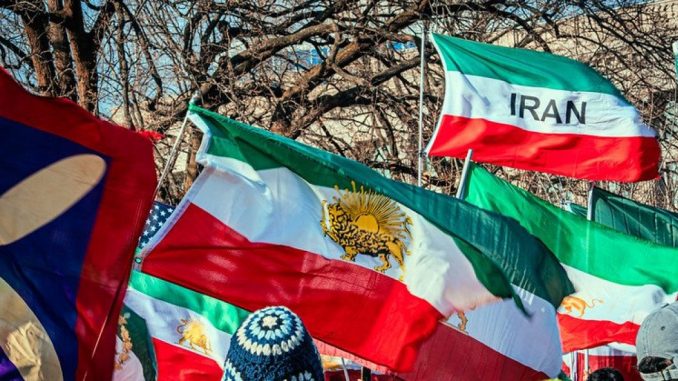
“2026.01.11 Free Iran Demonstration, Washington, DC USA 01156 07428” by Ted Eytan, CC BY-SA 4.0
Published May 11, 2026
WASHINGTON – The conflict involving Iran is increasingly being viewed through a wider economic lens, with analysts arguing that the real story is not just about regional fighting, but about global energy flows—and how disruptions in the Middle East can ripple straight into China’s economy and the broader world market.
While the situation remains centered in the Gulf region, the consequences are being felt far beyond it.
Energy Chokepoint Raises Global Stakes
At the center of concern is the Strait of Hormuz, one of the most important shipping lanes on the planet. A large share of the world’s oil supply moves through this narrow waterway, making it a critical pressure point during any escalation involving Iran.
Even limited instability in the region can lead to:
- Higher global oil prices
- Increased shipping and insurance costs
- Supply chain delays across industries
- Market uncertainty in energy-dependent economies
In simple terms, when this route is threatened, the global economy reacts almost immediately.
China Feels the Pressure Through Energy Imports
China, one of the world’s largest importers of oil and gas, is especially exposed to disruptions in Middle Eastern energy flows.
Analysts note that rising instability in the region can:
- Increase production and transportation costs for Chinese industry
- Put pressure on export-driven manufacturing sectors
- Raise overall energy security concerns in Beijing
- Force China to seek alternative or more expensive supply routes
While China is not directly involved in the conflict, its economy is closely tied to stable energy markets—and that makes it vulnerable to price spikes.
“Follow the Money” View: Conflict as Economic Leverage
Some analysts argue that modern conflicts increasingly function as economic pressure systems rather than purely territorial battles.
From this perspective, instability in Iran does not stay local. Instead, it:
- Disrupts global oil supply chains
- Raises costs for major importing economies
- Forces shifts in trade and investment decisions
- Creates uncertainty in global financial markets
The idea is straightforward: control over energy flow equals influence over global economic stability.
Global Markets React Before Governments Do
One of the key effects of Middle East instability is how quickly financial markets respond.
Even before policy changes or military developments escalate:
- Oil futures often rise sharply
- Shipping and freight costs adjust upward
- Investors move toward safer assets
- Businesses begin adjusting forecasts and pricing
This reaction can amplify economic pressure even when physical supply is not yet significantly disrupted.
China’s Strategy: Avoid Conflict, Protect Stability
China has largely avoided direct involvement in Middle Eastern conflicts, instead focusing on economic and diplomatic engagement.
Its approach includes:
- Securing long-term energy contracts
- Maintaining trade relationships across the region
- Promoting diplomatic de-escalation
- Protecting maritime trade routes critical to its economy
The goal is simple: avoid disruptions that could slow economic growth.
Broader Implications: A Connected Global Economy
The wider concern is that the global economy is tightly interconnected, meaning disruptions in one region can quickly spread worldwide.
In this case:
- The Middle East supplies key energy resources
- Asia depends heavily on imported fuel
- Europe and the U.S. are tied into global pricing systems
- Financial markets react instantly to perceived risk
That creates a system where local conflicts can have global consequences within hours.
🔍 Critical View: “Follow the Money” and the Real Drivers Behind Global Pressure Points
When you strip away the political language and focus on what actually moves the world economy, this view argues that it all comes back to a few basic things: energy, shipping routes, and control of trade flow. Everything else is built on top of that.
The Iran situation is being used as an example of how regional instability can create global economic effects—especially for countries like China that depend heavily on imported energy. But the deeper argument is not just about one country or one conflict. It is about how modern power actually works in practice.
Below are the key topics in simple terms.
1. Energy Control Still Drives Global Power
At the center of this view is a simple idea: whoever influences energy routes has influence over the global economy.
The Middle East remains one of the most important oil-producing regions in the world. That means:
- Oil prices are sensitive to conflict or instability
- Shipping lanes like the Strait of Hormuz are critical
- Even small disruptions can affect global markets
In practical terms, energy is not just a resource—it is leverage. When energy becomes unstable, every country that depends on it has to react.
2. China’s Dependence on Imported Energy
China is often highlighted in this discussion because its economy relies heavily on imported oil and gas.
That creates a simple chain reaction:
- Higher oil prices → higher production costs
- Higher costs → more expensive manufacturing
- More expensive exports → weaker global competitiveness
So even if China is not directly involved in any conflict, it still feels the impact through its economy.
Supporters of this view argue that this is a structural weakness: when your growth depends on imported energy, global instability becomes a direct economic risk.
3. Shipping Routes: The Hidden Pressure Point
A major but often overlooked factor is shipping.
Most global trade moves through sea routes, and a few of them are extremely important:
- Strait of Hormuz (oil shipments)
- Suez Canal (Europe-Asia trade)
- Key Pacific routes (Asia exports)
If any of these routes become unstable, the effects spread quickly:
- Shipping costs go up
- Delivery times slow down
- Insurance premiums increase
- Supply chains become unpredictable
In simple terms, global trade is like a system of pipes—if one narrow section gets blocked, everything slows down.
4. Economic Pressure as a Form of Global Competition
This perspective also argues that modern global competition is not always military—it is often economic pressure through indirect channels.
That includes:
- Energy price fluctuations
- Trade disruptions
- Investment uncertainty
- Supply chain stress
The idea is not always direct confrontation, but creating conditions where competitors have to spend more, adjust more, and react more.
From this point of view, instability in key regions becomes a factor that influences global economic balance without a single shot being fired between major powers.
5. “Follow the Money” Logic in Simple Terms
At the heart of this argument is a basic chain:
- Energy supply → affects prices
- Prices → affect production
- Production → affects trade
- Trade → affects national power
So instead of focusing only on military events, this view focuses on where money and resources move.
In that sense, conflict is not just about territory—it is about who controls the flow of energy and trade that keeps the global economy running.
6. China’s Strategy: Avoid Conflict, Secure Stability
China’s approach is generally described as cautious and economic-focused rather than military-driven.
Its main priorities include:
- Keeping energy imports stable
- Maintaining trade routes
- Building relationships with multiple suppliers
- Avoiding direct military involvement in regional conflicts
This reflects a simple calculation: instability is bad for long-term economic planning.
So the focus is not on controlling conflicts, but on reducing exposure to them.
7. The Risk Side: Instability Affects Everyone
Even supporters of this “economic pressure” view acknowledge a downside: instability does not stay contained.
When energy prices rise or shipping becomes uncertain:
- Consumers pay more for goods
- Businesses face higher costs
- Inflation can spread globally
- Even strong economies feel the impact
So while some actors may benefit strategically, the global system as a whole becomes more fragile.
8. The Bigger Picture: A Connected System Under Stress
The final point is that the world economy is tightly connected.
That means:
- A conflict in one region can affect energy globally
- Energy affects manufacturing everywhere
- Manufacturing affects trade balances
- Trade balances affect political power
So even local conflicts can have global consequences simply because everything is linked.
👥 On the Ground: What “Follow the Money” Really Feels Like in Everyday Life
When people talk about Iran, China, global energy routes, and major power competition, it can sound distant and abstract. But on the ground, the effects are actually very simple and very direct: prices change, supply chains slow down, and households feel the pressure in everyday costs.
This is what the “follow the money” idea looks like when you strip away the political language.
1. Fuel Prices Are the First and Loudest Signal
The most immediate impact of instability in key oil regions is what happens at the gas station.
When global energy supply feels uncertain:
- Oil prices rise quickly on global markets
- Fuel companies adjust prices almost immediately
- Transport and delivery costs increase
That leads to a ripple effect:
- Bus and taxi fares can go up
- Food transport becomes more expensive
- Public utilities may face higher operating costs
In simple terms: when fuel gets expensive, everything else slowly follows.
Even if people are far away from the conflict, they still feel it in their daily expenses.
2. Shipping Routes Quietly Control What You Pay in Stores
Most people never think about global shipping, but it is one of the most important parts of the modern economy.
Almost everything you buy depends on ships moving through key routes like the Strait of Hormuz, Suez Canal, and other global chokepoints.
When those routes become unstable:
- Shipping insurance costs increase
- Companies reroute cargo to safer but longer paths
- Delivery times become less predictable
- Freight costs go up
That eventually shows up in:
- Higher prices for electronics
- More expensive imported food
- Increased retail prices for everyday goods
So even if the conflict is far away, it still ends up in the supermarket.
3. China’s Role: Why Manufacturing Feels the Pressure First
China is often mentioned because it is deeply connected to global supply chains and energy imports.
When global oil prices rise:
- Factories pay more for electricity and fuel
- Transportation of raw materials becomes more expensive
- Export prices increase to cover costs
Since China produces a large portion of the world’s manufactured goods, these changes don’t stay inside China—they spread globally.
That means:
- A higher cost of production in Asia
- Higher retail prices in Europe, the U.S., and other markets
- Slower global trade growth if costs remain high
In simple terms: when manufacturing costs rise in one major hub, the whole world feels it.
4. Businesses React Before Governments Do
On the ground level, businesses don’t wait for full-blown crises—they adjust early based on risk.
When instability increases:
- Companies delay expansion plans
- Shipping routes are redesigned for safety
- Inventory levels are increased (which raises storage costs)
- Insurance costs for cargo rise
This creates a “cautious economy” where companies prioritize safety over growth.
In plain terms: uncertainty makes businesses slow down even before anything actually breaks.
5. Everyday People See the Effects Before the Causes
Most people don’t follow geopolitics. They don’t track shipping lanes or oil futures.
They notice results like:
- Higher grocery bills
- More expensive fuel
- Rent and utilities creeping up
- Slower wage growth compared to prices
This creates a disconnect:
- Governments talk about strategy and global balance
- People experience higher cost of living
That gap is where frustration often builds, because the causes are far away, but the effects are very close.
6. Energy Is the Core of the Entire System
At the center of everything is energy.
Without it:
- Transportation stops
- Factories slow down
- Electricity costs rise
- Supply chains break down
So when energy markets are unstable, it doesn’t just affect one sector—it affects everything at once.
In simple terms: energy is the “fuel” for the entire modern economy, and when it becomes unstable, everything becomes more expensive and less predictable.
7. The Hidden Trade-Off Behind Government Decisions
From a practical standpoint, governments face a constant balancing act:
Option A: Focus on stability and security
- Higher defense and energy spending
- More involvement in global regions
- Attempt to secure supply routes
Option B: Focus on cost control
- Lower spending on external security
- Less global involvement
- Greater exposure to global shocks
Neither option is perfect. Each one has real-world consequences that eventually show up in taxes, prices, and public services.
8. Why Global Events Feel Local Even When They Aren’t
The modern economy is tightly connected, which means:
- A disruption in one region affects global oil prices
- Oil prices affect transportation and manufacturing
- Manufacturing affects product prices everywhere
- Product prices affect household budgets
So even events that seem geographically distant can quickly become local economic issues.