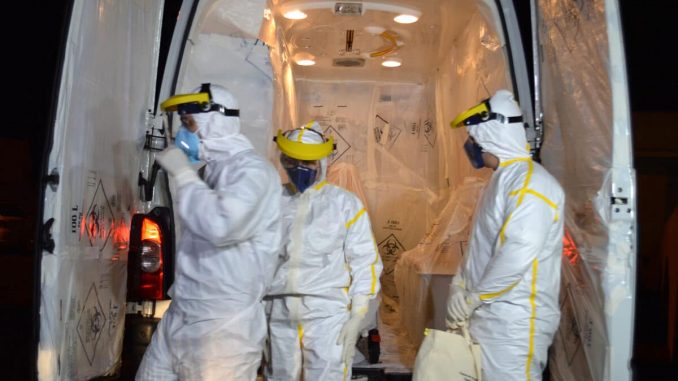
An ambulance is readied by technicians wearing biological hazard protective clothes to transport a Guinean patient suspected of having contracted Ebola, in Cascavel, state of Parana, Brazil, in this October 10, 2014 photo. AFP file photo
Published June 25, 2026
PARIS, June 24–25, 2026 — France has confirmed its first Ebola case linked to the ongoing outbreak in Central Africa, after a doctor who recently returned from a humanitarian mission in the Democratic Republic of Congo (DRC) tested positive for the virus, according to health authorities and multiple reports.
The case marks the first detection of Ebola outside Africa in the current outbreak, prompting immediate isolation protocols and contact tracing measures in France.
Doctor Returned From High-Risk Mission Area
According to health officials, the patient is a medical worker who had been assisting in an Ebola-affected region in eastern DRC, where the current outbreak has been spreading since May 2026.
- The doctor tested positive after returning to France
- He was immediately placed in isolation at a specialist infectious disease facility
- Authorities say the patient is in stable condition and receiving care under strict biosecurity protocols
 The French Health Ministry has confirmed a doctor flying from the Democratic Republic of the Congo to Paris has tested positive for Ebola. (AFP: John MacDougall)
Contact Tracing and Isolation Measures Activated
French health authorities have launched an urgent epidemiological investigation to identify anyone who may have been exposed.
- Several contacts of the patient have been identified and isolated as a precaution
- Monitoring is being carried out under a 21-day observation period, consistent with Ebola incubation protocols
- Officials emphasized that the patient was isolated quickly upon arrival, reducing the risk of secondary transmission
Health Authorities Stress Low Public Risk
Despite the alarming nature of the case, global health agencies and European health experts have emphasized that the overall risk to the public remains low.
- Ebola spreads through direct contact with bodily fluids, not airborne transmission
- Europe’s healthcare systems are considered well-prepared for containment
- The World Health Organization (WHO) and European Centre for Disease Prevention and Control (ECDC) continue to classify the risk of wider spread as low to very low
 The latest official figures record more than 1,000 cases in the outbreak, including 267 deaths. (Reuters: Gradel Muyisa Mumbere)
Linked to Ongoing Ebola Outbreak in Africa
The infection is tied to the current Ebola outbreak centered in:
- Eastern DRC (Ituri region)
- Parts of Uganda, where cross-border transmission has also been reported
The outbreak involves the Bundibugyo strain of Ebola, which has limited treatment options and no widely approved vaccine, making containment efforts heavily reliant on isolation and contact tracing.
 The Alliance for International Medical Action said the patient, who flew to Paris from the Democratic Repbulic of the Congo, was one of its doctors. (Reuters: Gradel Muyisa Mumbere)
Growing Concern but No Panic Advisories
Health officials have urged caution but discouraged alarm, noting:
- Rapid detection and isolation procedures were followed correctly
- No evidence yet of community spread in France
- Ongoing monitoring of all potential contacts is underway
 Public / Political Reactions:
🇫🇷 French Government and Health Authorities
French authorities moved quickly to contain the country’s first Ebola case linked to the current outbreak after confirmation of infection in a returning medical worker.
- The French Ministry of Health confirmed that the patient, a healthcare worker returning from a humanitarian mission in the
- Democratic Republic of Congo, was immediately isolated upon diagnosis.
- Health officials activated emergency epidemiological protocols, including rapid contact tracing and mandatory monitoring of all identified close contacts.
- Authorities emphasized that France’s hospital system is fully equipped with high-level biosecurity units capable of managing highly infectious diseases.
- Officials stressed that early detection and rapid isolation significantly reduce the risk of onward transmission within the country.
➡️ Position: France maintains that the case is fully contained, with no evidence of community spread and strong systems in place to prevent further transmission.
🌍 World Health Organization (WHO) and International Health Agencies
Global health bodies have responded by reinforcing surveillance guidance while downplaying immediate public risk.
- The WHO confirmed it is working with French and Congolese authorities to track the origin and exposure chain of the case.
- International health experts reiterated that Ebola spreads through direct contact with bodily fluids and is not airborne, limiting widespread transmission risk under controlled conditions.
- Agencies continue to classify the broader risk to Europe as low due to rapid detection and strong healthcare infrastructure.
Monitoring efforts are being intensified in affected African regions where the outbreak is ongoing.
➡️ Position: International agencies view the situation as serious but contained, with low risk of sustained spread outside outbreak zones.
🇨🇩 Democratic Republic of Congo Health Authorities
Officials in the DRC, where the outbreak originated, acknowledged the case as part of ongoing cross-border risk concerns.
- Health authorities confirmed continued transmission in localized outbreak areas in eastern DRC.
- Teams are working with international partners to strengthen containment, vaccination (where applicable), and contact tracing efforts.
- Officials emphasized the importance of protecting frontline healthcare workers, who remain at highest risk of infection.
- Cross-border monitoring with neighboring countries has been intensified.
➡️ Position: The DRC stresses that the outbreak remains active locally, with international coordination critical to preventing further export cases.
🇪🇺 European Health and Security Agencies
European institutions responded by reinforcing preparedness measures across member states.
- The European Centre for Disease Prevention and Control (ECDC) issued updated guidance on monitoring travelers returning from affected regions.
- Member states were advised to maintain readiness in isolation units and infectious disease response protocols.
- No travel restrictions were imposed, but enhanced screening awareness has been recommended.
- Officials emphasized that early detection systems across Europe remain robust.
➡️ Position: Europe considers the situation manageable, relying on surveillance and rapid response rather than travel restrictions.
📢 Public and Medical Community Response
Healthcare professionals and public health experts highlighted both concern and confidence in containment systems.
- Medical experts praised France’s rapid isolation response as a model for outbreak control.
- Some public concern emerged due to Ebola’s high fatality rate and historical outbreaks.
- Health communicators urged calm, emphasizing that modern treatment protocols and isolation systems significantly reduce risk.
- Hospitals across France reviewed emergency preparedness procedures as a precaution.
➡️ Position: The public health community sees the case as serious but controlled, with strong confidence in containment measures.
 Resulting Effects
The confirmation of France’s first Ebola case outside Africa in the current outbreak has triggered immediate containment actions and heightened international health monitoring, while reinforcing both the risks of cross-border disease transmission and the effectiveness of rapid-response health systems.
1. Rapid Activation of Emergency Health Protocols in France
French authorities moved quickly to prevent any possible spread following the confirmed case.
🏥 The patient was immediately isolated in a high-security infectious disease facility.
🧪 Intensive contact tracing was launched to identify and monitor all potential exposures.
🚨 Hospitals reinforced biosecurity procedures and reviewed Ebola response readiness.
🧍♂️ Identified contacts were placed under strict medical observation.
➡️ Result: Early detection → rapid containment measures and minimized transmission risk.
2. Increased International Health Surveillance
Global health agencies expanded monitoring efforts following the confirmed case in Europe.
🌍 The WHO and partner agencies increased surveillance in both Europe and West Africa.
📡 Cross-border tracking systems were strengthened to detect potential exported cases early.
🧬 Epidemiological data sharing between countries was intensified.
➡️ Result: Single imported case → strengthened global monitoring and coordination systems.
3. Heightened Attention on Ebola Outbreak Zones in Africa
The case has refocused attention on ongoing transmission in affected African regions.
📍 Active outbreaks in the Democratic Republic of Congo remain the primary source of risk.
🚑 Efforts to vaccinate and protect frontline healthcare workers have been reinforced.
🧑⚕️ International aid coordination is being scaled up to support containment.
➡️ Result: Imported case in Europe → renewed urgency in controlling outbreak hotspots in Africa.
4. Strong Confidence in Hospital Containment Systems
Health experts have pointed to the effectiveness of modern healthcare infrastructure in limiting spread.
🏥 High-level isolation units in France were able to manage the case immediately.
🧯 Strict infection control procedures reduced risk of secondary transmission.
📊 No evidence of community spread has been detected so far.
➡️ Result: Robust healthcare systems → low risk of sustained transmission in developed regions.
5. Public Concern and Preparedness Measures
The announcement has triggered public attention but not widespread panic, alongside precautionary readiness.
⚠️ Public concern increased due to Ebola’s severity and history of outbreaks.
📢 Health officials emphasized that Ebola is not airborne and requires direct contact for transmission.
🧑⚕️ Hospitals reviewed emergency protocols and reinforced training measures.
➡️ Result: Awareness increase → precautionary preparedness without major disruption.
 Future Outlook
The confirmation of an Ebola case in France—linked to the ongoing outbreak in Central Africa—has shifted attention toward containment durability, cross-border surveillance, and the likelihood of additional imported cases, while health authorities continue to stress that the situation remains controlled.
1. Continued Risk of Additional Imported Cases
Health officials expect that more isolated imported cases could still occur as long as the outbreak persists in Africa.
✈️ International travel from affected regions in the Democratic Republic of Congo and surrounding areas remains a monitoring priority.
🧑⚕️ Healthcare workers and aid staff are considered the highest-risk group for future exposure.
🧪 Entry screening and post-travel monitoring protocols are likely to remain in place or expand.
➡️ Outlook: Ongoing African outbreak → continued low but persistent risk of export cases.
2. Sustained Containment Strategy in Europe
European countries are expected to rely on rapid detection and isolation rather than broad restrictions.
🏥 High-security hospital units will remain on standby for any suspected cases.
📡 Surveillance systems for infectious diseases will continue active monitoring of travelers.
🚫 No widespread travel bans are currently expected unless transmission increases significantly.
➡️ Outlook: Europe maintains containment-focused strategy → low likelihood of widespread transmission.
3. Intensified Efforts to Control Outbreak in Africa
Global health agencies are expected to prioritize stopping transmission at the source.
🌍 WHO-led coordination efforts will likely increase in affected regions.
💉 Vaccination campaigns (where available) and contact tracing are expected to expand.
🚑 International medical support may be scaled up to protect frontline workers.
➡️ Outlook: Stronger intervention in Africa → key factor in preventing further international spread.
4. Strengthening of Global Health Security Systems
The case is expected to reinforce long-term investment in outbreak preparedness.
🧬 Countries may review infectious disease response protocols and emergency readiness.
📊 Cross-border health data sharing and early warning systems are likely to expand.
🏥 Hospitals worldwide may reassess high-risk pathogen preparedness.
➡️ Outlook: Single imported case → long-term strengthening of global epidemic response systems.
5. Low Risk of Sustained Transmission in Europe
Despite concern, experts continue to assess the risk of large-scale spread as very low.
🧯 Rapid isolation and contact tracing significantly reduce outbreak potential.
📉 Ebola’s transmission requires direct contact, limiting uncontrolled spread in structured healthcare systems.
📢 Public health messaging is expected to continue emphasizing containment success.
➡️ Outlook: Strong healthcare infrastructure → low probability of sustained outbreak in Europe.
 Bottom Line
The confirmation of Ebola in France—the first outside Africa in the current outbreak—has triggered swift isolation measures and intensified global health monitoring, but authorities stress that the situation remains under control. Rapid diagnosis, immediate quarantine, and robust hospital containment systems have so far prevented any evidence of community transmission, keeping the risk to the wider public low. While concern has increased internationally, health agencies emphasize that the main threat continues to come from ongoing transmission in Africa, making outbreak containment at the source the key factor in preventing further imported cases.
SOURCES: INQUIRER.NET – France detects first Ebola case outside Africa in current outbreak
ABC.NET.AU – France detects first Ebola case in doctor returning from DRC