Published June 25, 2026
MANILA, Philippines — As Filipino families continue to grapple with rising food prices, transportation costs, and other daily expenses, electricity bills have become another source of growing financial pressure.
In recent months, social media platforms, consumer forums, and community discussions have been flooded with complaints from households shocked by higher-than-expected electric bills. Many consumers initially blamed newly noticed charges appearing on their statements, including subsidies and other pass-through costs. However, energy experts and billing breakdowns reveal that the biggest reason behind recent bill increases is often much simpler: the cost of generating electricity itself has gone up.
The Real Driver: Higher Generation Charges
While many consumers focus on the various line items appearing on their bills, the largest component of most electricity charges remains the generation charge—the cost of producing electricity purchased from power suppliers.
When fuel prices rise, supply becomes tighter, or wholesale electricity prices increase, generation costs also rise. These increases are generally passed on to consumers.
As a result, even households whose electricity consumption remains relatively unchanged can still experience noticeably higher bills.
For many consumers, however, understanding this distinction is difficult because electric bills contain numerous separate charges, adjustments, taxes, and subsidies that make it challenging to identify what is actually causing the increase.
Public Frustration Over Additional Charges
Beyond the generation charge, many consumers have expressed frustration over charges they believe should not be included in their monthly electricity bills.
These include:
- Senior Citizen Subsidy
- Lifeline Subsidy
- Feed-in Tariff Allowance (FiT-All)
- Green Energy Auction Allowance
- Universal Charges
- System Loss Charges
While many of these charges are mandated by law and approved by regulators, consumers increasingly question why they are required to shoulder costs associated with social programs, energy incentives, and other government initiatives.
For families already struggling with household expenses, every additional charge—regardless of size—adds to the perception that electricity bills are becoming increasingly burdensome.
“Why Are Consumers Paying More?”
One of the most common complaints circulating online centers on the belief that ordinary consumers are being asked to absorb costs that should be funded elsewhere.
Many consumers support assistance programs for senior citizens and low-income households but argue that such programs should perhaps be funded through broader government revenues rather than through electricity bills.
The debate has fueled broader questions about fairness, transparency, and accountability in the country’s energy pricing system.
The Solar Question
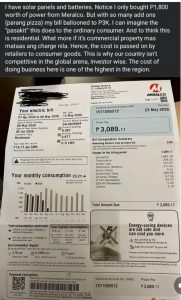
Frustration over rising electricity costs has also renewed interest in rooftop solar power.
Many homeowners view solar panels as a way to reduce dependence on the grid and gain greater control over their monthly expenses. However, some consumers argue that the process of connecting solar systems to the distribution network remains complicated, costly, and bureaucratic.
Although rooftop solar and net metering are legally permitted, critics contend that application requirements, inspections, technical compliance standards, and processing times discourage wider adoption among ordinary households.
Consumer advocates argue that if reducing electricity costs and promoting renewable energy are national priorities, the process should be made easier and more accessible for the public.
The Public Perception Problem
A growing number of consumers believe that the current system discourages energy independence.
While Meralco denies attempting to restrict solar adoption and notes that net metering is available to qualified customers, critics argue that every added fee, permit, inspection, and approval requirement makes the transition to solar more difficult for ordinary families.
For households hoping to reduce their reliance on the grid, these requirements can feel less like safeguards and more like obstacles.
Whether that perception is accurate or not, it has become a powerful source of public frustration.
A Growing Call for Transparency
Consumer groups are increasingly calling for clearer billing explanations that help customers understand exactly why their bills increase from one month to the next.
Many argue that when generation charges rise, consumers deserve straightforward explanations rather than lengthy billing statements filled with technical terms and multiple line items.
Greater transparency, advocates say, would help reduce confusion and improve public trust in the electricity sector.
Energy Costs and Everyday Life
For millions of Filipinos, electricity is no longer just another utility expense—it is an essential household necessity that affects nearly every aspect of daily life.
From students attending online classes to workers operating small businesses from home, rising electricity costs have a direct impact on family budgets and economic well-being.
As energy prices continue to fluctuate, public scrutiny of the country’s power sector is likely to intensify.
The Real Issue: Are Consumers Being Distracted?
As public outrage over electricity bills intensified, much of the discussion shifted toward line items such as senior citizen subsidies, lifeline subsidies, renewable energy charges, and other pass-through costs.
While these charges have generated controversy, critics argue that focusing solely on them risks overlooking the biggest contributor to most electricity bills: the generation charge.
According to Meralco’s own billing breakdown, the generation charge accounts for roughly 64% of a typical residential electricity bill, making it by far the largest component of what consumers pay every month. Any increase in generation costs can therefore have a much larger impact on total bills than many of the smaller charges receiving public attention.
Consumer advocates argue that many households experiencing “bill shock” may mistakenly believe that newly noticed subsidy charges are the primary reason their bills increased. In reality, recent rate hikes have largely been attributed to higher generation costs, fuel prices, foreign exchange movements, and increases in power purchased from suppliers.
This has led some critics to question whether public discussions are becoming overly focused on smaller bill components while the larger structural drivers of electricity prices receive less attention.
For consumers, the distinction matters. While subsidy-related charges remain controversial and are often criticized as unfair burdens on paying customers, the available billing data indicates that increases in generation costs have been the primary driver of recent electricity rate hikes.
The broader concern raised by consumer groups is not simply the existence of subsidies or pass-through charges, but whether the country’s overall power pricing system is delivering affordable electricity to ordinary Filipinos.
📊 Bottom Line
While many consumers have focused on subsidy-related and pass-through charges appearing on their electric bills, the primary reason recent electricity costs have risen is the increase in generation charges—the cost of producing power itself. Nevertheless, public frustration remains high as households struggle to understand complex billing structures and shoulder a growing number of charges beyond their direct electricity consumption. For many Filipinos, the debate is no longer just about power rates; it is about affordability, transparency, and whether the country’s energy system is serving the interests of the people who ultimately pay the bill.
SOURCES: GMA NEWS ONLINE – Meralco: Subsidies ordered collected from consumers