
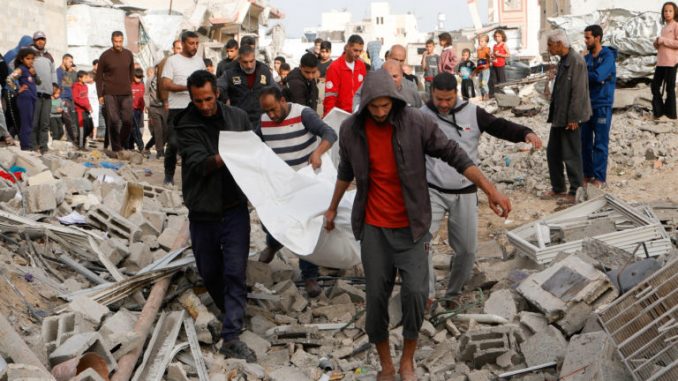
People carry a body of a Palestinian recovered from the site of an Israeli strike on a house, in Khan Younis in the southern Gaza Strip, April 6, 2025. Photo by Hatem Khaled/Reuters
Published July 18, 2026
GAZA CITY — Israeli airstrikes killed at least nine Palestinians, including three children, in Gaza City on Saturday, according to Palestinian hospital officials, underscoring the fragility of the ceasefire that has been repeatedly tested by continued military operations and exchanges of fire.
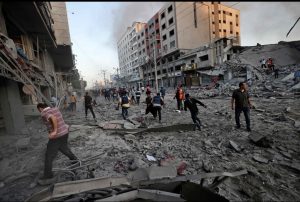 The aftermath of recent Israeli airstrikes in Gaza City.
One strike hit an apartment in Gaza City’s Nasr neighborhood, killing five people, including children between the ages of 8 and 18, according to officials at Shifa Hospital. Six others, including four children, were reportedly injured. A separate strike in the Zeitoun neighborhood killed four more people and critically wounded another individual.
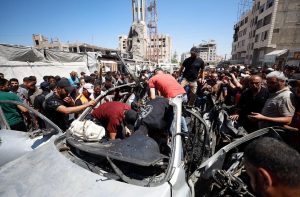 Residents inspecting damaged buildings and vehicles.
The Israel Defense Forces (IDF) said the operations targeted Hamas infrastructure and militants operating in the area. In a separate incident, the military said it struck what it described as a Hamas operative in the Zeitoun neighborhood and added that it was reviewing the outcome of the attack.
Residents and local officials say Israeli airstrikes have intensified across the Gaza Strip in recent days despite the ceasefire that took effect in October 2025. Israel has maintained that it will continue targeting militants it believes pose an immediate threat, while Hamas has accused Israel of repeatedly violating the ceasefire agreement.
According to Gaza’s Health Ministry, more than 1,100 Palestinians have been killed since the ceasefire began, while five Israeli soldiers have also died during the same period. The ministry, which is part of the Hamas-run government, does not distinguish between civilians and combatants in its casualty figures, though its records are generally regarded as credible by U.N. agencies and independent researchers.
 Destruction in residential neighborhoods following the strikes.
The war began after Hamas launched its October 7, 2023, attack on southern Israel, killing about 1,200 people and taking 251 hostages. Israel responded with a large-scale military campaign in Gaza that has continued through periods of temporary ceasefire and renewed fighting.
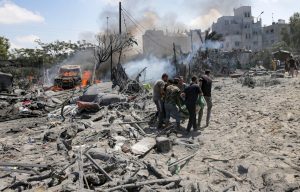 Emergency responders and civilians searching through rubble.
The latest strikes highlight the continuing volatility of the conflict, with civilians on both sides remaining affected as diplomatic efforts to secure a lasting peace continue to face significant challenges.
⚠️ Implications:
The latest Israeli airstrikes in Gaza, despite an existing ceasefire, underscore the fragile security situation and the difficulty of maintaining lasting peace. Continued military operations, ongoing militant activity, and the humanitarian impact on civilians suggest that the conflict remains far from resolved.
🇮🇱 1. The Ceasefire Remains Fragile
- Israeli forces continue conducting strikes against targets they identify as Hamas infrastructure and militants.
- Hamas has accused Israel of violating the ceasefire, while Israel maintains it is acting against ongoing security threats.
- Repeated incidents risk undermining confidence in existing ceasefire arrangements.
🔍 Implication: The likelihood of renewed large-scale fighting increases if ceasefire violations continue.
⚔️ 2. Military Operations Are Continuing Despite Diplomatic Efforts
- Israel has signaled it will continue targeting individuals and facilities it considers security threats.
- Hamas and other armed groups remain active despite ceasefire agreements.
- Diplomatic negotiations have yet to produce a comprehensive and lasting resolution.
⚠️ Implication: Military operations may remain a defining feature of the conflict even during periods officially described as ceasefires.
🏥 3. The Humanitarian Situation Remains Severe
- Civilian casualties continue to be reported, including women and children.
- Damage to residential areas places additional strain on Gaza’s already fragile healthcare and emergency services.
- Humanitarian organizations continue to call for greater protection of civilians and increased access to aid.
🌐 Implication: Ongoing violence is likely to worsen humanitarian conditions and increase international concern over civilian safety.
🌍 4. International Pressure for De-escalation Is Likely to Increase
- Governments and international organizations continue urging all parties to reduce hostilities.
- Civilian casualties often intensify diplomatic calls for restraint and renewed negotiations.
- Mediators remain engaged in efforts to preserve the ceasefire and prevent broader escalation.
📢 Implication: International diplomatic efforts are likely to intensify as violence continues.
🤝 5. Prospects for a Lasting Peace Remain Uncertain
- Deep disagreements over security, hostages, governance, and future political arrangements continue to hinder negotiations.
- Both sides maintain fundamentally different conditions for ending the conflict.
- Trust between the parties remains extremely limited.
🕊️ Implication: Achieving a durable peace agreement will remain challenging without significant diplomatic progress.
🌐 6. Regional Stability Continues to Be at Risk
- Continued fighting in Gaza has the potential to affect neighboring countries and regional security.
- Escalation could increase tensions involving other armed groups and regional actors.
- The conflict remains closely watched by governments across the Middle East and the international community.
🧭 Implication: Even localized military operations carry the risk of broader regional consequences if tensions continue to rise.
💬 Overall Takeaway:
The latest Israeli airstrikes in Gaza highlight the continued fragility of the ceasefire and the persistent security challenges facing both Israelis and Palestinians. Despite ongoing diplomatic efforts, military operations and civilian casualties continue to underscore how quickly tensions can escalate. As long as core issues—including security, hostages, governance, and humanitarian concerns—remain unresolved, the risk of renewed violence will persist, making a lasting and sustainable peace increasingly difficult to achieve.
SOURCES: AP NEWS – Israeli strikes in Gaza kill 3 children and 6 adults, health officials say
THE INDEPENDENT – Israeli strikes in Gaza kill 3 children and 6 adults, health officials say
Think before you click. Stay informed by following verified reporting as events continue to develop.




