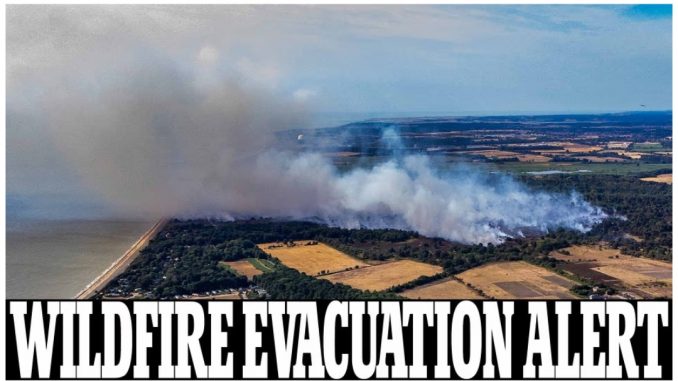
Aerial photo shows a fire ravaging an area the size of 14 football pitches in Suffolk
Published July 30 , 2026
SUFFOLK, England — A rapidly spreading wildfire along England’s Suffolk coast forced the evacuation of hundreds of holidaymakers as firefighters battled to contain flames advancing through dry heathland near the Sizewell B nuclear power station. The blaze prompted authorities to declare a major incident, with emergency crews working around the clock to protect nearby communities, holiday parks, and critical infrastructure.
The wildfire broke out amid prolonged hot, dry weather that has left large areas of vegetation highly susceptible to fire. While officials stressed there is currently no threat to the nearby nuclear facility, the incident has underscored growing concerns over Britain’s increasing wildfire risk during periods of extreme heat.
 Aerial photo shows a fire ravaging an area the size of 14 football pitches in Suffolk
 The wildfire is spreading in the direction of Sizewell B nuclear power station, but is not thought to be a threat to the site
 Britain is on high alert for ‘exceptionally severe’ wildfires after more than 200 were recorded in the past two weeks. Pictured: The fire in Suffolk
Wildfire Triggers Mass Evacuations and Major Emergency Response
Authorities evacuated approximately 200 caravans from nearby holiday parks as a precaution while residents and visitors were urged to avoid the affected area because of heavy smoke and rapidly changing fire conditions.
More than 90 firefighters, supported by specialist wildfire units, water carriers, drones, and off-road vehicles, have been deployed to contain the blaze. Emergency crews continue working in difficult terrain where strong winds and dry vegetation have complicated firefighting efforts.
 Firefighters are tackling the blaze at Dunwich in Suffolk, which has been described as a ‘dynamic situation’
 Fire crews are seen battling a fire in Romford, east London, yesterday where around 30 acres of grassland were destroyed
Officials confirmed that the Sizewell B nuclear power station remains safe and continues operating normally, with emergency services maintaining close coordination and monitoring as the wildfire response continues.
The incident comes during one of England’s hottest and driest periods in recent years, with fire authorities warning that prolonged heat and limited rainfall have significantly increased the likelihood of vegetation fires across the country. Environmental experts also cautioned that the blaze could cause lasting damage to Suffolk’s protected heathland habitats and wildlife.
 Suffolk Fire and Rescue has declared the blaze a major incident ‘due to the size and complexity’
 Fire crews tackle a blaze in London yesterday after temperatures reached 34C
 The blaze on Dunwich Heath, which began at around 5.30pm yesterday, is spreading rapidly in the direction of Sizewell B nuclear power station, which is about 2.5 miles away

Authorities continue urging the public to avoid the affected area, follow evacuation instructions, and exercise extreme caution as firefighters work to fully contain the wildfire.
👥 Public / Political Reactions:
🇬🇧 United Kingdom
British authorities declared a major incident as emergency crews continued battling the wildfire in Suffolk.
- Fire officials deployed more than 90 firefighters, supported by specialist wildfire units, water carriers, drones, and off-road vehicles.
- Authorities evacuated around 200 caravans from nearby holiday parks as a precaution.
- Residents and visitors were urged to avoid the area, remain indoors if affected by smoke, and follow evacuation instructions.
- Officials stressed there is currently no threat to the nearby Sizewell B nuclear power station.
➡️ Position: The UK government and emergency services are prioritizing public safety, wildfire containment, and protecting nearby communities and critical infrastructure.
⚛️ Sizewell B Nuclear Power Station
Operators of the nuclear facility sought to reassure the public as concern grew over the fire’s proximity.
- Officials confirmed the plant continues to operate safely.
- Continuous monitoring is underway as firefighters work nearby.
- Emergency coordination remains in place should conditions change.
➡️ Position: Operators say the facility remains secure, with no immediate danger posed by the wildfire.
🌍 Environmental Experts
Conservationists warned the blaze could have long-term ecological consequences.
- Heathland ecosystems provide habitats for rare wildlife and protected plant species.
- Experts warned that large-scale fires can permanently damage fragile landscapes.
- Recovery of burned heathland could take years depending on the severity of the fire.
➡️ Position: Environmental groups are urging stronger wildfire prevention measures as extreme weather increases fire risks across Britain.
👥 Public Response
Holidaymakers and local residents described scenes of panic as the fire spread.
- Families rushed to leave campsites and caravan parks with little warning.
- Social media users shared dramatic images and videos of towering smoke clouds and advancing flames.
- Many praised firefighters for their rapid response while expressing concern over increasingly frequent wildfires during Britain’s hotter summers.
➡️ Position: Public sentiment has largely focused on support for emergency responders while raising concerns about the growing impact of extreme weather.
🏛️ Broader Impact
The Suffolk wildfire has renewed debate over Britain’s preparedness for climate-driven emergencies.
- Experts say prolonged heatwaves and drought conditions are increasing the frequency of wildfires across the UK.
- The incident has highlighted the importance of protecting critical infrastructure located near fire-prone areas.
- Emergency planners may face growing pressure to expand wildfire response capabilities as extreme weather events become more common.
➡️ Position: The wildfire is being viewed as another warning that climate-related disasters are becoming a greater challenge for public safety, infrastructure, and environmental protection across the United Kingdom.
⚠️ Resulting Effects:
The Suffolk wildfire has disrupted communities, displaced holidaymakers, and highlighted the growing threat of extreme weather across the United Kingdom. Although emergency crews continue making progress in containing the blaze, officials warn that prolonged heat and dry conditions could increase the likelihood of similar incidents in the weeks ahead.
1. Mass Evacuations and Travel Disruptions
The wildfire forced the evacuation of holiday parks and affected travel across parts of Suffolk.
🏕️ Hundreds of holidaymakers were evacuated from campsites and caravan parks.
🚧 Road closures and emergency cordons disrupted local traffic and tourism.
🏠 Temporary shelters were opened for displaced visitors and residents.
➡️ Result: Rapidly spreading wildfire → evacuations, travel disruptions, and temporary displacement.
2. Emergency Services Under Pressure
Firefighters faced difficult conditions as they worked to contain the blaze.
🚒 More than 90 firefighters, supported by specialist wildfire units, remained on the front lines.
🚁 Drones, water carriers, and off-road vehicles were deployed to assist operations.
⚠️ Shifting winds and dry vegetation complicated containment efforts.
➡️ Result: Large wildfire → increased demand on emergency response resources.
3. Concerns Over Critical Infrastructure
The fire’s proximity to the Sizewell B nuclear power station attracted national attention.
⚛️ Authorities confirmed there is no immediate threat to the facility.
👮 Emergency agencies continue monitoring conditions around critical infrastructure.
📡 Officials remain prepared to respond should the situation change.
➡️ Result: Wildfire near key infrastructure → heightened monitoring and precautionary measures.
4. Environmental Damage
The blaze threatens one of Suffolk’s valuable heathland ecosystems.
🌿 Protected habitats and native wildlife may suffer long-term damage.
🦉 Rare species could lose nesting and feeding grounds.
🌱 Ecological recovery may take years depending on the extent of the destruction.
➡️ Result: Heathland wildfire → significant environmental and biodiversity impacts.
5. Tourism and Local Economy Affected
The emergency has disrupted one of Suffolk’s busy holiday destinations.
🏖️ Campsites and holiday parks temporarily suspended operations.
💷 Local businesses may experience financial losses due to cancellations.
📉 Tourism activity could remain affected until the area is declared safe.
➡️ Result: Wildfire emergency → economic losses for the local tourism sector.
6. Growing Climate Concerns
The incident has intensified discussions about Britain’s increasing wildfire risk.
🌡️ Prolonged heatwaves and drought conditions have left vegetation dangerously dry.
🔥 Fire services have reported a rise in wildfires across several parts of England.
📋 Experts say emergency planning may need to adapt to more frequent extreme weather events.
➡️ Result: Extreme weather → increased focus on wildfire preparedness and climate resilience.
7. Ongoing Risk Remains
Although firefighters have made progress, the danger has not completely passed.
💨 Changing winds could reignite hotspots or spread flames to new areas.
🚨 Emergency crews remain on high alert until the fire is fully contained.
👥 Authorities continue urging the public to avoid affected areas and follow official safety guidance.
➡️ Result: Continuing firefighting operations → sustained vigilance until the wildfire is fully extinguished.
🔮 Future Outlook:
The Suffolk wildfire is expected to remain a significant emergency until firefighters fully contain the blaze. While authorities say there is currently no threat to nearby critical infrastructure, continued hot, dry, and windy conditions could increase the risk of flare-ups and new wildfires across parts of the United Kingdom.
1. Firefighting Operations Will Continue
Emergency crews are expected to remain on scene until the wildfire is fully under control.
🚒 Firefighters will continue tackling hotspots and preventing the flames from spreading.
🚁 Specialist wildfire units, drones, and aerial monitoring are likely to remain deployed.
⚠️ Officials will closely monitor weather conditions that could affect containment efforts.
➡️ Outlook: Ongoing firefighting operations → continued emergency response until the fire is extinguished.
2. Evacuation Orders May Remain in Place
Authorities are expected to prioritize public safety while the danger persists.
🏕️ Evacuated holidaymakers may not be allowed to return until the area is declared safe.
🚧 Road closures and restricted access could continue in affected communities.
🏠 Emergency shelters may remain available for displaced residents and visitors.
➡️ Outlook: Safety concerns → continued restrictions in and around the wildfire zone.
3. Critical Infrastructure Will Remain Under Close Watch
Officials are expected to maintain heightened monitoring around the nearby Sizewell B nuclear power station.
⚛️ Operators will continue coordinating with emergency services.
📡 Continuous assessments will ensure the facility remains protected.
👮 Authorities will respond quickly should conditions change.
➡️ Outlook: Preventive monitoring → continued protection of critical infrastructure.
4. Environmental Recovery Could Take Years
Experts believe the wildfire may leave lasting damage to Suffolk’s heathland.
🌿 Burned habitats will require long-term ecological recovery.
🦉 Wildlife populations may take time to recover from habitat loss.
🌱 Conservation groups are expected to assess environmental damage once the fire is contained.
➡️ Outlook: Ecological restoration → a long-term priority after the emergency ends.
5. Wildfire Preparedness May Increase Across the UK
The incident is expected to reinforce concerns about Britain’s growing wildfire risk.
🌡️ Authorities may expand public awareness campaigns during periods of extreme heat.
🚒 Fire services could strengthen wildfire response capabilities and planning.
📋 Local governments may review emergency preparedness for future heat-related disasters.
➡️ Outlook: Lessons from Suffolk → stronger wildfire prevention and emergency planning.
6. Tourism Recovery Will Depend on Conditions
The local tourism industry is expected to recover once the emergency has passed.
🏖️ Holiday parks and attractions will likely reopen after safety inspections.
💷 Businesses may work to restore visitor confidence following the disruption.
📈 Recovery will depend on how quickly authorities declare the area safe.
➡️ Outlook: Tourism recovery → gradual return as wildfire risks diminish.
7. Extreme Weather Will Remain a Key Concern
Meteorologists and emergency planners expect wildfire risks to remain elevated during prolonged dry spells.
🔥 Additional vegetation fires remain possible if hot and windy weather continues.
🌍 Climate experts warn that similar incidents could become more frequent in the future.
🤝 Continued cooperation between emergency services, local authorities, and the public will be essential in reducing future wildfire risks.
➡️ Outlook: Persistent extreme weather → continued vigilance and stronger climate resilience across the United Kingdom.
🧩 Bottom Line:
The Suffolk wildfire has become one of the most significant emergency incidents to hit England this summer, forcing mass evacuations, straining emergency services, and highlighting the growing threat posed by prolonged heat and dry conditions. While firefighters continue making progress, authorities remain cautious as changing weather could quickly alter the situation.
🔥 The wildfire demonstrates how rapidly vegetation fires can escalate into major emergencies, threatening homes, holiday destinations, and protected natural landscapes.
🚒 Emergency responders continue working around the clock to contain the blaze, protect nearby communities, and ensure that critical infrastructure—including the nearby Sizewell B nuclear power station—remains safe.
🌿 Environmental concerns extend beyond the immediate fire, with experts warning that damaged heathland ecosystems and wildlife habitats may take years to recover.
🌡️ Climate and preparedness remain central issues, as increasingly hot and dry summers raise concerns that wildfires could become more frequent and severe across the United Kingdom.
➡️ Bottom Line: The Suffolk wildfire serves as a stark reminder that extreme weather is reshaping Britain’s emergency landscape. Although there is currently no threat to the nearby nuclear facility, the incident underscores the importance of rapid emergency response, public preparedness, and long-term strategies to address the growing risks associated with climate-driven wildfires.
SOURCES: DAILYMAIL ONLINE – Tinderbox Britain: Hundreds of holidaymakers evacuated as firefighters battle wildfire in Suffolk while grass fires rage in London – with half of England in ‘exceptionally serious’ drought
LONDON BUSINESS NEWS – Britain turns into a tinderbox as fire chiefs warn one spark could trigger disaster
ESSEX LIVE – Good Morning Britain issues breaking news as Suffolk wildfire sparks evacuations