China hit by Pacific missile backlash after doubling its nuclear warheads and losing access to a key Congo export [PLA/WeChat]
Published August 12, 2026
SUVA, Fiji — China’s latest ballistic missile test in the Pacific has triggered fresh concern among Pacific Island governments and intensified debate over Beijing’s rapidly expanding military capabilities, putting renewed pressure on a region that has long sought to avoid becoming an arena for major-power confrontation.
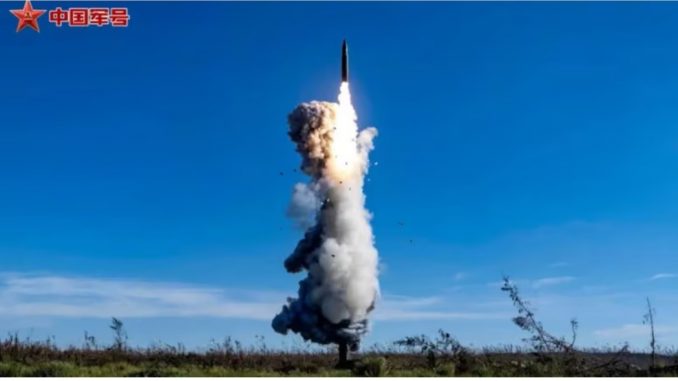
The missile test, conducted in July, involved an unarmed nuclear-capable intercontinental ballistic missile launched into the southern Pacific. The U.S. State Department said it monitored the launch and criticized Beijing for what it described as a rapid and opaque expansion of its nuclear weapons program.
The test has also exposed divisions among Pacific Island nations.
Individual Pacific leaders condemned the launch, but Pacific foreign ministers were unable to produce a unified response because governments in the region have differing relationships with Beijing and Western countries.
For some Pacific governments, the issue is not simply whether China has the right to conduct a missile test. It is whether increasingly powerful nations are turning the Pacific into a testing ground and strategic competition zone without sufficient consultation with the countries located there.
The controversy comes as China’s nuclear arsenal continues to expand.
Public estimates put China’s nuclear stockpile at more than 600 warheads, while U.S. defense assessments have projected that Beijing could possess as many as 1,000 deliverable nuclear warheads by 2030 if its current trajectory continues.
That buildup gives the Pacific missile test greater significance.
A nuclear-capable intercontinental ballistic missile is designed for extremely long-range delivery. Even when a test missile carries no nuclear warhead, demonstrating the ability to launch such a weapon into the Pacific provides valuable information about China’s strategic capabilities and signals that Beijing is continuing to develop the sea, land and air components of its nuclear forces.
The U.S. government has openly expressed concern.
The State Department has urged Beijing to participate in meaningful arms-control discussions and establish regular notification procedures for missile and space launches.
The timing has also attracted attention.
China’s missile launch occurred as Australia and Pacific Island nations were strengthening their own security relationships. Fiji recently signed its first defense treaty with Australia, adding another layer to the broader strategic changes occurring across the region.
The result is an increasingly complicated Pacific security environment.
China has expanded its economic and diplomatic presence throughout the Pacific, while Australia, New Zealand and the United States have sought to strengthen relationships with island governments. Pacific nations, meanwhile, have repeatedly emphasized that they want their own priorities and sovereignty respected rather than becoming secondary players in a contest between larger powers.
That creates a difficult balancing act.
Some governments see closer security relationships with Australia, New Zealand or the United States as useful for defense, disaster response and maritime security. Others maintain close political and economic relationships with Beijing and are reluctant to endorse policies that could be interpreted as taking sides.
The disagreement over China’s missile test demonstrates just how difficult it can be for Pacific governments to maintain a unified position.
For Beijing, the missile test can also be viewed as a demonstration of military capability rather than simply a regional provocation. China has defended its military activities as part of its national-defense program.
But the reaction from Pacific governments shows that the consequences extend beyond Beijing and Washington.
The Pacific is home to some of the world’s smallest nations, many of which have limited military capabilities but occupy strategically important territory and waters.
That makes the region increasingly important as China, the United States and their allies expand military exercises, defense agreements and strategic deployments.
The missile test therefore represents more than a single weapons launch.
It is another sign that the Pacific is becoming an increasingly important arena for strategic competition — and that countries located in the region are being forced to navigate between major powers while attempting to preserve their independence.
For the United States and its allies, China’s expanding nuclear arsenal and long-range missile capabilities create a growing strategic challenge. For Pacific Island governments, the immediate concern is different: how to maintain regional stability without allowing their waters and territory to become dominated by outside military competition.
China’s nuclear expansion and latest Pacific missile test have made that balancing act considerably more difficult.
For now, China’s missile test has delivered a clear message: Beijing’s military reach is expanding, Pacific nations are divided over how to respond, and the strategic importance of the region continues to grow.
⚠️ Implications:
Rising regional tensions: China’s missile test could intensify security concerns among Pacific Island nations and U.S. allies in the region.
Greater scrutiny of China’s nuclear expansion: The test is likely to draw additional attention to the size, range and development of China’s nuclear forces.
Pacific nations face a difficult balancing act: Governments in the region may face increasing pressure to strengthen security ties with Australia, the United States and other partners while maintaining relations with Beijing.
Australia and its allies may strengthen defenses: Continued Chinese missile and nuclear developments could encourage greater military cooperation, surveillance and missile-defense planning across the Indo-Pacific.
More military activity in the Pacific: Additional missile tests, military exercises and strategic deployments could become more common as major powers compete for influence.
Potential diplomatic fallout: Pacific governments may demand greater notification and consultation over major military tests conducted in or near their region.
A broader strategic warning: The test demonstrates that China’s military capabilities extend far beyond its immediate coastline, reinforcing the importance of the Pacific in the wider U.S.-China strategic competition.
Risk of further division: With Pacific nations holding different relationships with China, Australia and the United States, future security disputes could make it increasingly difficult for the region to present a unified position.
💬 Overall Takeaway:
China’s Pacific missile test is more than a demonstration of military capability. It highlights the growing importance of the Pacific as a strategic arena and raises questions about Beijing’s expanding nuclear and long-range missile forces.
For Pacific Island nations, the challenge is maintaining regional stability while avoiding becoming caught between competing major powers. For Australia, the United States and their allies, China’s expanding capabilities represent a growing security consideration.
The immediate impact may be diplomatic rather than military, but continued missile testing and nuclear expansion could increase tensions and accelerate the strategic competition taking place across the Indo-Pacific.
SOURCES: AFRICA BUSINESS INSIDER – China hit by Pacific missile backlash after doubling its nuclear warheads and losing access to a key Congo export
CHANNEL NEWS ASIA – China missile test: Beijing successfully launches ICBM from submarine in Pacific Ocean