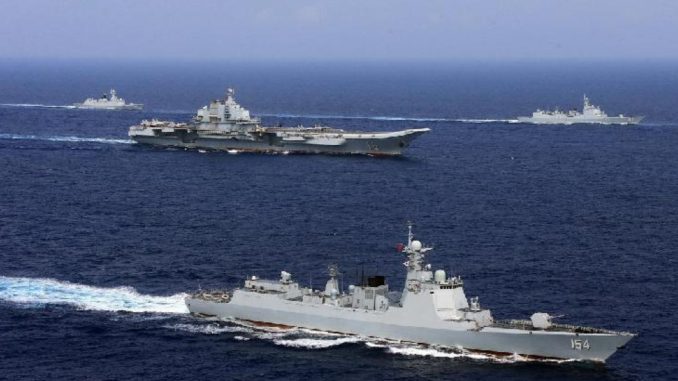
Chinese military aircraft and naval vessels conduct operations near Taiwan as tensions rise across the Taiwan Strait. Beijing is increasingly focused on blockade scenarios and studying lessons from modern warfare, including the ongoing conflict involving Iran, while Taiwan strengthens its defenses against a potential Chinese military escalation.
Reported by:

Cherry Meigh Timbol
News Content Editor
Published September 1, 2026
China is intensifying pressure around Taiwan while closely studying the lessons emerging from the war involving the United States, Israel and Iran, according to Taiwan’s latest assessment of the Chinese military threat.
Taiwan’s defense ministry says Beijing is strengthening its control of the air and sea around the island and increasingly conducting exercises designed to establish the conditions for a potential blockade or wider military operation.
The development comes at a particularly sensitive moment for the Indo-Pacific. China’s expanding military activity around Taiwan comes as Washington’s prolonged conflict with Iran has highlighted the enormous quantities of ammunition, missiles and air-defense interceptors required during sustained high-intensity warfare.
Beijing Studies the Iran War
Taiwan’s annual defense assessment says China is incorporating lessons from the war in Ukraine and the conflict involving the United States and Iran into its military training and exercises.
Among the issues Beijing is reportedly studying are rapid ammunition consumption, pressure on air-defense systems, industrial mobilization and the reliability of allied support.
The Ukraine war has also demonstrated the battlefield value of large numbers of relatively inexpensive drones, while the Iran conflict is providing another real-world example of the demands placed on modern air defenses and long-range strike capabilities.
The implications for Taiwan are significant.
A conflict over the island would not necessarily begin with a traditional amphibious invasion. Instead, Beijing could attempt to isolate Taiwan, disrupt its communications and air defenses, and interfere with the sea and air routes on which the island depends.
Taiwan says China’s recent exercises have increasingly focused on joint blockade and control operations involving the People’s Liberation Army, navy, air force and coast guard.
Taiwan Warns of a Growing Encirclement
Taipei says China’s regular combat-readiness patrols and operations farther from the Chinese mainland are allowing Beijing to gradually strengthen its control over the waters and airspace surrounding Taiwan.
The objective, according to the Taiwanese assessment, would be to create an encirclement and disrupt Taiwan’s command-and-control systems and air defenses early in a conflict.
Taiwan also says China does not yet possess the capability for a full-scale amphibious assault, making blockade and coercive operations an important part of Beijing’s current strategy.
China regards Taiwan as part of its territory and has never renounced the use of force to bring the island under its control. Taiwan rejects Beijing’s sovereignty claims and maintains that its future can only be decided by its own people.
A New Mobilization Law Adds to Concern
Beijing has revised its National Defense Mobilization Law, with the new legislation scheduled to take effect on October 1, 2026.
The revised law establishes mechanisms for rapidly converting economic and social resources into defense capabilities when national security is threatened.
It covers areas including reserve personnel, strategic material reserves, military production, logistics, national defense duties and the requisition of civilian resources.
The legislation does not mean China has decided to launch a war against Taiwan. However, its timing and broader scope are likely to receive close attention in Taipei, Washington and other Asian capitals.
China’s government says the revisions are intended to modernize the national defense mobilization system and improve the country’s ability to respond to security threats.
The Iran War Is Sending a Warning to Asia
The conflict in the Middle East is also creating a different problem for the United States and its allies.
Sustained combat has placed pressure on U.S. weapons inventories, raising concerns among Asian allies about whether Washington could maintain sufficient supplies during another major conflict while simultaneously supporting partners in Europe and the Middle East.
That issue is particularly relevant to Taiwan, which relies heavily on U.S. weapons and military support.
For Beijing, the lesson may be that industrial capacity, missile stocks, drones, air-defense systems and logistics could prove just as important as sophisticated platforms in a prolonged conflict.
China’s military planners are therefore likely to pay close attention to how the United States conducts long-range operations, maintains supply lines and manages weapons consumption during an extended campaign.
Pressure Extends Beyond the Taiwan Strait
China’s confrontation with Taiwan is also increasingly visible across the Pacific.
Beijing recently warned of unspecified consequences after Taiwan’s foreign minister attended a Pacific Islands Forum gathering in Palau.
China objected to Taiwan’s participation, while Australia and New Zealand defended the forum’s authority to determine its own guest list.
The dispute illustrates how the Taiwan issue is no longer confined to the Taiwan Strait. Beijing and Taipei are competing for diplomatic influence across the wider Pacific, where strategic relationships are becoming increasingly important to both China and the United States.
The growing rivalry means that diplomatic disputes, military exercises and economic pressure are increasingly becoming interconnected parts of the wider struggle for influence in the Indo-Pacific.
🧩 Bottom Line:
The Taiwan Strait is entering a more dangerous strategic phase. Beijing does not appear to need an invasion tomorrow to increase pressure on Taiwan. By gradually strengthening control of surrounding air and sea routes, rehearsing blockade scenarios, studying the weaknesses exposed by the Iran war and expanding its national mobilization framework, China can build the capability and leverage to make a future crisis far more difficult for Taiwan and its allies.
The central question now is not simply whether China intends to attack Taiwan. It is how much military and economic pressure Beijing can apply before the pressure itself becomes the trigger for a larger confrontation.
For Washington and Taipei, the lessons of the Iran war are therefore arriving at a critical moment: a Taiwan conflict could become a test not only of military power, but of industrial capacity, ammunition reserves, logistics and the ability of allies to sustain a long war.
SOURCES: CHINA DAILY – China revises defense mobilization law to boost security, modernize capabilities
MND TAIWAN – PLA activities in the waters and airspace around Taiwan
INVESTING.COM – Taiwan says ’unpredictable’ China strengthens air and sea control nearby