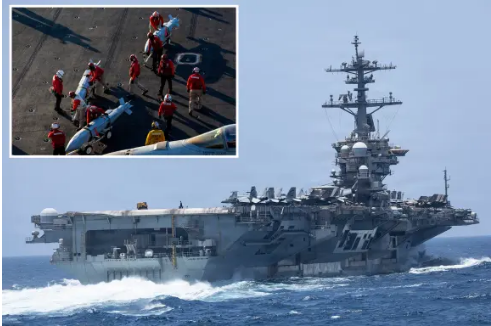
WASHINGTON — The Pentagon is facing growing scrutiny over conditions aboard the USS Abraham Lincoln after reports that sailors have attempted to go overboard during the aircraft carrier’s extraordinarily long deployment in the Middle East.
The nuclear-powered carrier, carrying roughly 5,000 sailors and Marines, has been at sea for more than 200 days without a port call, according to lawmakers and reports from military families. The deployment was originally expected to last about seven months but has been repeatedly extended amid U.S. military operations involving Iran.
The allegations have triggered demands for answers from members of Congress, who are questioning whether the prolonged deployment is taking an unacceptable toll on the physical and mental well-being of the crew.
Reports of Sailors Trying to Go Overboard
The most disturbing allegations involve multiple incidents in which sailors reportedly attempted to go overboard.
Military Times reported that at least two sailors had to be prevented from going overboard, while military families described deteriorating morale and increasing concerns about the psychological strain of the deployment. In one reported incident, a sailor intervened after seeing a shipmate preparing to go over the side.
The Navy has not provided a precise number of sailors who have attempted to go overboard or engaged in self-harm during the deployment.
At the same time, Navy officials have pushed back against claims of a broader suicide crisis, saying they have not observed an increase in suicidal ideation or attempts aboard the carrier and that medical, religious and mental-health professionals are available to sailors.
Families Raise Alarm Over Conditions
The concerns extend beyond mental health.
Lawmakers and military families have cited allegations involving moldy showers, broken toilets, shortages of hygiene products, inadequate hot water, water concerns and problems with food and mail delivery.
Rep. Mike Levin, D-Calif., has publicly highlighted allegations that sailors were dealing with severe shortages and deteriorating living conditions aboard the ship.
More than 200 family members also reportedly met with acting Navy Secretary Hung Cao in San Diego to voice concerns about the prolonged deployment and the condition of their loved ones.
For families waiting at home, uncertainty over when the carrier will return has added another layer of stress.
Blumenthal Demands Answers From Hegseth
Sen. Richard Blumenthal, D-Conn., a member of the Senate Armed Services Committee, sent a letter to Defense Secretary Pete Hegseth and acting Navy Secretary Hung Cao demanding detailed answers about the carrier’s deployment.
Blumenthal said the Lincoln has gone more than 200 days without a port call, calling it a record for consecutive days at sea.
He questioned whether the Navy’s current operational tempo is sustainable and demanded information about the ship’s habitability problems, crew readiness, mental-health monitoring, safety incidents and the rationale behind continuing the deployment.
The senator also warned that prolonged deployments can have consequences beyond immediate crew welfare, potentially affecting equipment readiness, maintenance schedules and the Navy’s ability to respond to future crises.
Hegseth Pushes Back
Hegseth has rejected the characterization of conditions aboard the carrier as being as severe as some reports suggest.
During a press briefing Thursday, Hegseth called reports about poor conditions aboard the Lincoln “completely misrepresented.” He nevertheless acknowledged that sailors are operating under difficult circumstances and emphasized the need to support the force.
The administration has defended the military’s commitment to American service members, while the Navy says commanders continue to monitor the crew’s psychological readiness and provide access to counselors, chaplains and medical personnel.
A Deployment That Keeps Getting Longer
The USS Abraham Lincoln departed Naval Base San Diego on Nov. 21, 2025, for what was initially planned as a seven-month deployment.
Instead, the carrier was redirected toward the Middle East and has remained there amid continuing military operations involving Iran. Its deployment has now stretched into its ninth month, with no publicly announced return date.
The Navy is reportedly preparing the USS Theodore Roosevelt carrier strike group to eventually relieve the Lincoln, although officials have not provided a specific timeline because of operational-security concerns.
Readiness vs. the Human Cost
The controversy presents a difficult challenge for Pentagon leaders.
Aircraft carriers are designed for sustained operations, but an extended deployment places enormous demands on sailors working around aircraft, weapons, fuel, heavy machinery and other hazards while operating under potentially dangerous conditions.
Blumenthal has argued that the question is no longer simply how long the Navy can keep one carrier deployed, but whether the current operational tempo can be maintained without creating a future readiness crisis.
For the sailors aboard the Lincoln, however, the issue is immediate.
They have spent months away from their families while facing an uncertain return date and the demands of continuous military operations.
The growing controversy now puts the Pentagon under pressure to demonstrate that maintaining America’s military presence in the Middle East is not coming at the expense of the service members being asked to carry out the mission.