Reported by:

Cherry Meigh Timbol
News Content Editor
Published October 15, 2026
The Gulf of Oman remains a critical maritime corridor for international trade and military operations, connecting the Arabian Sea with the Strait of Hormuz and the Persian Gulf. Any confrontation involving U.S. naval forces and Iran-affiliated vessels in the area carries potential implications for regional security and commercial shipping.
U.S. Central Command Confirms Destruction of Iran-Affiliated Vessel
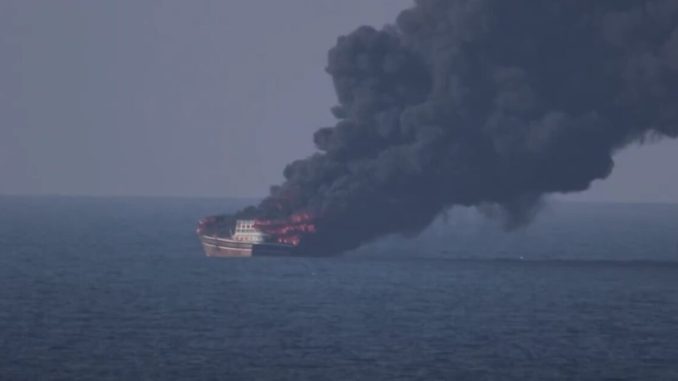
The U.S. military said it destroyed an Iran-affiliated traditional sailing vessel, known as a dhow, in the Gulf of Oman on October 6. U.S. Central Command (CENTCOM) disclosed the operation on October 14, stating that the vessel had been conducting surveillance and targeting activities against U.S. Navy ships.
According to CENTCOM, the crew was safely removed before the vessel was destroyed. The command said efforts to repatriate the crew members were continuing, but it did not publicly identify them or provide further details about their status.
The U.S. military said it destroyed an Iran-affiliated traditional sailing vessel, known as a dhow, in the Gulf of Oman on October 6. U.S. Central Command (CENTCOM) disclosed the operation on October 14, stating that the vessel had been conducting surveillance and targeting activities against U.S. Navy ships.
According to CENTCOM, the crew was safely removed before the vessel was destroyed. The command said efforts to repatriate the crew members were continuing, but it did not publicly identify them or provide further details about their status.
The announcement did not specify the exact location of the encounter, the weapons used to destroy the vessel, or the evidence supporting the military’s assessment of its activities.
Alleged Surveillance Operations Against U.S. Warships
CENTCOM accused Iran’s Islamic Revolutionary Guard Corps (IRGC) of targeting American warships and civilian mariners operating in regional waters over the preceding seven months. The latest disclosure adds to Washington’s concerns about maritime surveillance and threats to naval operations near Iran.
A dhow is a traditional vessel commonly used for fishing, trade, and transportation across the Middle East and the Indian Ocean. Such vessels operate throughout the region, making the specific intelligence behind the U.S. military’s assessment central to understanding the incident.
The U.S. statement did not establish publicly whether the crew directly participated in a planned attack or whether the vessel itself carried offensive weapons. CENTCOM’s stated justification centered on the alleged surveillance and targeting activities.
Incident Comes Amid Wider Maritime Tensions
The destruction occurred as tensions between Washington and Tehran continued to threaten shipping routes around the Strait of Hormuz and the Gulf of Oman.
The adjacent Strait of Hormuz is one of the world’s most important energy transit routes, connecting the Persian Gulf with the Gulf of Oman and the Arabian Sea. Disruptions in these waters can affect oil shipments, shipping insurance costs, and international energy markets.
Reuters reported on October 14 that Iran had been changing its tactics in maritime operations, including reportedly using small boats to identify and track potential targets after damage to Iranian radar capabilities. The report cited officials familiar with the developments.
The U.S. military has also continued enforcing restrictions on shipping associated with Iranian ports. In a separate incident reported earlier in October, American forces disabled the commercial vessel Ocean Molica, also known as Arika Sun, after it allegedly attempted to breach the U.S. naval blockade. That operation involved disabling the ship’s propulsion rather than destroying the vessel.
Strategic Significance
The incident highlights the growing risks facing military and commercial vessels operating near Iran. Surveillance activities that help identify naval positions could increase the danger of missile, drone, or other attacks if targeting information is passed to forces capable of carrying them out.
However, the public information released by CENTCOM does not independently establish how the vessel’s surveillance activities were conducted or whether they directly supported a specific planned attack.
The safe removal of the crew before the vessel’s destruction is a significant detail in the military’s account. The status and eventual repatriation of the crew remain outstanding issues.