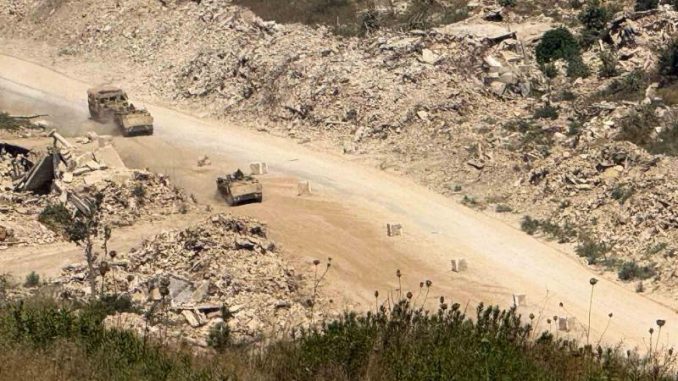
Israeli vehicles drive on a road in southern Lebanon, as seen from the Israeli side of the Israel-Lebanon border, in northern Israel, August 6, 2026.
Reported by:

Cherry Meigh Timbol
News Content Editor
Published August 16, 2026
BEIRUT, Lebanon — Israel launched its deadliest strikes on southern Lebanon since a June truce between Israel and Hezbollah, killing at least 11 people and raising fears that renewed fighting could undermine a fragile framework agreement intended to end years of conflict between the two sides.
Lebanese officials said the Saturday strikes hit several locations in southern Lebanon, including Ansar and Deir al-Zahrani, killing civilians and wounding others. The reported dead included three children.
Israel said its military action was carried out in response to a Hezbollah attack that wounded three Israeli soldiers. Israeli officials said the strikes targeted Hezbollah military infrastructure and killed a senior Hezbollah commander.
The escalation comes at a particularly sensitive moment, with Lebanon and Israel attempting to advance a U.S.-brokered framework that links an Israeli withdrawal from southern Lebanon to the disarmament of Hezbollah.
Israel Says Strikes Targeted Hezbollah
The Israeli military said its forces struck Hezbollah positions after the Iran-backed group attacked Israeli troops in southern Lebanon.
Israel identified the target as Hezbollah commander Ali Samir al-Haj Hassan, whom Israeli officials accused of operating from an area containing military infrastructure. Israel also acknowledged that civilians were killed, saying Hezbollah deliberately embeds military activity among civilian populations.
The Israeli government has repeatedly argued that Hezbollah’s continued military presence in southern Lebanon represents a direct threat to communities in northern Israel.
Israel’s position is that its forces must retain the ability to act against imminent threats until Hezbollah is disarmed and its military infrastructure dismantled.
Lebanon Reports Civilian Deaths
Lebanese authorities described the strikes as a major escalation and condemned the civilian casualties.
At least 11 people were reported killed, with four deaths reported in Deir al-Zahrani and additional fatalities in Ansar. The strikes also prompted renewed displacement from communities in southern Lebanon as residents fled areas affected by the violence.
Lebanese Prime Minister Nawaf Salam condemned the attacks, saying they threaten efforts to stabilize the country and advance negotiations. President Joseph Aoun also criticized the strikes as damaging to the diplomatic process.
The Lebanese government has been attempting to strengthen the authority of the Lebanese Armed Forces in the south while navigating pressure from Israel, the United States and Hezbollah.
Hezbollah Threatens Retaliation
Hezbollah condemned the Israeli strikes and vowed that the attacks would not go unanswered.
The group accused Israel of escalating the situation and said the strikes would be met with a response.
The threat has raised concerns that the latest violence could trigger another cycle of Hezbollah attacks and Israeli retaliation, potentially threatening the truce that has significantly reduced the intensity of fighting since June.
Hezbollah has also rejected efforts to force it to surrender its weapons before Israel withdraws from Lebanese territory.
Framework Agreement Under Pressure
The latest violence comes less than two months after Lebanon and Israel reached a U.S.-brokered framework agreement designed to establish a pathway toward ending the conflict.
The framework links Hezbollah’s disarmament with a phased Israeli withdrawal from southern Lebanon. It also envisions the Lebanese military expanding its authority and an international mechanism helping verify the dismantling of Hezbollah’s military infrastructure.
However, the agreement has faced major obstacles.
Israel has insisted that it will not fully withdraw from southern Lebanon until Hezbollah is disarmed. Israeli Defense Minister Israel Katz recently reiterated that position after U.S. officials criticized Israel’s continued military presence.
Hezbollah, meanwhile, has rejected disarmament demands and argued that Israel must withdraw first.
That creates a fundamental stalemate: Israel says Hezbollah must disarm before withdrawal, while Hezbollah rejects disarmament while Israeli forces remain in Lebanon.
Disagreement Over International Verification
The framework also calls for mechanisms to verify Hezbollah’s disarmament.
Britain, Italy, Switzerland and Indonesia have been discussed as possible contributors to an international monitoring mechanism, according to reporting cited by Reuters. However, Lebanese officials later denied that Beirut had formally agreed to a specific list of countries.
The disagreement illustrates how difficult implementation of the framework could become even without a major military escalation.
Questions remain over who will conduct inspections, how Hezbollah’s weapons will be identified and whether Lebanese forces will have sufficient authority and resources to enforce the agreement.
U.S. Diplomatic Effort Faces New Test
Washington has invested heavily in the framework, attempting to prevent another full-scale Israel-Hezbollah war while strengthening the Lebanese state.
The latest strikes could therefore put additional pressure on the Trump administration to prevent the situation from deteriorating.
The United States faces a complicated balancing act. Israel argues that continued military operations are necessary for its security, while Lebanon says Israeli strikes undermine sovereignty and diplomatic negotiations.
At the same time, Hezbollah remains unwilling to surrender its military capabilities without an Israeli withdrawal.
SOURCES: THE ARAB WEEKLY – Lebanon sees sharpest Israeli escalation since framework agreement
THE MANILA TIMES – Lebanon reports 11 dead in strikes that Israel says targeted Hezbollah
BBC NEWS – Eleven killed in Israeli strikes on southern Lebanon, authorities say