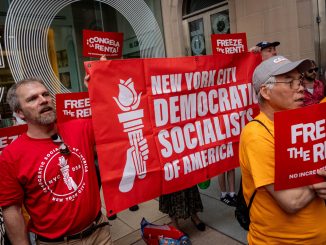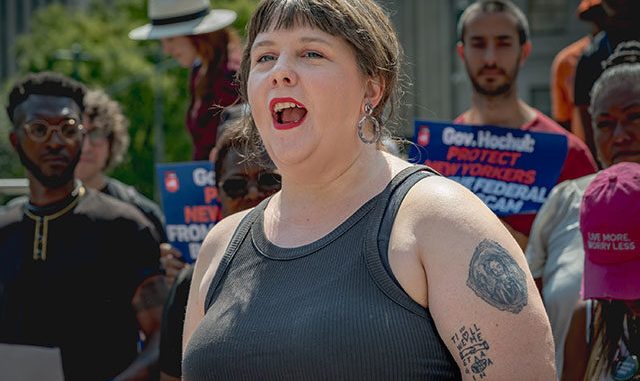
State Assemblywoman Emily Gallagher joins criminal justice advocates with Court Watch NYC at a news conference on Thursday.EmilyAssembly/X
Reported by:

Cherry Meigh Timbol
News Content Editor
Published August 17, 2026
NEW YORK — New York Assemblywoman Emily Gallagher’s recent comments about shoplifting basic necessities have ignited a debate that goes far beyond toothpaste and soap. Her argument—that people who steal necessities may be acting out of poverty and a “biological need”—raises a legitimate question about how society should respond to poverty, but it also risks blurring an important line between understanding why a crime happens and excusing the crime itself.
The Argument at the Center of the Controversy
Gallagher made the comments during a news conference outside Manhattan Criminal Court with criminal-justice advocates from Court Watch NYC. The group said it had monitored 360 arraignments over four days and found that more than half involved misdemeanors.
Gallagher characterized many of the cases as “crimes of poverty,” pointing specifically to people accused of stealing products such as toothpaste and soap. She argued that the deeper problem was economic inequality and questioned why people struggling to survive should face criminal consequences for obtaining necessities.
There is an important distinction here: poverty can be a reason someone commits theft without making theft legally or morally permissible.
That distinction is at the heart of this controversy.
 Two shoplifters work together to stuff meat into a backpack at the Pioneer store in The Bronx, NY.
Poverty Deserves Compassion—But Businesses Deserve Protection
There is little controversy over the idea that people living in extreme poverty need help.
A person who cannot afford food, hygiene products or medication should have access to legitimate assistance. Governments, charities and community organizations can play an important role in providing that assistance.
But shifting the solution from “help people obtain necessities” to “don’t enforce theft of necessities” creates an entirely different policy question.
Retail stores are not abstract corporations. They employ cashiers, managers, security guards and other workers. Small businesses also operate on narrow margins and must pay rent, utilities, wages and suppliers.
A store losing merchandise without receiving payment still suffers a financial loss, regardless of the reason behind the theft.
The Problem With Assuming Every Theft Is About Personal Need
Perhaps the biggest weakness in Gallagher’s argument is the assumption that stealing toothpaste or soap necessarily proves the person needs those products for personal use.
That isn’t always the case.
Retail theft can involve individuals stealing merchandise for resale, organized theft operations or repeat offenders. Reporting on Gallagher’s comments has also noted that everyday products can become targets because they are relatively easy to resell.
This makes a blanket approach particularly problematic.
A policy designed to protect someone stealing a tube of toothpaste because they genuinely cannot afford one could potentially be exploited by someone stealing dozens of products for profit.
Intent matters. Circumstances matter. Repetition matters.
Criminal Justice Does Not Have to Mean Mass Incarceration
This is where Gallagher’s broader argument deserves more serious consideration.
Critics sometimes present the debate as if the only alternatives are either jail everyone who steals or legalize shoplifting.
That is a false choice.
A justice system can hold people accountable without automatically sending every first-time offender to prison.
Diversion programs, restitution, community service, treatment programs and conditional dispositions can potentially address low-level offenses while avoiding unnecessary incarceration. A former prosecutor quoted by Fox News made essentially this distinction, arguing that poverty should influence how a case is handled but should not become a “permission slip” to steal.
That may be the more productive middle ground.
New York’s Retail-Crime Debate
The controversy is also occurring amid a broader debate over New York’s approach to quality-of-life offenses.
Gallagher and other progressive advocates have called on Mayor Zohran Mamdani to move away from so-called “broken windows” policing, which emphasizes enforcement of offenses such as fare evasion, graffiti and other lower-level violations.
Supporters argue that aggressive enforcement of minor offenses can disproportionately affect poor and vulnerable people.
Opponents argue that ignoring low-level offenses can eventually undermine public order and make residents less confident that laws will be enforced.
The disagreement isn’t simply between “compassionate” people and “uncaring” people. Both sides are responding to different risks.
New York’s Retail-Crime Debate
The controversy is also occurring amid a broader debate over New York’s approach to quality-of-life offenses.
Gallagher and other progressive advocates have called on Mayor Zohran Mamdani to move away from so-called “broken windows” policing, which emphasizes enforcement of offenses such as fare evasion, graffiti and other lower-level violations.
Supporters argue that aggressive enforcement of minor offenses can disproportionately affect poor and vulnerable people.
Opponents argue that ignoring low-level offenses can eventually undermine public order and make residents less confident that laws will be enforced.
The disagreement isn’t simply between “compassionate” people and “uncaring” people. Both sides are responding to different risks.
The Real Victims Can Get Lost
The most concerning aspect of the rhetoric surrounding this issue is the possibility that victims disappear from the conversation.
When a shoplifting incident is described only as an example of poverty, the store owner or employee who suffered the loss can become invisible.
Imagine a small neighborhood store losing thousands of dollars in merchandise over months. Eventually, the owner may respond by locking products behind plastic cases, reducing inventory, hiring additional security—or closing altogether.
The irony is that the poorest neighborhoods can be among the biggest losers when local stores disappear.
Residents without cars may suddenly have to travel farther to purchase basic necessities. Prices may rise. Convenience declines.
The people supposedly being protected can ultimately face another burden.
A Better Policy: Compassion With Accountability
A serious progressive criminal-justice policy does not need to choose between compassion and accountability.
It could instead establish a clear framework:
First-time, low-value theft: diversion, restitution, community service or assistance programs.
Evidence of genuine economic hardship: connect offenders with food, housing, employment and benefit programs.
Repeat offenders: stronger intervention and meaningful consequences.
Organized retail theft: aggressive investigation and prosecution.
Businesses: protection from repeated theft and support for security measures.
That approach recognizes that a person can be poor, desperate and deserving of help while simultaneously acknowledging that another person’s property cannot simply become a public resource.
Editorial Assessment
Gallagher is right about one fundamental point: poverty should not be treated as a criminal identity.
But she risks going too far if the argument becomes that poverty effectively eliminates responsibility for theft.
The better question isn’t whether someone “deserves” punishment for needing toothpaste.
The better question is:
How can New York help someone who cannot afford toothpaste without making the store owner pay for it?
That is the policy challenge lawmakers should be addressing.
Government can provide assistance. Charities can provide necessities. Communities can expand access to hygiene products. Social services can intervene before desperation turns into crime.
But compassion should not require transferring the cost of poverty onto another private citizen or business.
Overall Editorial Takeaway
The Gallagher controversy exposes a much larger weakness in America’s criminal-justice debate: both sides can reduce a complicated problem to a slogan.
“Lock them all up” does not solve poverty.
“Let them steal what they need” does not protect businesses or property rights.
The responsible approach lies somewhere between those extremes.
New York should aggressively address poverty and provide legitimate access to basic necessities while maintaining a clear principle that need may explain theft, but it does not erase the rights of the person who owns what was stolen.
The ultimate test of criminal-justice reform should not be whether fewer people are arrested.
It should be whether fewer people need to steal in the first place—while ordinary residents and businesses remain safe and protected.